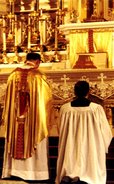
7 July 2007

Motu Proprio Released! (In Latin)

http://www.vatican.va/holy_father/benedict_xvi/motu_proprio/documents/hf_ben-xvi_motu-proprio_20070707_summorum-pontificum_lt.html

LITTERAE APOSTOLICAE
MOTU PROPRIO DATAE

BENEDICTUS XVI

SUMMORUM PONTIFICUM

Summorum Pontificum cura ad hoc tempus usque semper fuit, ut Christi Ecclesia Divinae Maiestati cultum dignum offerret, «ad laudem et gloriam nominis Sui» et «ad utilitatem totius Ecclesiae Suae sanctae».

Ab immemorabili tempore sicut etiam in futurum, principium servandum est «iuxta quod unaquaeque Ecclesia particularis concordare debet cum universali Ecclesia non solum quoad fidei doctrinam et signa sacramentalia, sed etiam quoad usus universaliter acceptos ab apostolica et continua traditione, qui servandi sunt non solum ut errores vitentur, verum etiam ad fidei integritatem tradendam, quia Ecclesiae lex orandi eius legi credendi respondet»[1].

Inter Pontífices qui talem debitam curam adhibuerunt, nomen excellit sancti Gregorii Magni, qui tam fidem catholicam quam thesauros cultus ac culturae a Romanis in saeculis praecedentibus cumulatos novis Europae populis transmittendos curavit. Sacrae Liturgiae tam Missae Sacrificii quam Officii Divini formam, uti in Urbe celebrabatur, definiri conservarique iussit. Monachos quoque et moniales maxime fovit, qui sub Regula sancti Benedicti militantes, ubique simul cum Evangelii annuntiatione illam quoque saluberrimam Regulae sententiam vita sua illustrarunt, «ut operi Dei nihil praeponatur» (cap. 43). Tali modo sacra liturgia secundum morem Romanum non solum fidem et pietatem sed et culturam multarum gentium fecundavit. Constat utique liturgiam latinam variis suis formis Ecclesiae in omnibus aetatis christianae saeculis permultos Sanctos in vita spirituali stimulasse atque tot populos in religionis virtute roborasse ac eorundem pietatem fecundasse.

Ut autem Sacra Liturgia hoc munus efficacius expleret, plures alii Romani Pontifices decursu saeculorum peculiarem sollicitudinem impenderunt, inter quos eminet Sanctus Pius V, qui magno cum studio pastorali, Concilio Tridentino exhortante, totum Ecclesiae cultum innovavit, librorum liturgicorum emendatorum et «ad normam Patrum instauratorum» editionem curavit eosque Ecclesiae latinae usui dedit.

Inter Ritus romani libros liturgicos patet eminere Missale Romanum, quod in romana urbe succrevit, atque succedentibus saeculis gradatim formas assumpsit, quae cum illa in generationibus recentioribus vigente magnam habent similitudinem.

«Quod idem omnino propositum tempore progrediente Pontifices Romani sunt persecuti, cum novas ad aetates accommodaverunt aut ritus librosque liturgicos determinaverunt, ac deinde cum ineunte hoc nostro saeculo ampliorem iam complexi sunt redintegrationem»[2]. Sic vero egerunt Decessores nostri Clemens VIII, Urbanus VIII, sanctus Pius X[3], Benedictus XV, Pius XII et beatus Ioannes XXIII.

Recentioribus autem temporibus, Concilium Vaticanum II desiderium expressit, ut debita observantia et reverentia erga cultum divinum denuo instauraretur ac necessitatibus nostrae aetatis aptaretur. Quo desiderio motus, Decessor noster Summus Pontifex Paulus VI libros liturgicos instauratos et partim innovatos anno 1970 Ecclesiae latinae approbavit; qui ubique terrarum permultas in linguas vulgares conversi, ab Episcopis atque a sacerdotibus et fidelibus libenter recepti sunt. Ioannes Paulus II, tertiam editionem typicam Missalis Romani recognovit. Sic Romani Pontifices operati sunt ut «hoc quasi aedificium liturgicum [...] rursus, dignitate splendidum et concinnitate» appareret[4].

Aliquibus autem in regionibus haud pauci fideles antecedentibus formis liturgicis, quae eorum culturam et spiritum tam profunde imbuerant, tanto amore et affectu adhaeserunt et adhaerere pergunt, ut Summus Pontifex Ioannes Paulus II, horum fidelium pastorali cura motus, anno 1984 speciali Indulto “Quattuor abhinc annos”, a Congregatione pro Cultu Divino exarato, facultatem concessit utendi Missali Romano a Ioanne XXIII anno 1962 edito; anno autem 1988 Ioannes Paulus II iterum, litteris Apostolicis “Ecclesia Dei” Motu proprio datis, Episcopos exhortatus est ut talem facultatem late et generose in favorem omnium fidelium id petentium adhiberent.

Instantibus precibus horum fidelium iam a Praedecessore Nostro Ioanne Paulo II diu perpensis, auditis etiam a Nobis Patribus Cardinalibus in Concistorio die XXIII mensis martii anni 2006 habito, omnibus mature perpensis, invocato Spiritu Sancto et Dei freti auxilio, praesentibus Litteris Apostolicis DECERNIMUS quae sequuntur:

Art. 1. Missale Romanum a Paulo VI promulgatum ordinaria expressio “Legis orandi” Ecclesiae catholicae ritus latini est. Missale autem Romanum a S. Pio V promulgatum et a B. Ioanne XXIII denuo editum habeatur uti extraordinaria expressio eiusdem “Legis orandi” Ecclesiae et ob venerabilem et antiquum eius usum debito gaudeat honore. Hae duae expressiones “legis orandi” Ecclesiae, minime vero inducent in divisionem “legis credendi” Ecclesiae; sunt enim duo usus unici ritus romani.

Proinde Missae Sacrificium, iuxta editionem typicam Missalis Romani a B. Ioanne XXIII anno 1962 promulgatam et numquam abrogatam, uti formam extraordinariam Liturgiae Ecclesiae, celebrare licet. Conditiones vero a documentis antecedentibus “Quattuor abhinc annos” et “Ecclesia Dei” pro usu huius Missalis statutae, substituuntur ut sequitur:

Art. 2. In Missis sine populo celebratis, quilibet sacerdos catholicus ritus latini, sive saecularis sive religiosus, uti potest aut Missali Romano a beato Papa Ioanne XXIII anno 1962 edito, aut Missali Romano a Summo Pontifice Paulo VI anno 1970 promulgato, et quidem qualibet die, excepto Triduo Sacro. Ad talem celebrationem secundum unum alterumve Missale, sacerdos nulla eget licentia, nec Sedis Apostolicae nec Ordinarii sui.

Art. 3. Si communitates Institutorum vitae consecratae atque Societatum vitae apostolicae iuris sive pontificii sive dioecesani quae in celebratione conventuali seu “communitatis” in oratoriis propriis celebrationem sanctae Missae iuxta editionem Missalis Romani anno 1962 promulgatam habere cupiunt, id eis licet. Si singula communitas aut totum Institutum vel Societas tales celebrationes saepe vel plerumque vel permanenter perficere vult, res a Superioribus maioribus ad normam iuris et secundum leges et statuta particularia decernatur.

Art. 4. Ad celebrationes sanctae Missae de quibus supra in art. 2 admitti possunt, servatis de iure servandis, etiam christifideles qui sua sponte id petunt.

Art. 5, § 1. In paroeciis, ubi coetus fidelium traditioni liturgicae antecedenti adhaerentium continenter exsistit, parochus eorum petitiones ad celebrandam sanctam Missam iuxta ritum Missalis Romani anno 1962 editi, libenter suscipiat. Ipse videat ut harmonice concordetur bonum horum fidelium cum ordinaria paroeciae pastorali cura, sub Episcopi regimine ad normam canonis 392, discordiam vitando et totius Ecclesiae unitatem fovendo.

§ 2. Celebratio secundum Missale B. Ioannis XXIII locum habere potest diebus ferialibus; dominicis autem et festis una etiam celebratio huiusmodi fieri potest.

§ 3. Fidelibus seu sacerdotibus id petentibus, parochus celebrationes, hac in forma extraordinaria, permittat etiam in adiunctis peculiaribus, uti sunt matrimonia, exsequiae aut celebrationes occasionales, verbi gratia peregrinationes.

§ 4. Sacerdotes Missali B. Ioannis XXIII utentes, idonei esse debent ac iure non impediti.

§ 5. In ecclesiis, quae non sunt nec paroeciales nec conventuales, Rectoris ecclesiae est concedere licentiam de qua supra.

Art. 6. In Missis iuxta Missale B. Ioannis XXIII celebratis cum populo, Lectiones proclamari possunt etiam lingua vernacula, utendo editionibus ab Apostolica Sede recognitis.

Art. 7. Ubi aliquis coetus fidelium laicorum, de quo in art. 5 § 1 petita a parocho non obtinuerit, de re certiorem faciat Episcopum dioecesanum. Episcopus enixe rogatur ut eorum optatum exaudiat. Si ille ad huiusmodi celebrationem providere non potest res ad Pontificiam Commissionem “Ecclesia Dei” referatur.

Art. 8. Episcopus, qui vult providere huiusmodi petitionibus christifidelium laicorum, sed ob varias causas impeditur, rem Pontificiae Commissioni “Ecclesia Dei” committere potest, quae ei consilium et auxilium dabit.

Art. 9, § 1. Parochus item, omnibus bene perpensis, licentiam concedere potest utendi rituali antiquiore in administrandis sacramentis Baptismatis, Matrimonii, Poenitentiae et Unctionis Infirmorum, bono animarum id suadente.

§ 2. Ordinariis autem facultas conceditur celebrandi Confirmationis sacramentum utendo Pontificali Romano antiquo, bono animarum id suadente.

§ 3. Fas est clericis in sacris constitutis uti etiam Breviario Romano a B. Ioanne XXIII anno 1962 promulgato.

Art 10. Fas est Ordinario loci, si opportunum iudicaverit, paroeciam personalem ad normam canonis 518 pro celebrationibus iuxta formam antiquiorem ritus romani erigere aut rectorem vel cappellanum nominare, servatis de iure servandis.

Art. 11. Pontificia Commissio “Ecclesia Dei” a Ioanne Paulo II anno 1988 erecta[5], munus suum adimplere pergit.

Quae Commissio formam, officia et normas agendi habeat, quae Romanus Pontifex ipsi attribuere voluerit.

Art. 12. Eadem Commissio, ultra facultates quibus iam gaudet, auctoritatem Sanctae Sedis exercebit, vigilando de observantia et applicatione harum dispositionum.

Quaecumque vero a Nobis hisce Litteris Apostolicis Motu proprio datis decreta sunt, ea omnia firma ac rata esse et a die decima quarta Septembris huius anni, in festo Exaltationis Sanctae Crucis, servari iubemus, contrariis quibuslibet rebus non obstantibus.

Datum Romae, apud Sanctum Petrum, die septima mensis Iulii, anno Domini MMVII, Pontificatus Nostri tertio.

BENEDICTUS PP. XVI

A Small Matter about Bibles...

The following is intended to expand upon the points about Bible Versions raised in the July 2007 Spotlight p 9 (the monthly internal publication of Blessed Sacrament Church, Singapore). This is also in commemoration of Bible Sunday, in this regional Bishop’s Conference. What follows all comes from my own personal experience.

First of all, the term Translation instead of Version is much more preferable especially since the various writers of Sacred Scripture did not write in English and in rendering it into English, one has to translate not create a new version. The duty of a translator is to render exactly what the author has written. By imposing ideas of what one thinks the author means, a mistranslation would result.

Contained with Sacred Scripture are 73 Books, and the exact list of these 73 Books dates back to at least AD 382 in the Synod of Rome under Pope Damasus I. This was very much during the time of the Early Christians. More than 1000 years later the Martin Luther would remove Books and verses from the Bible because they were not in conformity to the errors he was teaching. Luther also used the argument that the list of books from the Old Testament has to be based upon the list drawn up by the Council of Jamnia in AD 70. The problem with this argument is that by then the decrees of Jewish Rabbis no longer had any bearing on the Early Church.

Contrary also to Protestant thought is the fact that the Catholic Church did allow accurate translations of Sacred Scripture. Inaccurate translations on the other hand were severly suppressed. There is in existance, copies of translations into the language spoken in England during that time. As early as the 600s we have a copy of the work of Caedmon, a monk of Whitby, consisting of great portions of the Bible in the common tongue. In the next century we have the well-known translations of Venerable Bede, a monk of Jarrow, who died whilst busy with the Gospel of St. John. In the same (eighth) century we have the copies of Eadhelm, Bishop of Sherborne; of Guthlac, a hermit near Peterborough; and of Egbert, Bishop of Holy Island; these were all in Saxon, the language understood and spoken by the Christians of that time. Coming down a little later, we have the free translations of King Alfred the Great who was working at the Psalms when he died, and of Aelfric, Archbishop of Canterbury; as well as popular renderings of Holy Scripture like the Book of Durham, and the Rushworth Gloss and others that have survived the wreck of ages. After the Norman conquest in 1066, Anglo-Norman or Middle-English became the language of England, and consequently the next translations of the Bible we meet with are in that tongue. There are several specimens still known, such as the paraphrase of Orm (About 1150) and the Salus Animae (1250), the translations of William Shoreham and Richard Rolle, hermit of Hampole (died 1349). [Source: Where We Got the Bible, by Rt Rev Henry G. Graham]

Following the separation of the English Crown from the bosom of the Church, Catholics were heavily persecuted by the authorities. Many great monasteries were burnt and it was illegal to even attend Mass. Many great martyrs died for the faith during this period. Some English Catholic fled over the English Channel to France to seek refuge. Amongst these were the scholars who translated what is now known as the Douay Rheims Bible. The title page itself however reads "The Holy Bible, faithfully translated into English out of the authentic Latin. Diligently conferred with the Hebrew, Greek and other Editions." As one can very clearly see, the concern of the translators was accuracy.

The translators published the New Testament in 1582 in the French town Douay. Although they completed the Old Testament soon after, due to a lack of funds the publication was delayed. It was eventually published in Rheims in two volumes in 1609 and 1610. Over the years of 1749 to 1752, the English Bishop Richard Challoner (who was an Anglican convert), made a thorough revision to the translation. For the next 200 years, every single English speaking Catholic would use this translation of the Bible. This translation is also still very much entrenched in English speaking Catholics. When one recites the Hail Mary, one is using the translation from the Douay Rheims Bible. To this day, it is still being published. Loreto Publications publishes a 1941 facsimile reprint of the Douay Rheims, while Baronius Press publishes a fresh digital typeset of the 1899 Douay Rheims.

The Douay-Rheims is called a literal translation. Yet it is not the only one of its kind.
Over the 1936 to 1950, an Monsignor Ronald Knox was authorised by the English Catholic Hierarchy to produce a fresh translation from the Latin Vulgate. This was known as the Knox Bible. Only the New Testament is still in print, and is published by Templegate Publishers. In the 1940s and 1950s a revision to the Douay Rheims was produced in the United States by the Confraternity of Christian Doctrine. This translation was called the Confraternity Bible. Sinag Tala prints both the New Testament and the full Bible.

In recent times, many other versions of the Bible in English have been produced. Two very significant problems plague them. The first is the claim to have translated from the Hebrew and Greek manuscripts and the second is the use of inclusive language. All modern versions of the Bible claim to reference and translate from the Hebrew and Greek manuscripts. Not all however are plagued by inclusive language.

In 1957, the Revised Standard Version (RSV) was completed by a Protestant organisation called the Division of Christian Education of the National Council of the Churches of Christ in the United States of America. Although a Catholic Edition was produced with Imprimatur in 1966, it still remains a Protestant translation, and is hampered by mistranslations. The RSV however is still considered to be a largely literal translation of the Bible. Even though a Second Catholic Edition was published in 2000, it is still plagued by the same mistranslations. Both Ignatius Press and Oxford Press print the Catholic Edition of the RSV. A 1971 edition of the RSV was used in the Catechism of the Catholic Church, but currently no publisher prints it. [Different from the New Revised Standard Version]

In 1961, the Dominicans published a Bible in French called the La Bible de Jerusalem. This was translated into English by a group of British Scholars and published in 1966 as the Jerusalem Bible (JB). Amongst the editors of the Bible was J.R.R. Tolkien and at times Tolkien fans refer to the JB as the Tolkienite Bible. The South East Asian region is very fortunate that the Philippine Bible Society still prints a facsimile copy. [Different from the New Jerusalem Bible]

Both of these Bibles do not contain any inclusive language, but claim to translate from the Hebrew and Greek manuscripts. As mentioned earlier, the duty of a translator is to translate what the author wrote, not what he thinks the author wrote. This however is not always the case.

In the RSV, John 3:16 reads “For God so loved the world that he gave his only Son, that whoever believes in him should not perish but have eternal life.” The Greek text however reads “For God so loved the world that he gave his only Son, that whoever believes in him should not perish but should have eternal life.” Every single other Catholic Bible (aside from the Good News Bible) translates correctly to the latter. The former with a missing ‘should’ leaves open the way to Protestant conception of once saved always saved. Even the Catholic Edition contains this mistranslation.

In the JB, Luke 1:28 read “… Rejoice, so highly favoured! ...” Although ‘so highly favoured is a possible translation of the Greek ‘kecharitomene’, it more accurately translates to ‘most exalted one’. In terms of degree there is a huge gap in meaning in both terms. God through his Angel, Gabriel bestowed far more honour than just ‘high favour’. The use of ‘most exalted one’ would improve on ‘full of grace’ which is from the Latin gratia plena. Yet this was not done.

These are just two instances where even the Greek and Hebrew manuscripts were not translated accurately into English.

Now I mentioned the term inclusive language, but I did not elaborate much about it. Inclusive language is also called gender neutral language. At its most basic level what inclusive language does to St Paul’s Epistles for example would be to change ‘my brothers’ to ‘my brothers and sister’. To a large extent there is no problem with this instance. Yet inclusive language is far more than just this. Taken to its fullest extent, inclusive language removes the masculine references of the Bible. For example both Psalm 1 and Psalm 111 start of with the line “Blessed is the man.” Using the gender neutral, the verse would read, “Blessed is the one” or “Blessed are those”. On the surface level it does not look like there is much of a difference since what follows after does apply to both genders. These two Psalms however are also prophecies about Christ, and that he is male is non-negotiable. Feminists have argued that Christ is both genders and some even claim that God is female.

So although the New Jerusalem Bible (1985) does in some instance improve on the JB, the use of inclusive language basically ruined the entire project. The same goes for the New Revised Standard Version (1991), which also did improve on the RSV and corrected the translation error of John 3:16. The New American Bible is also plagued by this problem. Another problem with the New American Bible is that anti-Catholic commentary is included in the Bible.

In 1979 the Good New Bible was produced by a Protestant organisation called the American Bible Society. The Good News Bible is also known as Today’s English Version. It should be noted that the chief editor, Robert Bratcher has no intention at all translating what was actually written by the writers of Sacred Scripture. The outcome was a very poorly produced version that even the Protestant Churches rejected. The beauty contained within Sacred Scripture has been significantly stripped away, and glaring inaccuracies and omissions are committed. A second edition was published in 1992, and the same problems remain. Inclusive language is also used, but the biggest problem is the glaring errors and omissions.

For example, reference to the cutting of the foreskin is circumcision in Genesis 17:11 is arbitrarily removed from the Good News Bible. Furthermore in Luke 2:21 where Jesus is circumcised the Good News Bible wrongly states that a baby is circumcised 1 week after birth. It should be 8 days after birth. Luke 2:21 links back to Genesis 17:12, and in Genesis 17:12 the Good News Bible states clearly 8 days.

The Good News Bible is said to be for those who do not have a good command of the English language. Given the problems however, it is more of a mistranslation. In terms of easy to read English, there is another far better alternative called the Christian Community Bible.

In 1994, the Claretians Fathers published the Christian Community Bible. A very significant amount of commentary is included and various significant verses retain the use of more traditional wording. An excellent feature that is included is a table with every single reading of the Mass used throughout the year. In 2004 however, inclusive language added. All fresh prints of the Christian Community Bible are plagued by it. Claretian Publications and the Daughters of St Paul publish the 2004 edition. It is also freely available online.

There are huge problems with modern day translations into English. This has to do with the translators reading the original languages, deciding what they think it means, and then translating their interpretation into English; all without regard for what is actually written. Even for private reading the translation should be proper. Having a simplified version, more often than not indicates that some of the original meaning is lost. Take for instance ‘chalice of salvation’ and ‘cup of salvation’. The use of ‘cup’ is a simplification, and yes, ‘chalice’ means cup. Yet chalice also has another meaning that is lost in the use of the word ‘cup’, chalice also means severe trial.

As a young person, I read the Douay Rheims. Especially when certain verses seem so difficult to understand in modern translations, the Douay Rheims is so much simpler. Compare Genesis 3:15 from the Douay Rheims, with the version you own. “I will put enmities between thee and the woman, and thy seed and her seed: she shall crush thy head, and thou shalt lie in wait for her heel.” In terms of a serious study of the Sacred Scripture, the Douay Rheims is excellent. In fact the Douay Rheims is much closer to the Hebrew and Greek than any modern translation. Personally, I also find the Christian Community Bible to also be good for one looking for an easy to read Bible with commentary at a reasonable price.

How did I come to know I this? I opened up the Bible and started reading. But before reading, one should begin with a prayer. You may use the following:

O King of Glory, Lord of Hosts, leave us not as orphans, but send us the Promised of the Father, the Spirit of Truth.
We implore you, O Lord, that the Consoler, will enlighten our souls and infuse into them all truth, as Your Son has promised. Through the same Christ our Lord. Amen.

And after you finish...

Let me not, O Lord, be puffed up with worldly wisdom, which passes away, but grant me that love which never abates, that I may not choose to know anything among men, but Jesus, and Him crucified. Amen.

Another Breaking News!

[Taken from Rorate Caeli]
Andrea Tornielli reports today in Il Giornale that the Congregation for the Doctrine of the Faith is about to release a Doctrinal Document stating in definitive and clear terms the interpretation of the Lumen Gentium passage according to which, "Haec ...unica Christi Ecclesia ... in hoc mundo ut societas constituta et ordinata, subsistit in Ecclesia catholica" ("this ...one Church of Christ ... constituted and organized in the world as a society, subsists in the Catholic Church")


"The Church of Christ is the Catholic one"

from Rome

The Church of Christ is not distinct or distinguishable from the Catholic Church, which is the only one to possess "all elements of the Church instituted by Jesus". The Congregation for the Doctrine of the Faith will confirm it next week, responding to "doubts" [dubia] raised in the past few years. The doctrinal stand of the former Holy Office ... should be accompanied by an authoritative theological comment on the pages of L'Osservatore Romano.

At the center of the debate is once again the meaning of the verb "subsists", used by the Council in the Constitution Lumen Gentium, where it is said that the only Church of Christ "subsists in the Catholic Church" (in Latin, "subsistit in"). Words which, in the course of the years, have suffered several interpretations, including the one according to which Jesus in reality had not thought of founding a Church and, in case he had, it would have afterwards divided itself in various Churches and ecclesial communities. Therefore ... , there would not be the true Church of Christ anymore, but only several expressions of it.

This recurrent thesis has already been repeatedly denied by the Popes. In 1973, with the declaration Mysterium Ecclesiae, of Paul VI; in 1985, with the notification of the Congregation for the Doctrine of the Faith on a book of liberation theologian Leonardo Boff; in 1992, with the Letter to the Bishops Communionis Notio, and, finally, in 2000 ... , with the declaration Dominus Iesus, approved by John Paul II.

Nonetheless, the doubts return cyclically ... .


I.Media informs that it will be released on Tuesday, July 10 (France-Presse dispatch/La Croix).

Baseless Anti-Semitic Fears of Motu Proprio

VATICAN CITY, JULY 6, 2007 (Zenit.org).- Benedict XVI's apostolic letter concerning the Roman Missal promulgated by John XXIII in 1962, will not reinstate a prayer for the conversion of "perfidious Jews."

The Vatican press office announced today the Pope's letter issued "motu proprio," on his own initiative, is titled "Summorum Pontificum," and will be released Saturday at noon, accompanied by an explanatory letter.

Several media reports erroneously contend that the letter could in effect reinstate a prayer offensive to Jews from the Good Friday liturgy of the Tridentine Mass, which dates back to 1570. The prayer stated: "Oremus et pro perfidies Judaeis" (Let us pray for the perfidious Jews).

On the first Good Friday after his election to the papacy in 1959, Pope John XXIII eliminated the adjective "perfidious" from the prayer. Since then the expression "Let us pray for the Jews" has been used.

That same year, he also eliminated from the rite of baptism the phrase used for Jewish catechumens: "Horresce Jusaicam perfidiam, respue Hebraicam superstitionem" (Disavow Jewish unbelieving, deny Hebrew superstition).

Also eliminated were similar formulas for those converting from idolatry, Islam or a heretical sect.

The 1962 missal was promulgated with an apostolic letter issued "motu proprio" by John XXIII "Rubricarum Instructum." The missal does not make reference to "perfidious Jews."

On Good Friday in 1963, John XXIII underlined the importance of this decision when the old formulation of the prayer for the Jews was read. The Pope interrupted the liturgy and asked that that the liturgical invocations begin again from the beginning, following the new text.

The Roman Missal adopted by Pope Paul VI in 1969, and put into effect in 1970, reformulated the prayer. It reads: "Let us pray for the Jewish people, the first to hear the word of God, that they may continue to grow in the love of his name and in faithfulness to his covenant.

"Almighty and eternal God, long ago you gave your promise to Abraham and his posterity. Listen to your Church as we pray that the people you first made your own may arrive at the fullness of redemption."

6 July 2007

Motu Propio: 7 July 2007!

Its official! Pope Benedict XVI's Motu Proprio relaxing the use of the 1962 Missal will be released on 7.7.07!

VATICAN CITY, JUL 6, 2007 (VIS) - Tomorrow, Saturday July 7, the Vatican Information service will transmit a special service for the publication of the Apostolic Letter "Motu Proprio data" of His Holiness Benedict XVI, "Summorum Pontificum," concerning the use of the pre-1970 Roman liturgy. The document will be accompanied by an explanatory Letter from the Holy Father.

Motu Proprio Text?

[Taken from Whispers from the Logia]
LITTERAE APOSTOLICAE
MOTU PROPRIO DATAE

BENEDICTUS XVI

Summorum Pontificum cura ad hoc tempus usque semper fuit, ut Christi Ecclesia Divinae Maiestati cultum dignum offerret, «ad laudem et gloriam nominis Sui» et «ad utilitatem totius Ecclesiae Suae sanctae».
Ab immemorabili tempore sicut etiam in futurum, principium servandum est «iuxta quod unaquaeque Ecclesia particularis concordare debet cum universali Ecclesia non solum quoad fidei doctrinam et signa sacramentalia, sed etiam quoad usus universaliter acceptos ab apostolica et continua traditione, qui servandi sunt non solum ut errores vitentur, verum etiam ad fidei integritatem tradendam, quia Ecclesiae lex orandi eius legi credendi respondet»....

* * *

[Some details?]
1. Implementation has been fixed for 14 September -- the feast of the Triumph of the Cross.

2. As for the review period, the Pope says to the bishops: "I invite you, dear Brothers, to send to the Holy See an account of your experiences, three years after this Motu Proprio has taken effect. If truly serious difficulties come to light, ways to remedy them can be sought."

3. Also “lawful,” according to the normative text – which, like its cover letter, comes in at four pages – are the erection of “personal parishes” for the celebration of the 1962 rites or the appointment of a “rector or chaplain” designated for the task, and the unimpeded use by clerics of the Roman Breviary as likewise promulgated by Bl. John XXIII.

4. According to the text, only the diocesan bishop is granted the faculty to administer Confirmation according to the pre-Conciliar Roman Pontifical.

5. “The Latin Liturgy in its various forms has stimulated in the spiritual life very many Saints in every century of the Christian age and strengthened in the virtue of religion so many peoples and made fertile their piety,” Pope Benedict reiterates in the motu proprio itself that while the Second Vatican Council “expressed the desire that with due respect and reverence for divine worship it be restored and adapted to the needs of our age,” the ensuing years have yielded “not a small number of the faithful [who] have been and remain attached with such great love and affection to the previous liturgical forms.”

6. “[A]s a matter of principle,” Pope Benedict tells the bishops, even those priests ordained for 1962-exclusive communities “cannot… exclude celebrating according to the new books.” Said “exclusion of the new rite,” he says, “would not in fact be consistent with the recognition of its value and holiness.”

7. At the same time, the Pope says he finds it “true that there have been exaggerations and at times social aspects unduly linked to the attitude of the faithful attached to the ancient Latin liturgical tradition.” However, even in this the onus is placed on the prelates, whose “charity and pastoral prudence will,” he expects, “be an incentive and guide for improving these.”

5 July 2007

Fr John Fessio Comments on the Motu Proprio

[Taken from NLM]
Over at Ignatius Press' Spirit of the Liturgy page, there is a video by Fr. Joseph Fessio, S.J. where he lays out his thoughts on the Motu Proprio: Pope Benedict and the Old Mass (recorded on June 29th, 2007).
I believe that this is going to be a major step toward the genuine renewal of the Mass, and therefore the genuine renewal of the Church, which the Council so ardently desired, and I think we are going to owe a great debt to Pope Benedict for doing this."

4 July 2007

Motu Proprio: Summorum Pontificum

Vatican, Jul. 4, 2007 (CWNews.com) - A papal document widening use of the 1962 Roman Missal will be released on July 7, the Roman news agency I Media says, confirming reports that circulated late in June.

The motu proprio will be entitled Summorum Pontificum, I Media adds. The title of the Pope's document had not previously been mentioned in the media, despite numerous reports of its existence and intense speculation over its contents.

The German-language agency Kath.net reported on June 27 that the document by Pope Benedict XVI will be released on Saturday, July 7. The Kath.net story appeared after a special Vatican meeting in which a small group of prelates were briefed about the contents of the motu proprio. The Vatican press office later confirmed that the meeting had taken place, but did not confirm the publication date for the document.

The motu proprio is reportedly a 3-page document. It will be released in conjunction with a 4-page explanatory letter in which the Pope sets out his reason for encouraging the use of the pre-conciliar liturgy as an "extraordinary" form of the Latin rite.

[Taken from Rorate Caeli]
UPDATE (1600 GMT): M. Antoine-Marie Izoard, director of I.MEDIA, has courteously granted us the possibility to make public the following excerpts of this morning's exclusive dispatch (Copyright I.MEDIA):


Vatican - Agency I.MEDIA - July 4 2007

The Motu Proprio "Summorum Pontificum" for the liberalization of the Mass according to the Missal of 1962 will be published on July 7

The Apostolic Letter in the form of Motu Proprio which Benedict readies to publish in order to liberalize the use of the Mass and liturgical books according to the pre-Conciliar rite of 1962 will receive the name of "Summorum Pontificum", I.MEDIA has learned from Vatican sources. This document, greatly expected by the Traditionalist faithful and feared by a certain number of Bishops, will be published on July 7.

Summorum Pontificum (in [English], "...of the Supreme Pontiffs") is the incipit (beginning of the text) of the Motu Proprio of Benedict XVI liberalizing the use of the Mass said of "Saint Pius V", I.MEDIA has learned from Vatican sources. This Apostolic Letter which will be made public next July 7. The document will be accompanied by a long letter by the Pope explaining his motivations for this publication of which certain Bishops, particularly in France, disapprove [lit. "take a dim view"].

3 July 2007

A World View :)

You scored as Roman Catholic, You are Roman Catholic. Church tradition and ecclesial authority are hugely important, and the most important part of worship for you is mass. As the Mother of God, Mary is important in your theology, and as the communion of saints includes the living and the dead, you can also ask the saints to intercede for you.

Roman Catholic


100%

Neo orthodox


86%

Evangelical Holiness/Wesleyan


79%

Classical Liberal


61%

Fundamentalist


43%

Modern Liberal


36%

Charismatic/Pentecostal


36%

Reformed Evangelical


29%

Emergent/Postmodern


21%

What's your theological worldview?
created with QuizFarm.com

Dishonest Motu Proprio Report

[Taken from WDTPRS]

With a biretta tip to Fr. Blake, o{]:¬) I offer for your consideration a piece in the Jerusalem Post. This fits the famous "Tridentine template" which includes the obligatory elements of any ignorant article about the Motu Proprio.

But this piece, below, is something else entirely. It includes a couple very interesting images, juxtaposed. As yourself why, after reading this (My emphases and comments)

The Vatican is expected to publish this week a document authorizing the use of a controversial Latin Mass, parts of which are deemed anti-Semitic, [By whom? And, is this claim actually true?] the Holy See announced Thursday.

According to a report in Britain’s Independent newspaper, some clergy fear that if the Latin Mass [Ooopppsss] were brought back into common use, it would limit the Church’s dialogue with Jews and Muslims, as well as create a schism among Catholics worldwide. [Again and again, the issue of ecumenism pops up. However, what non-Catholic critics really want is that Catholics not actually be Catholic, that they sacrifice their identity for the sake of dialogue. However, as I have written many times elsewhere, Pope Benedict believes the Church has a right to her own language, symbols, forms of prayer and identity. She has a right to a voice in the public square, using her own language and symbols, expressing her own identity. This is one of the deeper purposes of the MP. This is what smarter critics of the Church and MP are really afraid of.]

The 16th-century Tridentine Mass – recited every Good Friday – refers to Jews as "perfidious," and claims they live in "blindness" and "darkness." The Mass prays that God might "take the veil from their hearts" so that Jews can come to acknowledge Jesus Christ.

Rev. Keith Pecklers, an expert on Jesuit liturgy, [Which is really a good way of saying it, though it sounds like a contradiction of terms.] told the Independent that elements [Note well the ideologically charged label "element"] in the Church who embraced the old Mass tended to oppose "collaboration with other Christians and [the Church’s] dialogue with Jews and Muslims." [Again, its all about dialogue with non-Catholics.]

Currently, priests who wish to recite the Latin Mass, which was replaced in 1969 with liturgy in the vernacular, must receive permission from their bishops.

Pope Benedict’s decision, some believe, is an attempt to bring the ultra-traditionalist Society of St. Pius X group back under the auspices of the Vatican. The move has been opposed by many senior representatives of the Catholic Church in Britain, including Cardinal Cormac Murphy-O’Connor, leader of the Roman Catholic Church in England and Wales, as well as Jewish leaders. [AND??? SO???? We are really supposed to make decisions about what we believe or how we pray on the basis of objections of non-Catholics? Apparently.]


[Psalmus 42 Comment: And each publication is supposed to have its own fact checkers. Right?]

The Recovery of the Sacred

[Taken from Paterson Diocese Website, Comments and Emphasis by Fr Z on WDTPRS]

The Dutch historian and philosopher of religion Gerardus van der Leeuw once said, “The modern man is not capable of finding himself in several circles simultaneously as his primitive cousins did. ‘When we dance, we do not pray; when we pray, we do not dance. And when we work, we can neither dance nor pray.’” In a word, the sense of the sacred has disappeared. But not completely nor irretrievably.

The Liturgy of the Church is a moment where all the dimensions of our lives come before the living God. [So often since the Council it has been claimed that Mass is a human experience, rather than an encounter with the divine.] It is the place where we have an active encounter with God. It is the place, therefore, where we can rediscover the sacred in our lives.

The Second Vatican Council began the liturgical reform with the hope of reinvigorating this sense of the Presence of God who comes to meet us in love. Two generations after the Council, we are still searching for a deeper sense of the sacred in our Liturgy. We now realize some of the ways in which this can be accomplished. It is good to look at a few of these.

Certain settings demand their own particular etiquette. [The aptum et pulchrum has been lost in most dimensions of society, but it is especially lacking in liturgical practice far and wide.] Dress at a wedding reception differs from dress at a sports event. Conversation in a bar is louder than in a funeral home. The more we realize we are coming into the Presence of God in Church, the more respectful and reverent our whole person becomes. Chewing gum in Church, loud talking, beach attire and immodest dress simply do not belong!

In church, we need to cultivate a sense of God who is present to us. This is why we are called to observe moments of silence. Both before Mass begins and during Mass. Liturgy is much more than our joining together. It is our opening ourselves to God. By our singing and praying, we respond to the God who addresses us in Liturgy. A constant torrent of words and songs filling every empty space in the Liturgy does not leave the heart the space it needs to rest quietly in the Divine Presence.

In the Annunciation, after the angel announces to Mary that she is to be the Mother of the Lord and Mary gives her fiat, there is silence (cf. Lk 1:38). In this pregnant silence, that Word becomes flesh. Mary remains the model of the disciple before the Word of God. She reminds us that we need moments of silence for God to enter our life. We need those moments in our personal prayer and in the Liturgy. [This is similar in some respects to a sermon I gave in NJ last year, in Camden!]

In the Liturgy recorded in the last book of the New Testament, in the Book of Revelation, the word proskynein (to bow) is used twenty-four times—more than in any other part of the New Testament. John, the author of the Book of Revelation, presents this heavenly Liturgy as the model and standard for the Church’s Liturgy on earth. Our body bowed in prayer acknowledges the Lord’s majesty. It visibly confesses our belonging to God who is the Lord of all. Here is a strong reminder of the place of body in Liturgy. [So, bodily posture does make a difference.]

We are not just spirit when we pray. We pray in our total reality as body and spirit. And so, to recapture the sense of the sacred, therefore, we need to express our reverence through our body language. The norms of the Liturgy wisely have us stand in prayer at certain moments, sit in attentive listening to the readings, and kneel [KNEEL!] in reverent adoration during the solemn prayer of consecration. These norms are not arbitrary nor are they left to the discretion of any individual celebrant. [Say the Black. Do the Red.]

Creativity is not an authentic rule for celebrating the Church’s Liturgy. In many cases, it humanizes [See above!] the Liturgy and draws attention from God to the celebrant. The priest is merely the servant of the Liturgy, not its creator or center.

Commenting on this, Cardinal Ratzinger, now Pope Benedict XVI, said: “The great¬ness of the Liturgy depends—we shall have to repeat this frequently—on its unspontaneity (Unbeliebigkeit)…. Only respect for the Liturgy’s fundamental unspontaneity and pre-existing identity can give us what we hope for: the feast in which the great reality comes to us that we ourselves do not manufacture but receive as a gift (Ratzinger, The Spirit of the Liturgy, p. 170). Since the Liturgy is a gift and not something of our own creation, it takes great humility to celebrate the Liturgy properly and reverently.

Observing the norms of the Liturgy helps to create a profound sense of the sacred in each of us at Mass. Celebrating Mass and observing liturgical norms also makes us visibly one with the entire Church to which we belong. “Priests who faithfully celebrate Mass according to the liturgical norms, and communities which conform to those norms, quietly but eloquently demonstrate their love for the Church” (Ecclesia de Eucharistia, 52). [In Sacramentum caritatis, His Holiness makes a strong connection between who we are and how we pray. We are our rites.]

Today it has become commonplace at the end of the Liturgy to recite a litany of gratitude for all those who, in some way or another, have made the celebration beautiful. ["I would like to thank the mother of the lady who folded the napkins for the luncheon to follow…"] No doubt there is a way to express gratitude at the end of Mass. But is it possible that each time applause breaks out [I know applause was common in the ancient churches, but I just can’t abide it.] in the Liturgy at the end of the Mass for someone’s contribution, we lapse into seeing the Mass as a human achievement? Sometimes even during the Mass after someone has sung a beautiful hymn, there is spontaneous applause. At such a moment, does not the real meaning of Liturgy lapse into some kind human entertainment?

We can recapture more and more the sense of the sacred, the more we allow the Liturgy to be what it is. A gift from God that allows God to speak and act in our life. A gift that draws us out of ourselves and out of time into the eternal life of God even now.

1 July 2007

Classical Roman Rite News Report on TV!

[Taken from Athanasius Contra Mundum]


I love this video, because they show you the glory of a solemn high Mass, the reverence of Sacred Music, and then they show you another video, of some banal children's mass, chalk board scratching music, and altar girls. Then they show you another TLM later, and there are armies of altar boys. What I love too, is how the reporters called the seminary and discovered that Latin has not been offered, and is only now going to offered as an elective!

Contemporary worship and the Traditional Mass really are differences as clear as black and white. Just consider a Mass that begins with those words from the forty second Psalm "I shall go unto the altar of God, who brings joy to my youth", and then another which begins "Good morning everybody". What more is there to say? I've said it all before. Either excellence, beauty, goodness and order matter to you in worship or chaos, mediocrity, vulgarity and banality are perfectly alright.

Baronius 1962 Daily Missal

With the impending release of the Motu Proprio by Pope Benedict XVI, liberalising the use of the liturgical books in force in 1962, it may be appropriate to consider getting a 1962 Daily Missal. Currently allcatholicbooks.com is having a wonderful offer and it is being sold for US$38.50 (+ shipping), which is the cheapest you can get.

The Roman Missal (1962) by Baronius Press includes a wonderful commentary on the liturgy. It is an extract from the Liturgical Year by Dom Prosper Gueranger, OSB, titled 'The Untiring Affirmation of the Works of God'. It is a full Latin-English Missal that allows you to follow entire Classical Roman Rite Mass at any time of the year.

There are only 3 left so, if interested do act quickly. Get it here.

Cardinal O'Malley and his Motu Proprio Comments...

[Taken from Lady in the Pew]
First of all, you may well be saying:

Kelly! Who the BLEEP are YOU to question Cardinal O'Malley when HE was in Rome personally, heard the document, heard the Holy Father's explanation of it, and anyway is the bleeping ARCHBISHOP of BOSTON, you NOBODY, you!

To which I respond:

Good points! And did I tell you I talked to my Uncle Ed last night?

My Uncle Ed lives in Detroit.

In his mid-eighties, he "goes fishin" at least once a week, takes care of his lawn, likes "Wheel of Fortune" and eats TV dinners on a regular basis. He also attends Mass every Sunday. In fact, during my rather mindless chatter on the weather, sports, and other assorted topics (I realize it's difficult to imagine me chatting mindlessly) he broke in to ask one question:

"You still go to church, right? Or what?"

After a moment of silence—yes, I was silent for a moment—I replied:

"Uh...yeah. Every day."

That, in turn, silenced Uncle Ed.

"What? I thought I heard you say `every day'. I'm asking you if you still go to church!"

It took about 15 minutes to explain to my uncle that here in Boston (totally unlike there, in Detroit) it's as easy as pie to go to Mass on a daily basis.

"Well I'll be bleeped." (In some ways I take after my Uncle Ed, even though we're not really blood related.) "You know...most people I know don't go to church. Catholics, I mean. I go. But it isn't the same, you know? Funny thing, the Mass, these days."

I know what he means.

Where I live, in one of the largest Catholic areas in the world... most Catholics don't go to church either. Not even on Sundays. Which, and please don't let this spoil your day, is a mortal sin. Which, in turn (and again, I'm not trying to be a downer here) could be a one-way ticket to Hell.

"Kelly. I'm sure your Uncle is a fine man but what does this have to do with...?"

I know...sometimes I wander. But I'm not really wandering here. Because, for one thing, Cardinal O'Malley writes:

In my comments at the meeting I told my brother bishops that in the United States the number of people who participate in the Latin Mass even with permission is very low. Additionally, according to the research that I did, there are only 18 priories of the Society of St. Pius X in the entire country. Therefore this document will not result in a great deal of change for the Catholics in the U.S. Indeed, interest in the Latin Mass is particularly low here in New England.

Coupla problems here.

First:

I told my brother bishops that in the United States the number of people who participate in the Latin Mass even with permission is very low.

In a way, he's right, given that the Novus Ordo is, in fact, the Latin Rite. As in, "Roman Catholic." But that's not, I believe, what he's saying. What he's saying is "the number of people who participate in the Indult Mass is very low."

Yeah? Well, with all due respect, the number of people who participate in Sunday Mass in any language is very low! Ergo, (if you'll all forgive the Latin), we've got a problem here.

Second:

Additionally, according to the research that I did, there are only 18 priories of the Society of St. Pius X in the entire country.

I think we may be observing the Archbishop of Boston falling for a straw man argument here...the straw man being the SSPX.

As I wrote yesterday, it seems that some folks think the Pontiff's Moto Proprio is simply a sop to get the SSPX priests back into the fold. Again, I wasn't there but you know what?

I think that's a lot of doo-hickey.

Cardinal O'Malley writes:

The Holy Father was very clear that the ordinary form of celebrating the Mass will be the new rite, the Norvus Ordo.

Makes sense.

But by making the Latin Mass more available, the Holy Father is hoping to convince those disaffected Catholics that it is time for them to return to full union with the Catholic Church.

Maybe this makes sense, too. But the question is this: is this the sole reason for the Moto Proprio? Cardinal O'Malley implies that it is:

So the Holy Father’s motivation for this decision is pastoral. He does not want this to be seen as establishing two different Roman Rites, but rather one Roman Rite celebrated with different forms. The Moto Propio is his latest attempt at reconciliation.

I think, yes, the Holy Father's motive is a pastoral one. But to imply that the only motive is to attempt reconciliation with SSPX is a stretcher, in my humble opinion.

Gerald's quote says it quite well:

As a cardinal, Joseph Ratzinger [uh...the guy we now call Pope Benedict XI] continually advocated the return of the Latin language to the Mass, that Gregorian Chant be sung and that the congregation does not stand around the altar fixated on the priest but rather face, together with the priest, towards East, looking towards God. Above all he wants that this liturgy, that was celebrated for centuries, expressing the holiest that the Church possesses, the Eucharistic sacrifice, lives again and continues to develop, accompanying the life of the faithful through time.

Here's my point: (yeah, I'm almost done, sheesh)

The notion that the Pope's Moto Proprio is just another olive branch offered to a schismatic bunch is foolish, I think. The fact is, most Catholics do not go to Mass! And one reason may well be that the Mass as celebrated today lacks much of that holiness, that reverence, that says to the faithful: "This is a Sacrifice you are privileged to be a part of."

In Latin, for example, we hear "The Lord be with you," and respond "And with your spirit."

In English, we are more than likely to hear "Good morning! Peace and love to you all" and be expected to respond in any manner including "You go, Father!"

So maybe, just maybe, the Holy Father is trying to bring back the holiness, the reverence, that certainly ought to be associated with so great a Sacrifice. If he is—and I think he is—what the bleep is wrong with that?

Nothing. Just ask my Uncle Eddie. (Who, by the way, has never even heard of SSPX.)

God love you. And God love and bless Cardinal O'Malley, whose birthday we celebrate today.

Classical Roman Rite Training Report...

Taken from NLM

[One of the Father's who visits the NLM recently attended the FSSP "boot camp" for priests wishing training from them as regards the classical Roman rite. The following is his report, both of what occurred and, even more interestingly, his personal experience. I've chosen to eliminate his name for the sake of anonymity. If he chooses to reveal himself in the comments, I shall leave that to him.]

"I would characterize my experience as frankly stunning, and even life changing. I must admit that the experience has recast my understanding of the priesthood to some degree."

by a Diocesan Priest

I. Summary of the Training

This past week I returned from what one priest called the Traditional Mass Boot Camp, hosted and taught by the fine priests, deacons and seminarians of the Fraternity of Saint Peter at Our Lady of Guadalupe Seminary in Denton NE. Being a “Novus Ordo” priest and having little exposure or opportunity to experience the traditional Rite, this weekend was nothing short of amazing.

Arriving on Monday we jumped right in with an introductory session on the Mass covering various basic principles such as the attitude and composure of the priest, and the centrality of the Mass as a sacrifice. Wasting no time we began our practicum, our class was broken up into small groups of three, according to experience with the traditional Mass and Latin skills. Over the course of the five day we had workshops on the vesting prayers, the Low Mass, the Requiem Mass, Gregorian Chant, the sung Mass, and Exposition and Benediction. These were covered in depth in class and the practicum sessions, which were and hour and a half to two hours long.

The daily schedule began with private Mass from 6:00 to 8:00 AM and ended with Compline at 9:00 PM. The resources and materials that the Fraternity provided was copious and pedagogically geared for a priest to learn the traditional Mass. Any priest who is willing to learn and take the time necessary can confidently know that he will be able to offer the Mass with the proper reverence and confidence that the Rite demands.

On our final day on the Feast of Sts. Peter and Paul we were privileged to pray the Solemn High Mass in choir with the Nuns the Carmelite Monastery of Mary Jesus and Joseph in Valparaiso, NE a short drive from the seminary, this was absolutely the crowing event of the week, beautify offered by Fr. James Fryar FSSP, accompanied by the Deacons and seminarians of the seminary and the angelic chants sung by the Carmelite Nuns.

II. Personal Observations

Being a priest of the modern Roman rite I was admittedly nervous and lacking confidence due to my lack of experience, I felt that I perhaps had got into something that was over my head, but the graciousness and patience of the members of the Fraternity of Saint Peter quickly overcame any misgivings I had.

I must confess that I was worried that there might be some looking down upon a "Novus Ordo" priest such as myself in a “Traditionalist” environment such as this, but the respect and genuine affection and gratitude that was shown me by the priests, deacons and seminarians of the FSSP was most edifying and humbling. I cannot speak highly enough about these excellent and truly humble men, who most joyfully offer themselves for the life of the Church.

One of the many remarkable things that struck me about my experience this past week was that these men of the FSSP and others like them have preserved for the entire Latin Rite the living memory and tradition of the Church in a unique way.

I would characterize my experience as frankly stunning, and even life changing. I must admit that the experience has recast my understanding of the priesthood to some degree.

Also, by this intensive introduction to the ancient Roman liturgical tradition, I now more fully understand the paradigm shift and rupture that Ratzinger/Benedict XVI has spoken of. I can’t help but feel that once the adolescent rebellion of liturgical abuse and rejection of our living heritage subsides, they will be there to help all of us reclaim and reinvigorate the Latin Rite in a way that is truly organic and faithful to our roots, strengthening and in some areas reestablishing a vibrant Catholic identity.

I wish to thank my benefactors who enabled me to attend this workshop; it was a profound privilege for me to go. I will remember you in my prayers and my intentions at the Sacrifice of the Mass.