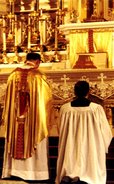
Please note the change in venue to St Patrick's School Chapel (490 East Coast Road). We are eternally grateful to the Lasallian Brothers for letting use their Chapel.
Showing posts with label Liturgy. Show all posts
Showing posts with label Liturgy. Show all posts
28 December 2007
Jan 2008 High Mass in Singapore! - Change of Venue
Please note the change in venue to St Patrick's School Chapel (490 East Coast Road). We are eternally grateful to the Lasallian Brothers for letting use their Chapel.


22 December 2007

13 October 2007
And the News gets Better :)
[Taken from WDTPRS]
About that last point: Msgr. Perl is not saying something in contrast to the Cardinal President of the Commission. He is just saying that even if the SSPXers were schismatic (he isn’t saying they are) Catholics would still be able to go to a Mass without incurring the censure.
Still, the golden nuggets in this interview are these:
He is a very good man for this position in these times.
I am glad he is speaking his mind about these issues.
There is an interesting piece on Petrus.
My translation and emphases.
Mass in Latin, a "Petrus" exclusice – Msgr. Perl of the [Pontifical Commission "Ecclesia Dei" speaks up: "Too many disobedient bishops and priests, a clarification on the Pope’s Motu Proprio under considerationIn a way, the interviewer wasted his precious questions on things that we already know.
by Bruno Volpe
CITTA’ DEL VATICANO - "It is true, we are drafting an instruction-document on the correct interpretation of the Motu Proprio Summorum Pontificum, which derestricted the Mass according to the liturgical books of St. Pius V as they were modified by Bl. John XXIII." So did Msgr. Camille Perl, Secretary of the Pontifical Commission "Ecclesia Dei" affirm in an exclusive interview with Petrus. He added, "Even though it is not a Congregation, we have received the faculty to prepare this document to define some aspects of the papal Motu Proprio among which, for example, the meaning of "stable group" (gruppo stabile). We have therefore to clear up what is meant by "stable group", precisely how many people have to ask their own parish priest (parroco) to celebrate Mass with the pre-Conciliar rite."
Q: Msgr. Peter, is this instruction needed because of various protests raised by bishops and priests who are contrary to the new norms concerning access to Mass with the Tridentine rite?
"The situation is in the plain sight of everyone. In any event, after the Pope’s Motu Proprio it was reasonable to foresee opposing reactions. Some people showed enthusiasm, others not. Still, it would be enough to consider that the Pope’s Motu Proprio didn’t fall out of the sky, but is the fruit of a long process."
Q: So why do some bishops and many priests not accept it?
You’d have to ask them. Personally, I believe that the problem is of a more general nature. Today, in many spheres of society, the sense of obedience and respect of authority has been lost. Few truly are, so to say, able to obey."
Q: So the Tridentine rite of St. Pius V, characterized by liturgical beauty and spirituality, was never abolished by the Church…
Absolutely not. The Second Vatican Council never canceled out the previous Missal. I hold that Pope Benedict XVI has done well to derestrict it, thus underscoring the value of a patrimony, a jewel of the Church. I don’t want to make comparisons between the Mass of Pope Paul VI and the previous Mass, for that wouldn’t be right. But historically is it not well-advised blot out the value of tradition."
Q: Regarding liturgical abuses, defined as "at the edge of the bearable" by Benedict XVI himself in the Motu Proprio Summorum Pontificum, there are always more…
"You’re telling me!" And no one manages to eliminate them, precisely because, as I was saying, there no longer exists a sense of respect for authority. The liturgy cannot be imposed, but it seems right to affirm that after the Second Vatican Council, and by this I obviously don’t mean to give out any opinion of condemnation, the Mass sometimes was transformed into something emotional, as if its true worth as sacrifice and gift was put aside. It was thought that the new might be better, that the new is always better. This happens also in daily life… new shoes are thought to be better than the old ones…".
Q: Finally, a clarification: The faithful in communion with the Pope and the Church of Rome can assist at Masses of the Priestly Fraternity of St. Pius X or do they incur an excommunication?
"Those who assist at a Mass of the SSPX are absolutely not excommunicated. The liturgy is valid, even if they are considered schismatic. Moreover, the liturgy of the Orthodox is also valid for Catholics."
About that last point: Msgr. Perl is not saying something in contrast to the Cardinal President of the Commission. He is just saying that even if the SSPXers were schismatic (he isn’t saying they are) Catholics would still be able to go to a Mass without incurring the censure.
Still, the golden nuggets in this interview are these:
- the Commission is considering interpretive guidelines for Summorum Pontificum
- the Commission has competence to issue such guidelines
- that competence supersedes that of individual diocesan bishops
- the Commission interprets the Motu Proprio
- the Commission is very aware of those who are opposing the Motu Proprio ("in plain sight")
And on the level of Msgr. Perl’s opinion:
- in this day and age few people are capable of true obedience
- many bishops and priests speaking and acting against the Pope’s provisions are showing disobedience
- just because something is newer it is not therefore better
He is a very good man for this position in these times.
I am glad he is speaking his mind about these issues.
12 October 2007
Instruments of Evil
[Taken from WDTPRS]
NB: His Excellency has made a connection between Pope Benedict’s decision to promulgate Summorum Pontificum and a remedy for ills in the Church, namely, empty churches and empty seminaries.
Thus, this the Pope’s provisions are willed by God, for they comes from Peter as something for the good of the Church. They seek the defend the Church and build her up at critical points of attack by the devil, namely, what happens in a church (worship of God and sanctification through the sacraments, especially Holy Mass) and what happens in a seminary (men are formed to be alter Christus).
Thus, anyone who resists the provisions of the Motu Proprio, aimed at healing these problems of the Church, actually aids the Enemy of the soul and becomes the devil’s pawns.
A kind reader sent me this fascinating excerpt from a talk given by His Excellency Most Rev. Malcolm Ranjith, Secretary of the Congregation for Divine Worship and Discipline of the Sacraments.
The talk was entitled “Faith, Obedience and Theology” and was delivered at the annual meeting of the Dutch Latin Liturgy Association (Vereniging voor Latijnse Liturgie) in ’s-Hertogenbosch (The Netherlands) on 6 October 2007.
He gave the talk in English, but the person who sent it to me translated it from Dutch. So, it probably varies a little from the original English, which perhaps someone out there can dig up for us.
Read this, with my emphases.
“The motu proprio Summorum Pontificum on the Latin Liturgy of July 7th 2007 is the fruit of a deep reflection by our Pope on the mission of the Church. It is not up to us, who wear ecclesiastical purple and red, to draw this into question, to be disobedient and make the motu proprio void by our own little, tittle rules. Even not if they were made by a bishops conference. Even bishops do not have this right. What the Holy Fathers says, has to be obeyed in the Church. If we do not follow this principle, we will allow ourselves to be used as instruments of the devil, and nobody else. This will lead to discord in the Church, and slows down her mission. We do not have the time to waste on this. Else we behave like emperor Nero, fiddling on his violin while Rome was burning. The churches are emptying, there are no vocations, the seminaries are empty. Priests become older and older, and young priests are scarce.”
NB: His Excellency has made a connection between Pope Benedict’s decision to promulgate Summorum Pontificum and a remedy for ills in the Church, namely, empty churches and empty seminaries.
Thus, this the Pope’s provisions are willed by God, for they comes from Peter as something for the good of the Church. They seek the defend the Church and build her up at critical points of attack by the devil, namely, what happens in a church (worship of God and sanctification through the sacraments, especially Holy Mass) and what happens in a seminary (men are formed to be alter Christus).
Thus, anyone who resists the provisions of the Motu Proprio, aimed at healing these problems of the Church, actually aids the Enemy of the soul and becomes the devil’s pawns.
We don’t have time to waste.
28 September 2007
President of the Italian Episcopal Conference speaks on the Motu Proprio
From the main address of the President of the Italian Episcopal Conference (CEI), Archbishop Angelo Bagnasco, to the permanent council of the Conference (September 17, 2007).
The initiative regarding which even the intra-Church attention has been focused in the past few months is the "Motu proprio" Summorum Pontificum, on the use of the Roman liturgy prior to the reform of 1970 and officially in force from the past September 14. The goal of this pronouncement is clearly entirely spiritual and pastoral. In fact, on the one hand, "it behooves all of us to preserve the riches which have developed in the Church’s faith and prayer" - as the Pope writes in the accompanying letter to the "Motu proprio" -; on the other, it is necessary "to make every effort to enable for all those who truly desire unity to remain in that unity or to attain it anew".
Within this horizon, he deigns to include as an "extraordinary" expression in the lex orandi of the Church the Roman Missal promulgated by Saint Pius V and aggiornato by Blessed John XXIII in 1962, though the "ordinary" way remains the Roman Missal published by Paul VI in 1970. And he insists in clarifying that there will not be two rites, but "two uses of the one Roman rite", who all [of us] wish always to be at the center of the ecclesial life, an occasion of full "reconciliation" and of a living unity in the Church herself.
What the Pope encourages us to adopt, beyond the cultural forces to which one is necessarily susceptible, is thus an inclusive, and not a confrontational, interpretative key. In the history of the liturgy, as in the life of the Church, there is "growth and progress, but never rupture", as he had already had the chance to affirm in the speech to the Roman Curia of December 22, 2005. In fact, in that occasion, celebrating the 40th anniversary of the Second Vatican Council, he indicated as valid not "the hermeneutic of discontinuity and rupture", but rather that of "reform, of renewal in continuity with the one subject-Church". In other words, it is the solicitude for the unity of the Church "in space and time" the motivating force which moves Benedict XVI, a matter which fundamentally pertains to the Successor of Peter.
But this passion for unity must move every Christian and every pastor considering the prospects which are opened with the "Motu proprio". And not, therefore, the search for a personal aesthetic fancy, detached from the community and often in opposition to others, but a will to include oneself always more in the Mystery of the Church which prays and celebrates, not excluding anyone and without a forestalling opposition regarding other liturgical forms or regarding the Second Vatican Council. Only thus will it be avoided that a measure intended towards greater unity and fervor in the Christian community be used instead to hurt and divide it.
I wish to add, nonetheless, that I am reasonably optimistic on a better appraisal of the "Motu proprio" in the life of our parishes. And I trust that certain pessimistic concerns, voiced [at the time], soon showed themselves to be unfounded. The sense of balance which has always characterized our clergy and, therefore, our pastoral [work], will allow [us] to find, thanks to the moderating action of the Bishops, the just way to make the new bud blossom in the living plant of ecclesial liturgy, and even, as a final result, to relaunch and increase the latter in its entirety
Reduced to a Show
[Taken from Catholic Conservative]
by Joseph Cardinal Ratzinger. Preface to the French edition of the Reform of the Roman Liturgy by Msgr Klaus Gamber.
A Young priest recently told me: "Today we need a new liturgical movement". He was expressing a desire, these days, only deliberately superficial souls would ignore.
What matters to that priest is not the conquest of new, bolder liberties. For, where is the liberty that we have yet to arrogate ourselves? That priest understood that we need a new beginning born from deep within the liturgy, as liturgical movement intended . . .
In its practical materialization, liturgical reform has moved further away from this origin. The result was not re-animation but devastation.
On the one hand, we have a liturgy which has degenerated so that it has become a show which, with momentary success for the group of liturgical fabricators, strives to render religion interesting in the wake of the frivolities of fashion and seductive moral maxims.
Consequently, the trend is the increasingly marked retreat of those who do not look to the liturgy for a spiritual show-master but for the encounter with the living God in whose presence all the "doing" becomes insignificant since only this encounter is able to guarantee us access to the true richness of being.
On the other hand, there is the conservation of ritual forms whose greatness is always moving but which, when pushed to extremes, manifests an obstinate isolationism and leaves, ultimately, a mark of sadness.
There is no doubt that between these two poles there are priests and parishioners who celebrate the new liturgy with respect and solemnity. But they, too, are made to feel doubtful by the contradiction of the two extremes and, in the final analysis, the lack of unity within the Church makes their faith seem - and wrongly so in most cases - just their own personal version of neo-conservatism.
Therefore, a new spiritual impulse is necessary so that the liturgy becomes a community activity of the Church for us once again and to remove it from the will of parish priests and their liturgical teams.
There can be no "fabricating" a liturgical movement of this kind, just as there can be no "fabricating" something which is alive. But a contribution can be made to its development by seeking to re- assimilate the sprit of the liturgy and by defending publicity that which was received.
The new beginning needs "fathers" who would serve as models, who would not content themselves with just showing the way . . . It is difficult to express in just a few words what is important in this diatribe of liturgists and what is not. But perhaps what I have to say will be of use. J.A. Jungman, one of the truly great liturgists of our century, offered his definition of the liturgy of his time, as it was intended in the West, and he represented it in terms of historical research. He described it as "liturgy which is the fruit of development".
This is probably in contrast with the Eastern notion which does not see liturgy as developing or growing in history but as the reflection of eternal liturgy whose light, through the sacred celebration, illumines our changing times with its unchanging beauty and greatness. Both conceptions are legitimate and by definition they are not irreconcilable.
What happened after the Council was totally different: in the place of liturgy as the fruit of development came fabricated liturgy.
We left the living process of growth and development to enter the realm of fabrication. There was no longer a desire to continue developing and maturing, as the centuries passed and so this was replaced - as if it were a technical production - with a construction, a banal on-the-spot product.
by Joseph Cardinal Ratzinger. Preface to the French edition of the Reform of the Roman Liturgy by Msgr Klaus Gamber.
A Young priest recently told me: "Today we need a new liturgical movement". He was expressing a desire, these days, only deliberately superficial souls would ignore.
What matters to that priest is not the conquest of new, bolder liberties. For, where is the liberty that we have yet to arrogate ourselves? That priest understood that we need a new beginning born from deep within the liturgy, as liturgical movement intended . . .
In its practical materialization, liturgical reform has moved further away from this origin. The result was not re-animation but devastation.
On the one hand, we have a liturgy which has degenerated so that it has become a show which, with momentary success for the group of liturgical fabricators, strives to render religion interesting in the wake of the frivolities of fashion and seductive moral maxims.
Consequently, the trend is the increasingly marked retreat of those who do not look to the liturgy for a spiritual show-master but for the encounter with the living God in whose presence all the "doing" becomes insignificant since only this encounter is able to guarantee us access to the true richness of being.
On the other hand, there is the conservation of ritual forms whose greatness is always moving but which, when pushed to extremes, manifests an obstinate isolationism and leaves, ultimately, a mark of sadness.
There is no doubt that between these two poles there are priests and parishioners who celebrate the new liturgy with respect and solemnity. But they, too, are made to feel doubtful by the contradiction of the two extremes and, in the final analysis, the lack of unity within the Church makes their faith seem - and wrongly so in most cases - just their own personal version of neo-conservatism.
Therefore, a new spiritual impulse is necessary so that the liturgy becomes a community activity of the Church for us once again and to remove it from the will of parish priests and their liturgical teams.
There can be no "fabricating" a liturgical movement of this kind, just as there can be no "fabricating" something which is alive. But a contribution can be made to its development by seeking to re- assimilate the sprit of the liturgy and by defending publicity that which was received.
The new beginning needs "fathers" who would serve as models, who would not content themselves with just showing the way . . . It is difficult to express in just a few words what is important in this diatribe of liturgists and what is not. But perhaps what I have to say will be of use. J.A. Jungman, one of the truly great liturgists of our century, offered his definition of the liturgy of his time, as it was intended in the West, and he represented it in terms of historical research. He described it as "liturgy which is the fruit of development".
This is probably in contrast with the Eastern notion which does not see liturgy as developing or growing in history but as the reflection of eternal liturgy whose light, through the sacred celebration, illumines our changing times with its unchanging beauty and greatness. Both conceptions are legitimate and by definition they are not irreconcilable.
What happened after the Council was totally different: in the place of liturgy as the fruit of development came fabricated liturgy.
We left the living process of growth and development to enter the realm of fabrication. There was no longer a desire to continue developing and maturing, as the centuries passed and so this was replaced - as if it were a technical production - with a construction, a banal on-the-spot product.
16 September 2007
Archbishop Ranjith Interview
Courtesy of NLM, emphasis mine
[The following interview by Alessandro Gnocchi and Mario Palmaro with Archbishop Ranjith originally appeared in Italian in Il Foglio -- and was translated by the kindness of one of our readers. Archbishop Ranjith's comments are in italics.]
ROME. Today, September 14th, comes into force the Motu Proprio of Pope Benedict which "liberalises" the Tridentine Mass, thus allowing the faithful who so desire to participate, in every parish, in celebrations in Latin according to the Missal of St. Pius V. In contrast until now to do so a special dispensation by the diocesan bishop was necessary.
Archbishop Malcolm Ranjith is the secretary of the Congregation for Divine Worship and the Discipline of the Sacraments, the Vatican vice-minister of liturgy.
In this interview he expresses the expectations and concerns of his dicastery in view of the reception which the Motu Proprio "Summorum Pontificum" has had in the Catholic Church. The document through which Benedict XVI has liberalised the Tridentine Mass has in fact aroused a great deal of interest. But it seems that many judge it only in ideological terms in light of the so-called spirit of the II Vatican Council.
For Msgr. Ranjith, however, "the Pope has profoundly esteemed the increasing requests of faithful in favour of the return of the Tridentine rite, and, also taking into account the current results of the post-conciliar liturgical reforms has made his decision.
"What is to be done now is not seeing spectres of divisions or retrograde theologies behind this decision, but to listen attentively and to obey with loyalty. It is not true that the reform of Paul VI is being devaluated. The Pope calls it the ordinary expression of the Mass. I believe that because of this decision some essential values of the liturgy will again be emphasised more, be it in the one or in the other way of celebrating.
"I am certain that above all the bishops, who at the moment of assuming their episcopal ministry have professed their complete loyalty and obedience to the Supreme Pontiff, will accept this decision with sentiments of generous collaboration and will safeguard the faithful implementation of the instructions of the Motu Proprio in the manner in which it is assigned to them, respecting the specific identities of the two manners of celebrating.
"I see that generally, the Motu Proprio has been well received. In any case, to speak of this as a move against the II Vatican Council would not only be a complete misapprehension, but also an attempt to create divisions in the Church. I don't see any reason for such alarmism."
The Pope seems to have made the liturgical question one of the fundamental themes of his pontificate.
"Already since the time of his episcopal ministry in Munich he had shown a great interest for the liturgical question. That on which he, now as Pope, continues to insist is the centrality of the eternal principle lex orandi, lex credendi, and the absolute necessity to know, celebrate and live profoundly the mystery of the liturgy as life-giving principle of the Church.
"The Pope wants that all the faithful enjoy that noble and transcendent as well as profoundly transforming sense of the liturgy. The liturgy is not so much what is being studied, as what is being celebrated, believed and lived."
There are many young priests, under 40, who are interested in the traditional liturgy.
"It's an interesting phenomenon, this demand by the young priests. To me it is a sign of the times and the II Vatican Council advised us to always be attentive to these signs. I see a strong thirst among them to be true to the demands of their vocation. The youth of today who decide to become priests make a choice which entails perhaps more sacrifices than those of yesterday. When we entered seminary, for instance, the atmosphere was more religious than today. I see that in some cases, this search leads them to choose a more traditional sense of the liturgy, to wear the cassock or some priestly or religious insignia, and to be ready to make other choices indicative of their vocation.
"This should not signify a condemnation of others who maybe have thought not to insist so much on these external apsects of their identity. But the times change. The youth want more coherence. The enthusiasm of the youth is always encouraged, not disregarded."
In these years many liturgical celebrations have shown a tendency to an abasement of the divine towards the human instead of the raising of the human towards the supernatural. Do you believe that the traditional liturgy will contribute to remedy this fact?
"Not only the traditional liturgy, but also the one of the Novus Ordo, if it is celebrated with faith, devotion, decorum, a sense of faithfulness to the norms and spirtual rigour, is capable of raising the human heart towards a true adoration of God. As the Pope says, 'the liturgy ... is veritatis splendor'. It (sc. the liturgy) is not something which we are doing, but rather something heavenly to which we are called to conform ourselves also in the external aspects. On the other hand it is the Church who celebrates the liturgy: adoration and praise of its Lord, as his people. Because of this ecclesial dimension, in the words of the Council in "Sacrosanctum Concilium", "no one else at all, be he even a priest, shall add, subtract or change anything on his own initiative in matters liturgical." The current problem is a spirit of disorder in the liturgical discipline, widely spread in different parts of the world. This situation is the result of a defective liturgical formation on different levels. Various priests do not know the true meaning of what is celebrated and propagate a "do it yourself" liturgy.
"Unfortunately, in some cases even the bishops themselves have become immobile and inconsistent, passively tolerating this situation or even, in some rare cases encouraging such attitudes. And then there are rather pedantic attitudes of some theorists, who have unfortunately forgotten that the liturgy is not so much an intellectual act as an act of adoration, and therefore of profound spirituality and faith."
We are witnessing a flight of the faithful towards two opposite extremes: the search for mysticism at all costs or the banalisation.
"What has happened in the name of the so-called 'spirit of the Council', which has not even been faithful to the instructions of its (the Council's) various documents, has caused grave damages to the Church, above all because of certain liturgical adventurism. This observation must not be interpreted as a criticism of the Council, but as a proposal to link again to what it had really stated. Some of the major changes in the liturgy have never been wished for by the Council. The banalisation of the eternal mysteries of the liturgy, achieved and justified by some liturgists, is now creating a growing demand to abandon altogether the earthly aspects and enter a phase of marked mysticism. A sane sense of equilibrium between the two aspects, i.e. the descendent and the ascendent, as well as a true appreciation of the eternal value of what truly happens in the liturgy, is important. The constant clarifications of Pope Benedict on the true nature of the liturgy are indications for the Church and above all for the bishops and the clergy about that necessary equilibrium. Without such an attitude one risks falling into superficiality and formalism on one side, and on the other side into a spiritualism that does not inspire to make Christian choices in life."
By means of the liturgical errors also doctrinal errors have come to pass. Will it be possible to remedy these also by means of the Tridentine liturgy?
"I believe yes, but the word 'also' is important. We mustn't abandon the attempts to make known to all the eternal value of every form of liturgical celebration, above all of the Novus Ordo. By way of the correction of some of these liturgical exaggerations, which probably the Tridentine Mass will facilitate in the coming years, there will be a further improvement of the Novus Ordo and thus also an overcoming of the theological crisis caused by the banalising tendencies of the liturgy."
Many priests and many faithful seem fearful to request the application of what the Pope has determined to be their right. Perhaps an encouragement is needed.
"I don't see what we need fear, for fear means a lack of faith. Besides, it would be grave in a world which abandons the sense of discipline and suffers because of this, if any shepherd of the Church gave a negative example in this sense, disobeying the Pope. That would implicate a counter-witness to Christ Who humbled Himself, and became obedient to the Father unto the death of the cross."
[The following interview by Alessandro Gnocchi and Mario Palmaro with Archbishop Ranjith originally appeared in Italian in Il Foglio -- and was translated by the kindness of one of our readers. Archbishop Ranjith's comments are in italics.]
ROME. Today, September 14th, comes into force the Motu Proprio of Pope Benedict which "liberalises" the Tridentine Mass, thus allowing the faithful who so desire to participate, in every parish, in celebrations in Latin according to the Missal of St. Pius V. In contrast until now to do so a special dispensation by the diocesan bishop was necessary.
Archbishop Malcolm Ranjith is the secretary of the Congregation for Divine Worship and the Discipline of the Sacraments, the Vatican vice-minister of liturgy.
In this interview he expresses the expectations and concerns of his dicastery in view of the reception which the Motu Proprio "Summorum Pontificum" has had in the Catholic Church. The document through which Benedict XVI has liberalised the Tridentine Mass has in fact aroused a great deal of interest. But it seems that many judge it only in ideological terms in light of the so-called spirit of the II Vatican Council.
For Msgr. Ranjith, however, "the Pope has profoundly esteemed the increasing requests of faithful in favour of the return of the Tridentine rite, and, also taking into account the current results of the post-conciliar liturgical reforms has made his decision.
"What is to be done now is not seeing spectres of divisions or retrograde theologies behind this decision, but to listen attentively and to obey with loyalty. It is not true that the reform of Paul VI is being devaluated. The Pope calls it the ordinary expression of the Mass. I believe that because of this decision some essential values of the liturgy will again be emphasised more, be it in the one or in the other way of celebrating.
"I am certain that above all the bishops, who at the moment of assuming their episcopal ministry have professed their complete loyalty and obedience to the Supreme Pontiff, will accept this decision with sentiments of generous collaboration and will safeguard the faithful implementation of the instructions of the Motu Proprio in the manner in which it is assigned to them, respecting the specific identities of the two manners of celebrating.
"I see that generally, the Motu Proprio has been well received. In any case, to speak of this as a move against the II Vatican Council would not only be a complete misapprehension, but also an attempt to create divisions in the Church. I don't see any reason for such alarmism."
The Pope seems to have made the liturgical question one of the fundamental themes of his pontificate.
"Already since the time of his episcopal ministry in Munich he had shown a great interest for the liturgical question. That on which he, now as Pope, continues to insist is the centrality of the eternal principle lex orandi, lex credendi, and the absolute necessity to know, celebrate and live profoundly the mystery of the liturgy as life-giving principle of the Church.
"The Pope wants that all the faithful enjoy that noble and transcendent as well as profoundly transforming sense of the liturgy. The liturgy is not so much what is being studied, as what is being celebrated, believed and lived."
There are many young priests, under 40, who are interested in the traditional liturgy.
"It's an interesting phenomenon, this demand by the young priests. To me it is a sign of the times and the II Vatican Council advised us to always be attentive to these signs. I see a strong thirst among them to be true to the demands of their vocation. The youth of today who decide to become priests make a choice which entails perhaps more sacrifices than those of yesterday. When we entered seminary, for instance, the atmosphere was more religious than today. I see that in some cases, this search leads them to choose a more traditional sense of the liturgy, to wear the cassock or some priestly or religious insignia, and to be ready to make other choices indicative of their vocation.
"This should not signify a condemnation of others who maybe have thought not to insist so much on these external apsects of their identity. But the times change. The youth want more coherence. The enthusiasm of the youth is always encouraged, not disregarded."
In these years many liturgical celebrations have shown a tendency to an abasement of the divine towards the human instead of the raising of the human towards the supernatural. Do you believe that the traditional liturgy will contribute to remedy this fact?
"Not only the traditional liturgy, but also the one of the Novus Ordo, if it is celebrated with faith, devotion, decorum, a sense of faithfulness to the norms and spirtual rigour, is capable of raising the human heart towards a true adoration of God. As the Pope says, 'the liturgy ... is veritatis splendor'. It (sc. the liturgy) is not something which we are doing, but rather something heavenly to which we are called to conform ourselves also in the external aspects. On the other hand it is the Church who celebrates the liturgy: adoration and praise of its Lord, as his people. Because of this ecclesial dimension, in the words of the Council in "Sacrosanctum Concilium", "no one else at all, be he even a priest, shall add, subtract or change anything on his own initiative in matters liturgical." The current problem is a spirit of disorder in the liturgical discipline, widely spread in different parts of the world. This situation is the result of a defective liturgical formation on different levels. Various priests do not know the true meaning of what is celebrated and propagate a "do it yourself" liturgy.
"Unfortunately, in some cases even the bishops themselves have become immobile and inconsistent, passively tolerating this situation or even, in some rare cases encouraging such attitudes. And then there are rather pedantic attitudes of some theorists, who have unfortunately forgotten that the liturgy is not so much an intellectual act as an act of adoration, and therefore of profound spirituality and faith."
We are witnessing a flight of the faithful towards two opposite extremes: the search for mysticism at all costs or the banalisation.
"What has happened in the name of the so-called 'spirit of the Council', which has not even been faithful to the instructions of its (the Council's) various documents, has caused grave damages to the Church, above all because of certain liturgical adventurism. This observation must not be interpreted as a criticism of the Council, but as a proposal to link again to what it had really stated. Some of the major changes in the liturgy have never been wished for by the Council. The banalisation of the eternal mysteries of the liturgy, achieved and justified by some liturgists, is now creating a growing demand to abandon altogether the earthly aspects and enter a phase of marked mysticism. A sane sense of equilibrium between the two aspects, i.e. the descendent and the ascendent, as well as a true appreciation of the eternal value of what truly happens in the liturgy, is important. The constant clarifications of Pope Benedict on the true nature of the liturgy are indications for the Church and above all for the bishops and the clergy about that necessary equilibrium. Without such an attitude one risks falling into superficiality and formalism on one side, and on the other side into a spiritualism that does not inspire to make Christian choices in life."
By means of the liturgical errors also doctrinal errors have come to pass. Will it be possible to remedy these also by means of the Tridentine liturgy?
"I believe yes, but the word 'also' is important. We mustn't abandon the attempts to make known to all the eternal value of every form of liturgical celebration, above all of the Novus Ordo. By way of the correction of some of these liturgical exaggerations, which probably the Tridentine Mass will facilitate in the coming years, there will be a further improvement of the Novus Ordo and thus also an overcoming of the theological crisis caused by the banalising tendencies of the liturgy."
Many priests and many faithful seem fearful to request the application of what the Pope has determined to be their right. Perhaps an encouragement is needed.
"I don't see what we need fear, for fear means a lack of faith. Besides, it would be grave in a world which abandons the sense of discipline and suffers because of this, if any shepherd of the Church gave a negative example in this sense, disobeying the Pope. That would implicate a counter-witness to Christ Who humbled Himself, and became obedient to the Father unto the death of the cross."
10 July 2007
Summorum Pontificum Clarifications
[Taken from NLM]
Evidently in the coming weeks and months, we can expect some formal and official clarifications from the Ecclesia Dei commission on questions such as those about to follow, but there does seem to be a few misunderstandings brewing out there about the Motu Proprio that are worthwhile responding to now.
Obviously we make no claim to be the authoritative interpreter of these matters, but many of these issues seem to be reasonable to respond to by a simple, straightforward and contextualized reading of the document -- in other words, with the "lights" we presently have available to us.
To that end, we offer our interpretations of the answers to these questions with the understanding that we submit to the definitive judgement of the Holy See, the authentic interpreter, who will no doubt be approached about all these matters, given the confusion that is out there.
By putting these out there however, hopefully people will at least see fit to "reserve judgement" or "presume the best" until a definitive response from Ecclesia Dei (or otherwise) is made. However, I personally feel quite safe in the conclusions made for each of these questions.
>Questions/Misunderstandings about the Motu Proprio
Question 1: Does the Motu Proprio not allow the classical liturgical books of 1962 to be used for the Easter Triduum?
Response: The statement about what is not allowed during the Easter Triduum does not reference the 1962 liturgical books, but rather private Masses -- regardless of which liturgical books.
The classical Roman books are not excluded from the Easter Triduum. However, where and when they might be used during the Triduum will depend upon the pastoral circumstances. Certainly at 'personal parishes' that use almost exclusively the 1962 liturgical books, they will continue to use the 1962 liturgical books for the Easter Triduum.
Source Reference: "Art. 2. In Masses celebrated without the people, each Catholic priest of the Latin rite, whether secular or regular, may use the Roman Missal published by Bl. Pope John XXIII in 1962, or the Roman Missal promulgated by Pope Paul VI in 1970, and may do so on any day with the exception of the Easter Triduum."
Question 2: Does the Motu Proprio now allow the 3 year lectionary to be used that is employed in the missal of Paul VI?
Response: The Motu Proprio only mentions that in public masses according to the classical liturgical books, the readings may be in the vernacular "using editions recognized by the Holy See." It seems that this simply refers to the readings as found in the classical liturgical books and not the new lectionary.
The use of "edition" is likely causing the confusion (as well a rumour that came out prior to the MP release) but that would simply seem to be a reference to using a vernacular translation that the Holy See has approved for liturgical use. (e.g. an inclusive language translation may not be employed.)
An approved edition, it would seem to me, is much different than approving a different lectionary altogether -- one based upon a different liturgical calendar, with variations and differences in the liturgical seasons and Feast days.
The fact that it can be mentioned as an option that can be implemented in the here and now by priests at their own discretion would further point to the fact that it merely intends to formalize a practice/indult which allowed the use of vernacular form of the readings (as found in the 1962 Missal itself) to be proclaimed at their proper liturgical points. With the structural differences in the liturgical year, as well as the number of readings and so on, the challenge of incorporating such successfully and harmoniously would reasonably seem to require at least as much intervention, study and planning as the matter of introducing the new prefaces (which is to be studied by the Ecclesia Dei commission). It therefore seems highly unlikely that such was intended.
Source Reference: Art. 6. In Masses celebrated in the presence of the people in accordance with the Missal of Bl. John XXIII, the readings may be given in the vernacular, using editions recognised by the Apostolic See.
Question 3: The Motu Proprio does not mention the sacrament of Holy Orders. Are ordinations in the classical form therefore not allowed any longer?
Response: The Motu Proprio seems to be focused upon the sacraments that would be offered in parish life, and which apply to the discretion of the parish priest, or in the case of the Sacrament of Confirmation, which are offered by the Bishop in a parish setting.
The Sacrament of Holy Orders is specific to the Bishop and not inside a parish setting, which would be one possibility as to why it wasn't mentioned. It is also noteworthy that it is a current practice and one that is not specifically mentioned as being prohibited now. This is also relevant.
It would therefore seem that the present scenario will continue to apply: Ordinations in diocesan seminaries will occur in accordance with the modern form. Ordinations of priests studying in classical use seminaries will occur in the classical form.
Evidently in the coming weeks and months, we can expect some formal and official clarifications from the Ecclesia Dei commission on questions such as those about to follow, but there does seem to be a few misunderstandings brewing out there about the Motu Proprio that are worthwhile responding to now.
Obviously we make no claim to be the authoritative interpreter of these matters, but many of these issues seem to be reasonable to respond to by a simple, straightforward and contextualized reading of the document -- in other words, with the "lights" we presently have available to us.
To that end, we offer our interpretations of the answers to these questions with the understanding that we submit to the definitive judgement of the Holy See, the authentic interpreter, who will no doubt be approached about all these matters, given the confusion that is out there.
By putting these out there however, hopefully people will at least see fit to "reserve judgement" or "presume the best" until a definitive response from Ecclesia Dei (or otherwise) is made. However, I personally feel quite safe in the conclusions made for each of these questions.
Question 1: Does the Motu Proprio not allow the classical liturgical books of 1962 to be used for the Easter Triduum?
Response: The statement about what is not allowed during the Easter Triduum does not reference the 1962 liturgical books, but rather private Masses -- regardless of which liturgical books.
The classical Roman books are not excluded from the Easter Triduum. However, where and when they might be used during the Triduum will depend upon the pastoral circumstances. Certainly at 'personal parishes' that use almost exclusively the 1962 liturgical books, they will continue to use the 1962 liturgical books for the Easter Triduum.
Source Reference: "Art. 2. In Masses celebrated without the people, each Catholic priest of the Latin rite, whether secular or regular, may use the Roman Missal published by Bl. Pope John XXIII in 1962, or the Roman Missal promulgated by Pope Paul VI in 1970, and may do so on any day with the exception of the Easter Triduum."
Question 2: Does the Motu Proprio now allow the 3 year lectionary to be used that is employed in the missal of Paul VI?
Response: The Motu Proprio only mentions that in public masses according to the classical liturgical books, the readings may be in the vernacular "using editions recognized by the Holy See." It seems that this simply refers to the readings as found in the classical liturgical books and not the new lectionary.
The use of "edition" is likely causing the confusion (as well a rumour that came out prior to the MP release) but that would simply seem to be a reference to using a vernacular translation that the Holy See has approved for liturgical use. (e.g. an inclusive language translation may not be employed.)
An approved edition, it would seem to me, is much different than approving a different lectionary altogether -- one based upon a different liturgical calendar, with variations and differences in the liturgical seasons and Feast days.
The fact that it can be mentioned as an option that can be implemented in the here and now by priests at their own discretion would further point to the fact that it merely intends to formalize a practice/indult which allowed the use of vernacular form of the readings (as found in the 1962 Missal itself) to be proclaimed at their proper liturgical points. With the structural differences in the liturgical year, as well as the number of readings and so on, the challenge of incorporating such successfully and harmoniously would reasonably seem to require at least as much intervention, study and planning as the matter of introducing the new prefaces (which is to be studied by the Ecclesia Dei commission). It therefore seems highly unlikely that such was intended.
Source Reference: Art. 6. In Masses celebrated in the presence of the people in accordance with the Missal of Bl. John XXIII, the readings may be given in the vernacular, using editions recognised by the Apostolic See.
Question 3: The Motu Proprio does not mention the sacrament of Holy Orders. Are ordinations in the classical form therefore not allowed any longer?
Response: The Motu Proprio seems to be focused upon the sacraments that would be offered in parish life, and which apply to the discretion of the parish priest, or in the case of the Sacrament of Confirmation, which are offered by the Bishop in a parish setting.
The Sacrament of Holy Orders is specific to the Bishop and not inside a parish setting, which would be one possibility as to why it wasn't mentioned. It is also noteworthy that it is a current practice and one that is not specifically mentioned as being prohibited now. This is also relevant.
It would therefore seem that the present scenario will continue to apply: Ordinations in diocesan seminaries will occur in accordance with the modern form. Ordinations of priests studying in classical use seminaries will occur in the classical form.
9 July 2007
PBS Report on the Classical Use
[Taken from NLM]
Awhile back it was reported that PBS was working on a report in relation to the Motu Proprio. That report is now available. There is text as well as video. (Thanks to one of our readers, Ken, for sending this in.)
Here is the text:
by TIM O’BRIEN
Catholics of a certain age grew up hearing the Mass only in Latin. But since the 1960s, priests have been allowed to say the Mass in Latin only with the permission of their bishop. [NLM: not accurate of course. For the sake of anyone reading this other than our normal readership, what required permission, formerly, was to say Mass according to the pre-conciliar liturgy. The post-conciilar liturgy can always be said in Latin, without any permission required.] The Vatican is now loosening those restrictions, so the Latin Mass -- also called the Tridentine Mass -- may soon become more widely available, although few of the world's Catholics understand Latin. And yet over the years some Catholics have remained committed to a Mass they consider more historically authentic. At St. Mary Mother of God Parish in Washington, D.C., Monsignor Charles Pope says the Mass in Latin one Sunday a month, and it’s well attended.
Monsignor CHARLES POPE (Archdiocese of Washington, D.C.): The Tridentine Mass is a form of the Mass that existed prior to 1962. Things began to change in the Catholic liturgy probably in the mid-1960s, and certainly by 1970 what’s known as the new Mass was fully in force.
There tends to be a religious tendency for the language used inside the churches to be more ancient, and I think that’s largely why Latin remained. It was the main language of the Church even after the Latin language had ceased to be spoken.
The priest always faced the altar. In fact, the priest and the people all face one direction. Some people say the priest had his back to the people. But the reality is that the priest and the people were all facing one direction, an eastward orientation -- at least theoretically eastward -- and everyone was looking for the risen Christ.
Tonight’s liturgy is referred to as a Solemn High Mass. There’s a priest, a deacon, and a sub-deacon who all take part in the liturgy, and it adds solemnity to the liturgy. And they each have proper roles to fill. We also have a lot of extra servers. And it’s just a more solemn form of the Mass, with an opening procession and, of course, the use of incense and so on, which is all unique to either the sung or the solemn high form of the Mass.
 People of all age groups attend and that’s, I think, a little bit surprising. It was always thought that if we were to go back to the Latin it would mostly be the older folks. But one of the things that’s been discovered just about everywhere the Latin Mass is celebrated, there’s a huge number of young people as well. And they didn’t grow up with the Latin, but there’s something attractive about this ancient form of the liturgy -- its dignity, and its sort of very just lofty quality, especially in some of its forms.
I’ve been saying this Mass for 18 years now, for all my years as a priest. There’s a part of me that loves to sort of step back into time and to be part of something ancient that goes way, way back, all the way back hundreds and hundreds of years, even thousands of years, into the ancient past using an ancient language. This is a Mass that most of the saints knew.
Source: Religion & Ethics NewsWeekly, July 06, 2007, PBS
Interview with Cardinal Castillon Hoyos
[Taken from Rorate Caeli]
From Sunday's edition of Il Giornale, an interview of the President of the Pontifical Commission Ecclesia Dei, Cardinal Castrillón Hoyos, with Andrea Tornielli, on the main aspects of Summorum Pontificum.
What meaning does the Pope's decision have?
"The Pontiff's letter is clear. It is a decision which comes from the heart and from the mind of a Pope who loves and knows liturgy well. He wishes that the heritage represented by the ancient liturgy be preserved, without this representing any contradiction with the new Mass. Thousands of letters arrived in Rome from those who asked for the freedom to be able to participate in the old rite."
There have been those who said that Ratzinger thus "rejected" the Council...
"Benedict XVI has not walked or will walk, in any way or expression, on a path which is different from that indicated by the Council. The new Mass remains the ordinary Roman Rite. There is nothing in the motu proprio or in the papal letter which signals a minimal deviation from the Council. It may be appropriate to recall that Vatican II did not forbid the ancient Mass, which was celebrated by the Conciliar Fathers during sessions. No rejection, no offense. It is an encounter with the demands of groups of faithful, an act of liberality."
Is it an act of continuity or rupture in comparison to the Montini and Wojtyla pontificates?
"There is no contraposition. Paul VI granted the possibility to celebrate with the old rite soon after the coming into effect of the new Missal and Pope Wojtyla intended to prepare a Motu proprio similar to the one now promulgated."
Is the authority of the Bishop undermined?
"Those who have argued [so], have done so based on a prejudice, because the role of the Bishop rests assured, canon law does not change. It is the competence of the pastor of the diocese to coordinate the liturgy, in harmony with the supreme orderer, who is the Pope. In case of problems, the Bishop will intervene, always in agreement with the dispositions established by the motu proprio. I am certain that the pastoral sensibility of Bishops will find the way to favor the unity of the Church, helping to avoid a schism."
How do we deal with the Holy Friday prayer for the Jews?
"The authorized Missal is that of 1962, promulgated by John XXIII, in which the expression 'perfidis iudaeis' and 'iudaica perfidia' had already been removed."
[...]
Do you predict difficulties?
"I am not aware, in the History of the Church, of any moment in which important decisions have been taken without difficulty. But I strongly hope that they may be coped with and overcome, with the approach suggested by the Pope in his letter."
After this decision, the end of the rupture with the Lefebvrists is closer?
"With this Motu proprio, the door is widely opened [si spalanca la porta] for a return of the Fraternity of Saint Pius X to full communion. If, after this act, the return does not take place, I truly will not be able to comprehend. I wish to clarify, though, that the papal document has not been made for the Lefebvrists, but because the Pope is convinced of the need to underline that there is a continuity in the Tradition, and that in the Church one does not move forward by way of fractures. The ancient Mass has never been abolished nor forbidden." [AnTor]
From Sunday's edition of Il Giornale, an interview of the President of the Pontifical Commission Ecclesia Dei, Cardinal Castrillón Hoyos, with Andrea Tornielli, on the main aspects of Summorum Pontificum.
What meaning does the Pope's decision have?
"The Pontiff's letter is clear. It is a decision which comes from the heart and from the mind of a Pope who loves and knows liturgy well. He wishes that the heritage represented by the ancient liturgy be preserved, without this representing any contradiction with the new Mass. Thousands of letters arrived in Rome from those who asked for the freedom to be able to participate in the old rite."
There have been those who said that Ratzinger thus "rejected" the Council...
"Benedict XVI has not walked or will walk, in any way or expression, on a path which is different from that indicated by the Council. The new Mass remains the ordinary Roman Rite. There is nothing in the motu proprio or in the papal letter which signals a minimal deviation from the Council. It may be appropriate to recall that Vatican II did not forbid the ancient Mass, which was celebrated by the Conciliar Fathers during sessions. No rejection, no offense. It is an encounter with the demands of groups of faithful, an act of liberality."
Is it an act of continuity or rupture in comparison to the Montini and Wojtyla pontificates?
"There is no contraposition. Paul VI granted the possibility to celebrate with the old rite soon after the coming into effect of the new Missal and Pope Wojtyla intended to prepare a Motu proprio similar to the one now promulgated."
Is the authority of the Bishop undermined?
"Those who have argued [so], have done so based on a prejudice, because the role of the Bishop rests assured, canon law does not change. It is the competence of the pastor of the diocese to coordinate the liturgy, in harmony with the supreme orderer, who is the Pope. In case of problems, the Bishop will intervene, always in agreement with the dispositions established by the motu proprio. I am certain that the pastoral sensibility of Bishops will find the way to favor the unity of the Church, helping to avoid a schism."
How do we deal with the Holy Friday prayer for the Jews?
"The authorized Missal is that of 1962, promulgated by John XXIII, in which the expression 'perfidis iudaeis' and 'iudaica perfidia' had already been removed."
[...]
Do you predict difficulties?
"I am not aware, in the History of the Church, of any moment in which important decisions have been taken without difficulty. But I strongly hope that they may be coped with and overcome, with the approach suggested by the Pope in his letter."
After this decision, the end of the rupture with the Lefebvrists is closer?
"With this Motu proprio, the door is widely opened [si spalanca la porta] for a return of the Fraternity of Saint Pius X to full communion. If, after this act, the return does not take place, I truly will not be able to comprehend. I wish to clarify, though, that the papal document has not been made for the Lefebvrists, but because the Pope is convinced of the need to underline that there is a continuity in the Tradition, and that in the Church one does not move forward by way of fractures. The ancient Mass has never been abolished nor forbidden." [AnTor]
Summorum Pontificum Commentary Part 1
[Taken from Athansius Contra Mundum]
This is truly a historic occasion, and the Motu Proprio Summorum Pontificum is an important document for the life of the Church. It is not a perfect document however, that is important to note. Some people really expected a document which would solve all problems. I knew from early on this would not be the case. My interest was mainly in whether or not important things were said, so as to make a starting point. It is my judgment that they have, and we have a strong and well fortified dock from which to begin our voyage into the heart of Catholic Tradition.
The text is blessedly brief and clear, not full of ambiguous mumbo jumbo about the pilgrim people of God this, etc. Though I think it could have ironed out some more, I am greatful for what we did get. This I think is highly important. If there was nothing good here, I would not say so. I would not put false optimism out there. Even the Society of St. Pius X has said that this document is basically good, even though it is only a start. We should be rejoicing, praying for the Pope, and begin building bridges with our local hierarchy to work for the implementation of this document. What I find both sad and ironic is that though I have waited for this document for 7 years, now I have truly very little to say, and have had to muster up the energy all day to write on this, but I feel it is important.
In the first place, Pope Benedict covers the history of the formation of the Roman Rite, and the codification of that rite by St. Pius V. He doesn't try and cover it up and make it look like St. Pius created his own liturgy as the modernists claim, he explains very clearly, in accord with obvious fact that the Tridentine Liturgy is a continuation of that same Roman Liturgy known to the saints. Then he makes mention of the reform efforts of every Pope from Clement VIII to John XXIII in 1961(typical edition 1962), and finally Vatican II and the reform of Paul VI. Noting the question of the Traditional Liturgy and the various indults since that time, Pope Benedict sets the background for the declaration which he makes in 12 articles. Note all translation and emphasis are mine:
Now some may say, wait a minute, Pope Benedict explained in his explanatory letter that he wasn't taking anything away. He is not, he is just pointing out that the Bishops never actually had the power to take it away, and it was through confusion and the failure of the Vatican to clearly state the status of the Missal that Bishops for a time had the ability to regulate it.
This is the most important part of the document, even above other considerations. It clearly states without ambiguity, again like St. Pius V, that this Mass is lawful and good.
On the other hand this Truduum business needs explaining. You see, a priest can not say low Mass privately for In Cena Domini, Parasceve, or Sabatto Sancto. This was true in the old rite, it is true in the Novus Ordo now, and it will continue to be true. The Pope is not revoking some long held privilege. It just means that one or the other shall be used publicly.
This is the end of part I. As time frees itself up I will come up with more, and an unofficial translation of the document.
This is truly a historic occasion, and the Motu Proprio Summorum Pontificum is an important document for the life of the Church. It is not a perfect document however, that is important to note. Some people really expected a document which would solve all problems. I knew from early on this would not be the case. My interest was mainly in whether or not important things were said, so as to make a starting point. It is my judgment that they have, and we have a strong and well fortified dock from which to begin our voyage into the heart of Catholic Tradition.
The text is blessedly brief and clear, not full of ambiguous mumbo jumbo about the pilgrim people of God this, etc. Though I think it could have ironed out some more, I am greatful for what we did get. This I think is highly important. If there was nothing good here, I would not say so. I would not put false optimism out there. Even the Society of St. Pius X has said that this document is basically good, even though it is only a start. We should be rejoicing, praying for the Pope, and begin building bridges with our local hierarchy to work for the implementation of this document. What I find both sad and ironic is that though I have waited for this document for 7 years, now I have truly very little to say, and have had to muster up the energy all day to write on this, but I feel it is important.
In the first place, Pope Benedict covers the history of the formation of the Roman Rite, and the codification of that rite by St. Pius V. He doesn't try and cover it up and make it look like St. Pius created his own liturgy as the modernists claim, he explains very clearly, in accord with obvious fact that the Tridentine Liturgy is a continuation of that same Roman Liturgy known to the saints. Then he makes mention of the reform efforts of every Pope from Clement VIII to John XXIII in 1961(typical edition 1962), and finally Vatican II and the reform of Paul VI. Noting the question of the Traditional Liturgy and the various indults since that time, Pope Benedict sets the background for the declaration which he makes in 12 articles. Note all translation and emphasis are mine:
A lot is going to be made of ordinary and extraordinary. Some will no doubt claim that since it is an Extraordinary expression, it should only be seen once in a while. Juridically speaking, and in terms of the Latin language, Ordinary and Extraordinary only explain the case in point of fact, not in what they ought to be as they do in English. The Latin identifies these as such because it is a fact that the Novus Ordo remains the normativa, the way the hierarchy normally does things. The Traditional Mass is the form out of the ordinary, but not a rare application. While I was searching for good Latin references on this I found an excellent commentary by Fr. Z which pointed out a usage by St. Jerome which meant excessive.
Art. 1. Missale Romanum a Paulo VI promulgatum ordinaria expressio "Legis orandi" Ecclesiae catholicae ritus latini est. Missale autem Romanum a S. Pio V promulgatum et a B. Ioanne XXIII denuo editum habeatur uti extraordinaria expressio eiusdem "Legis orandi" Ecclesiae et ob venerabilem et antiquum eius usum debito gaudeat honore. Hae duae expressiones "legis orandi" Ecclesiae, minime vero inducent in divisionem "legis credendi" Ecclesiae; sunt enim duo usus unici ritus romani.
Art. 1 The Roman Missal promulgated by Paul VI is the ordinary expression of the Lex orandi of the Catholic Church of the Latin rite. Yet the Roman Missal promulgated by St. Pius V and [promulgated] anew by Bl. John XXIII is to be considered as an extraordinary expression of that same lofty Lex orandi of the Church and she shall rejoice on account of its venerable and ancient usage by which it is dutifully honored. These two expressions of the Church’s Lex orandi truly by no means induce division in the law of belief of the Church; they are two uses of the one Roman Rite.
Proinde Missae Sacrificium, iuxta editionem typicam Missalis Romani a B. Ioanne XXIII anno 1962 promulgatam et numquam abrogatam, uti formam extraordinariam Liturgiae Ecclesiae, celebrare licet. Conditiones vero a documentis antecedentibus "Quattuor abhinc annos" et "Ecclesia Dei" pro usu huius Missalis statutae, substituuntur ut sequitur:I can't help but notice that the phrase "licet celebrare" which is lawful to celebrate was excised from the translation on the Vatican Website. I don't know why. Nevertheless, the phrase "never abrogated" is perhaps the most important participle in a papal document of the last 40 years. What it means is that regardless of what has been said before, intimated before, whatever apparent approval to the position that the Traditional Liturgy was abrogated the Vatican seemed to give by allowing its restriction, it is now beyond question that it is always lawful for any priest to say a Tridentine Mass, not only at 2pm on a Sunday afternoon once a month, but at 9am on Sunday morning, and indeed every day. By saying this Pope Benedict is taking from the hands of the Bishops the ability to prohibit the Traditional Liturgy.
Accordingly, the Holy Sacrifice of the Mass according to the typical edition of Bl. John XXIII having been promulgated in the year 1962 and never abrogated, is an extraordinary form of the Church's liturgy, lawful to celebrate. Truly the conditions from the preceding documents "Quattuor abhinc annos" and "Ecclesia Dei" the statutes for the use of this Missal, is substituted as follows:
Now some may say, wait a minute, Pope Benedict explained in his explanatory letter that he wasn't taking anything away. He is not, he is just pointing out that the Bishops never actually had the power to take it away, and it was through confusion and the failure of the Vatican to clearly state the status of the Missal that Bishops for a time had the ability to regulate it.
This is the most important part of the document, even above other considerations. It clearly states without ambiguity, again like St. Pius V, that this Mass is lawful and good.
Art. 2. In Missis sine populo celebratis, quilibet sacerdos catholicus ritus latini, sive saecularis sive religiosus, uti potest aut Missali Romano a beato Papa Ioanne XXIII anno 1962 edito, aut Missali Romano a Summo Pontifice Paulo VI anno 1970 promulgato, et quidem qualibet die, excepto Triduo Sacro. Ad talem celebrationem secundum unum alterumve Missale, sacerdos nulla eget licentia, nec Sedis Apostolicae nec Ordinarii sui.This is a logical consequence of the fact that the Missal is not and never has been abrogated. No permissions from the Bishop, or the Pope. You can't get any more clear than that.
In Masses celebrated without the people, any Catholic priest of the Latin rite, whether he be secular [diocesan] or religious, may say either the Roman Missal from Bl. Pope John XXIII from the year 1962 edition or from the supreme Pontiff Paul VI in the year promulgated in 1970 and the same on any day whatsoever, except the Triduum. For such a celebration according to one Missal or the other, the priest needs no license [permission], neither from the Apostolic seat nor from his Ordinary.
On the other hand this Truduum business needs explaining. You see, a priest can not say low Mass privately for In Cena Domini, Parasceve, or Sabatto Sancto. This was true in the old rite, it is true in the Novus Ordo now, and it will continue to be true. The Pope is not revoking some long held privilege. It just means that one or the other shall be used publicly.
Art. 3. Si communitates Institutorum vitae consecratae atque Societatum vitae apostolicae iuris sive pontificii sive dioecesani quae in celebratione conventuali seu "communitatis" in oratoriis propriis celebrationem sanctae Missae iuxta editionem Missalis Romani anno 1962 promulgatam habere cupiunt, id eis licet. Si singula communitas aut totum Institutum vel Societas tales celebrationes saepe vel plerumque vel permanenter perficere vult, res a Superioribus maioribus ad normam iuris et secundum leges et statuta particularia decernatur.This is important, as it necessarily addresses the question of religious orders. They too may have the Traditional Mass. If the superior wishes to allow it frequently, or make the order a Tridentine order, that is also entirely possible. (Norbertines, I hope you are paying attention).
If communities of institutes of consecrated life and also societies of apostolic life, whether of pontifical or diocesan right [law], desire to have the celebration of the Holy Mass according to the edition of the Roman Missal promulgated in 1962 it is lawful for them. If single communities or a whole Institute or Society as such wishes to perform celebrations often or for the most part or permanently, it [the decision] is decided by the major superiors both by the juridical norm and according to the particular laws and statutes of the community.
Art. 4. Ad celebrationes sanctae Missae de quibus supra in art. 2 admitti possunt, servatis de iure servandis, etiam christifideles qui sua sponte id petunt.This clarifies article 2 somewhat. A priest can say this Mass anywhere, and we can attend. It is not as if the MP is saying that priests may only say this Mass privately, they may do so publicly in a Church, or in a private home. Its not like the indult that Bugnini allowed for England in the 70's which said that only an old priest could say the old Mass, and then only privately.
Concerning the celebrations of Holy Mass from above in article 2, even Christ's faithful who ask it of their own accord may be admitted, providing the law is observed.
This is the end of part I. As time frees itself up I will come up with more, and an unofficial translation of the document.
8 July 2007
Pope broadens access to 1962 Mass (news/analysis)
by Phil Lawler
Vatican, Jul. 7, 2007 (CWNews.com) - With a motu proprio entitled Summorum Pontificum, made public on July 7, Pope Benedict XVI (bio - news) has provided for a much broader use of the Roman Missal of 1962, explaining that he hopes to encourage "interior reconciliation in the heart of the Church."
The long-awaited motu proprio, which had been the subject of intensive speculation within the Church for more than a year, gives every priest the right to celebrate the Mass using the 1962 Missal, and instructs pastors to "willingly accept" requests from the faithful for access to the older liturgical form.
The motu proprio sets forth new norms for the Roman liturgy, superseding the norms previously established by Pope John Paul II (bio - news) in his own motu proprio of 1988, Ecclesia Dei. The new canonical norms established by Pope Benedict will take effect on September 14.
Pope Benedict emphasizes that there are not two different rites, but two different forms of the Roman rite: the ordinary form, according to the current Roman Missal, and the extraordinary form, which uses the Missal that was in universal use prior to the liturgical changes that followed the Second Vatican Council.
The full text of Summorum Pontificum can be found in the original Latin on the Vatican web site. An unofficial English translation is also available.
Pope Benedict issued this motu proprio-- the 5th such document of his pontificate-- along with a letter to the world's bishops explaining the move. The text of the Pope's letter is also available on the Vatican web site.
In his explanatory letter the Holy Father acknowledges that some bishops expressed strong opposition to the release of the motu proprio. Their opposition, he writes in his explanatory letter, was based on fears that the wider use of the pre-conciliar liturgy could appear to undermine the authority of Vatican II, and/or cause divisions with the Catholic Church. These fears will prove unfounded, Pope Benedict says, if the faithful recognize the two forms of the Roman rite as equally valid forms of the same universal liturgy.
The Pope also acknowledges that some Catholics find a greater sense of reverence in the older liturgy-- in what will now be known as the extraordinary form of the Roman rite. He voices the hope that "the two forms of the usage of the Roman rite can be mutually enriching," suggesting that the simultaneous existence of the two different forms will encourage an organic development of new liturgical practices, stimulating "the reform of the reform."
Why it was needed
From the first days of his pontificate, Benedict XVI has emphasized the continuity of the Catholic tradition, insisting that the teachings of Vatican II must be interpreted in light of the constant teachings of the Church in the preceding centuries. With Summorum Pontificum he applies that same rule to the Roman liturgy-- and provides new norms of canon law to carry out that rule.
Even before he became Pope Benedict XVI, in his many written works on the liturgy, then-Cardinal Joseph Ratzinger remarked that the Novus Ordo liturgy was not the organic reform that had been recommended by Vatican II, but a break in continuity-- a new form that had been imposed upon the faithful, while the old order of the Mass was abruptly discarded. In the opening passage of Summorum Pontificum, Pope Benedict indirectly refers to that complaint when he says that the universal Church must uphold "the usages universally handed down by apostolic and unbroken tradition."
These traditions, the Pope continues, "are to be maintained not only so that errors may be avoided, but also so that the faith may be passed on in its integrity, since the Church’s rule of prayer (lex orandi) corresponds to her rule of belief (lex credendi).” Because the old Latin liturgy nourished the faithful for centuries, he reasons, it is incumbent upon the Church today to ensure that "this liturgical edifice, so to speak, might once again appear splendid in its dignity and harmony.”
While recognizing the glory of the older liturgical forms, Pope Benedict also frankly alludes to the chaos that has followed the liturgical changes of Vatican II. In his letter to the world's bishops the Pontiff reminds them that he has lived through the era of change-- indeed he was one of the champions of liturgical reform as envisioned by the Council-- and seen the uneven and sometimes appalling results. He remarks, "I have seen how arbitrary deformations of the liturgy caused deep pain to individuals totally rooted in the faith of the Church."
With his motu proprio the Holy Father hopes to restore reverence through a wider use of the "extraordinary form" of the liturgy-- the Mass of the 1962 Missal. At the same time, it is clear, he hopes that the wider use of the old form, with its scrupulous attention to rubrics, will encourage a more faithful and reverent approach to the ordinary form in the Novus Ordo Muss.
What is new?
Summorum Pontificum states flatly that the old form of the Mass, the 1962 Missal, was never abrogated. Implicitly the Pope is recognizing that many faithful Catholics have suffered a grave injustice, since they were told that the old form of the liturgy was now forbidden.
At present-- until the new norms established in the motu proprio take effect on September 14-- Catholics who seek access to the old Mass must petition their diocesan bishop, who may grant permission of the use of the 1962 Missal, under the terms of Pope John Paul's Ecclesia Dei-- or he may choose not to allow it.
With his new norms Pope Benedict recognizes that many bishops have not allowed the "wide and generous" access to the old form that his predecessor had encouraged. Citing St. Paul's words to the Corinthians (2 Cor 6), the Pope now exhorts all bishops: "Let us generously open our hearts and make room for everything that the faith itself allows."
But Pope Benedict goes beyond exhortation, and establishes the rights of the faithful in terms of canon law. Every priest has the right to use the "extraordinary form," and needs no further permission. Wherever a "stable group" of parishioners asks for the old Mass, their pastor should "willingly accept" their request, the Pope adds.
In short, whereas Ecclesia Dei treated the celebration of old Mass as an unusual concession that the diocesan bishop could grant, Summorum Pontificum establishes the "extraordinary form" as a normal usage of the Roman rite. For the past two decades the presumption has been that the 1962 Missal could not be used, and the bishop has had the authority to make exceptions to that norm. Now the presumption is that the 1962 Missal can be used, and bishops have the burden of explaining why it should not be available-- as, for instance, when no priest is adequately qualified to celebrate the old Mass.
If the faithful do not have access to the "extraordinary form," because of particular circumstances in their parishes, Pope Benedict says that they should approach the bishop. And if their bishop does not satisfy their request, he invites them to bring their problem to the Vatican's Ecclesia Dei commission-- where, one assumes, they will find a sympathetic hearing.
Pope Benedict does insist that priests who use the extraordinary form of the Mass should recognize the validity of the new liturgy. He writes that "priests of the communities adhering to the former usage cannot, as a matter of principle, exclude celebrating according to the new books." However, he allows for the celebration of the other sacraments-- confirmation, ordination, weddings and funerals-- according to the old rubrics.
The Pope stipulates that the "extraordinary form" of the Mass should be celebrated using the Roman Missal of 1962-- that is, in accordance with the old liturgical calendar. He does suggest that the readings from Scripture could be done in the vernacular. Otherwise he makes no change in the old liturgy.
The Pope allows for the possibility that some "personal parishes" will be created in which the old liturgy is the regular usage. He allows religious institutes to choose the old liturgy for their own communities. In ordinary parishes he envisions the use of the "extraordinary form" for one Sunday Mass. He stipulates that the 1962 Missal should not be used for the Easter Triduum in parishes, since during the Triduum the entire parish is drawn together for the celebration in the ordinary form.
What the motu proprio is not
Because much coverage of the motu proprio has been misleading-- especially in the secular media-- it is important to be clear about several things that Summorum Pontificum does not do, and several effects that the Holy Father obviously does not intend:
- The motu proprio does not restore the use of Latin to the liturgy. Priests have always had the right to use Latin in celebrating the Novus Ordo liturgy-- the "ordinary" form of the Roman rite. Indeed the use of Latin has always been strongly encouraged by the Vatican, even if few pastors have responded.
- The motu proprio does not require priests to use the older liturgy. Pope Benedict is not imposing any new liturgical forms; he is allowing the faithful to make use of an old form-- which, as he carefully points out, was never banned. Those lay Catholics who prefer the post-conciliar liturgy have no cause for concern; the new liturgy will remain the commonplace experience in most parishes.
- The Pope is not aiming this document solely at reconciliation of the alienated traditionalists in groups such as the Society of St. Pius X (SSPX)-- although he recognizes that the revival of the old liturgy will be viewed by traditionalists as a positive sign. Summorum Pontificum is intended for the entire Catholic Church, not for a small, disaffected minority. The restoration of the Latin Mass has been only one of several demands consistently made by SSPX leaders, and the motu proprio will not bridge the gap that separates them from the Holy See. Pope Benedict recognizes this fact in the letter that accompanies the document. He writes: "We all know that, in the movement led by Archbishop Lefebvre, fidelity to the old Missal became an external mark of identity; the reasons for the break which arose over this, however, were at a deeper level." And in the first formal response to the motu proprio from the SSPX leadership, Bishop Bernard Fellay, while welcoming the document, confirmed that it was not enough to bring about reconciliation. Bishop Fellay told his followers that the Pope's explanatory letter "does not conceal that difficulties still remain." The SSPX leader voiced his hope that the new policies "would allow for a calmer approach to the doctrinal questions that are at issue-- after the removal of the decree of excommunications that still affects the SSPX bishops."
- The motu proprio does not prescribe policies for a 3-year trial period. Although the Pope encourages bishops to report on their experiences with the new norms after 3 years, he gives no indication that the policies will be subject to change after that interval.
- The document does not restore the use of language that Jewish leaders have found offensive. Stories that spread quickly through the secular press, based on confused reporting, predicted that Jewish people would be shocked by the liturgical changes. Those stories were wholly inaccurate; the language in question was never a factor in the Pope's decision.
Future tests
Pope Benedict is not the first Pontiff to authorize wider use of the 1962 Missal. Pope John Paul II called for a "wide and generous" application of the indult he provided in Ecclesia Dei in 1988. But that "wide and generous" application was not forthcoming from the world's bishops. In all too many cases the bishops discourage the use of the old liturgy, and offer permission only under very limited circumstances-- in some cases clearly hoping to make it inconvenient for the faithful to attend the Latin Mass.
During the last year many bishops-- especially in France, Germany, the US, and Great Britain-- actively opposed the Pope's plan to release Summorum Pontificum. Will their resistance now manifest itself within their own dioceses, despite the Pope's extra efforts to answer their concerns?
The motu proprio gives diocesan bishops far less discretion in enforcing the liturgical norms, since the Pope emphasizes that priests have the right to celebrate the older form of the Mass without any special permission. The practical test of the motu proprio, then, may be whether bishops put pressure on their priests to discourage the extraordinary form.
Informed sources believe that the Pope plans to augment the authority of the Ecclesia Dei commission, enabling that Vatican bureau to answer complaints about resistance to the motu proprio as well as to help with its implementation. No doubt the powers of that pontifical commission will be tested soon after the September 14 date when the new norms go into effect.
In America, the liturgy committee of the US bishops' conference has already released a special newsletter dedicated to Summorum Pontificum, including both the papal documents themselves and a series of questions and answers about the new norms and the extraordinary form of the liturgy. Particularly in light of the hostility that the US bishops' committee has sometimes exhibited toward liturgical norms from Rome, the newsletter offers a remarkably even-handed and sympathetic perspective on the motu proprio.
In particular it is gratifying to read that the US bishops' liturgy committee recognizes the many Catholics have been troubled by the Novus Ordo liturgy because of "the false sense of creativity unfortunately practiced by some in the celebration of the post-conciliar liturgical rites." Citing the words of Pope Benedict, the newsletter notes that this "creative" approach has led to "deformations of the liturgy which were hard to bear." Insofar as the US bishops are now officially recognizing that experimentation has deformed the liturgy, Summorum Pontificum is already yielding rich fruit.
To be fair one must acknowledge that although many bishops have shown themselves unfriendly toward tradition-minded Catholics-- despite the pleas of John Paul II in Ecclesia Dei-- some traditionalists have been every bit as unfriendly in their attitude toward their bishops. Some traditionalists pounce on any opportunity to criticize the new liturgy, and a few-- a minority, certainly, but a very outspoken and divisive minority-- question whether the Novus Ordo liturgy is valid. The response to Summorum Pontificum in traditionalist circles will be another key test. If the motu proprio is warmly welcomed, that positive response might encourage bishops toward a generous implementation; if traditionalists fall into a pattern of carping criticism, bishops will feel that their hostility is justified.
In his explanatory letter, Pope Benedict is writing to bishops, not to lay traditionalists. So he can only urge the bishops to make an extra effort to accommodate reasonable requests. "It is true," he concedes, that there have been and at times social aspects unduly linked to the attitude of the faithful attached to the ancient Latin liturgical tradition. Your charity and pastoral prudence will be an incentive and guide for improving these."
The "reform of the reform"
Perhaps the most intriguing line in the Pope's explanatory letter accompanying the motu proprio comes immediately after he notes that "the two forms of the usage of the Roman rite can be mutually enriching." The Pope says that new Prefaces, and celebrations for some new saints, should be added to the 1962 Missal. Then he adds: "The Ecclesia Dei ommission, in contact with various bodies devoted to the usus antiquior, will study the practical possibilities in this regard."
That passage confirms that Pope Benedict sees Summorum Pontificum as one necessary step in a long-term reform of the liturgy. He apparently hopes that some elements of the new Novus Ordo liturgy will be integrated into the old Mass, while as some aspects of the extraordinary form will enrich the ordinary. In the long term, one suspects, the Pope sees a convergence of the two forms, bringing about the true organic reform of the liturgy that Vatican II envisioned.
"In the history of the liturgy there is growth and progress, but no rupture," the Pope writes. "What earlier generations held as sacred, remains sacred and great for us too, and it cannot be all of a sudden entirely forbidden or even considered harmful. It behooves all of us to preserve the riches which have developed in the Church’s faith and prayer, and to give them their proper place."
Reactions by Cardinal Richard
[Taken from WDTPRS]
An APCOM story has Card. Ricard of Bordeaux saying that Summorum Pontificum produces "neither winners nor losers".
Sound familiar?
Other highlights of the interview with Card. Ricard in the French weekly Famille Chretienne. With my interlinear comments.
1. The Pope knew that some people would worry about this.
And he did it anyway. Let us remember that in ancient times, the doctor didn’t stop cutting just because the patient was screaming and begging him to stop. This is for our own good.
2. Not all priests are adequately prepared for this. They lack formation.
Priests are smart. We can learn. I will teach any priest how to say the older Mass and help him with Latin. This is not astrophysics.
3. Books are lacking.
Print new ones? We have the resources of entire conferences of bishops to back this initiative if the spirit of this MP is embraced.
4. Priests will have to prepare two homilies.
How ‘bout… make ‘em a little shorter?
5. The Cardinal is worried that people in general and priests won’t understand why this was done.
Hmmm… tough one. If only someone in a position of authority could speak to people from, say, a pulpit, publish bulletins and articles, speak with the media, hold conferencs and classes. Hmmm… who could do such a thing.
6. The Pope’s motive was reconciliation.
I hope that means also that the opponents of the MP are now reconciled to the idea that it is reality. Seriously, this is not just a matter of arguing and proposing laws. This is a matter of opening hearts. We must work now to open hearts on all sides. This is everyone’s job.
7. The Cardinal is not worried about the authority of bishops being diminished.
I think we all know that this was the real problem in most cases of opposition.
8. Parish priests will bear the brunt of the new work this creates.
What’s new? I hope and pray that lay people will not put their priests in impossible situations. That they will treat the priests well and keep the kvetching to a minimum.
9. This document will create difficulites for the followers of the SSPX
Nothing new there. But the door is open. People of good will will step to the threshold.
An APCOM story has Card. Ricard of Bordeaux saying that Summorum Pontificum produces "neither winners nor losers".
Sound familiar?
Other highlights of the interview with Card. Ricard in the French weekly Famille Chretienne. With my interlinear comments.
1. The Pope knew that some people would worry about this.
And he did it anyway. Let us remember that in ancient times, the doctor didn’t stop cutting just because the patient was screaming and begging him to stop. This is for our own good.
2. Not all priests are adequately prepared for this. They lack formation.
Priests are smart. We can learn. I will teach any priest how to say the older Mass and help him with Latin. This is not astrophysics.
3. Books are lacking.
Print new ones? We have the resources of entire conferences of bishops to back this initiative if the spirit of this MP is embraced.
4. Priests will have to prepare two homilies.
How ‘bout… make ‘em a little shorter?
5. The Cardinal is worried that people in general and priests won’t understand why this was done.
Hmmm… tough one. If only someone in a position of authority could speak to people from, say, a pulpit, publish bulletins and articles, speak with the media, hold conferencs and classes. Hmmm… who could do such a thing.
6. The Pope’s motive was reconciliation.
I hope that means also that the opponents of the MP are now reconciled to the idea that it is reality. Seriously, this is not just a matter of arguing and proposing laws. This is a matter of opening hearts. We must work now to open hearts on all sides. This is everyone’s job.
7. The Cardinal is not worried about the authority of bishops being diminished.
I think we all know that this was the real problem in most cases of opposition.
8. Parish priests will bear the brunt of the new work this creates.
What’s new? I hope and pray that lay people will not put their priests in impossible situations. That they will treat the priests well and keep the kvetching to a minimum.
9. This document will create difficulites for the followers of the SSPX
Nothing new there. But the door is open. People of good will will step to the threshold.
Interview with Bishop Rifan
[Taken from Rorate Caeli]
In January 2002, Pope John Paul II established the Personal Apostolic Administration of Saint John Mary Vianney, a Particular Church for the clergy and the faithful attached to the Extraordinary Form of the Roman Rite with the same area as that of the Diocese of Campos, in Brazil. For the past five years, as Cardinal Castrillón Hoyos declared in his address to the Bishops of Latin America in Aparecida, Brazil, the Campos experiment has allowed the Holy See to display to the world the possibility of a full peaceful cohabitation of the Catholic faithful attached to the Ordinary Form of the Roman Rite (the Diocese of Campos) and those attached to the "Forma Extraordinaria" of the Rite, the names used by the Motu Proprio Summorum Pontificum, published today.
The Apostolic Administrator of the Campos Apostolic Administration, Bishop Fernando Areas Rifan, granted RORATE CÆLI an exclusive interview which will be published in two installments. Today, a day of celebration, we present the first part, which deals with his general impressions regarding Summorum Pontificum and lessons from Campos, as well as with the SSPX.
RORATE CÆLI: Bishop Fernando Rifan, thank you for accepting our invitation. Summorum Pontificum has finally been published. How long have you waited for it?
Bishop Fernando Rifan: We have been waiting for this document since the creation of our Personal Apostolic Administration Saint John Mary Vianney. That is, we hoped that the immense benefit which had been granted to us could spread throughout the world and that all could profit from this great treasure which is the ancient form of the Roman Rite.
Cardinal Castrillon Hoyos said in Aparecida that the Campos experience was an example of peaceful coexistence for the Catholic world. Could you tell us what the relationship between both communities is like, in some detail?
Cardinal Castrillon said in his pronouncement before the CELAM that "The Holy Father's project has been partly proved in Campos, where the peaceful coexistence of the two forms of the only Roman Rite in the Church is a beautiful reality. We hope that this example will also bear fruit in other places of the Church where Catholic faithful with diverse liturgical sensibilities live together." There is a good communal and cordial relationship between both bishops, the one of the Apostolic Administration and the diocesan Bishop, Dom Roberto Gomes Guimarães. Mutual consultations, frequent visits. For important ceremonies in the Cathedral, Dom Roberto invites me, and I attend. Last year, I gave the inaugural philosophy class at the diocesan seminary. One of the priests of the Administration is a Latin professor in the diocesan seminary. At the last priestly ordination in the diocesan Cathedral, it was the choir of the seminarians of the Apostolic Administration which sang the musical parts of the mass in Gregorian chant, at the request of the diocesan seminarians. There is an exchange of apostolates between the priests of the Administration and the Diocese: our priests are invited to aid in hearing confessions in diocesan parishes at certain events. And there is, in general, a good friendly relationship between both clergies, though safeguarding our liturgical identity and our independence.
It has been rumored that you were consulted in the preparatory phases of the creation of what would become the Institut du Bon Pasteur. Is this true? Were you ever consulted in during the preparatory phases of Summorum Pontificum?
In the creation of the Institute of the Good Shepherd, I attempted to give all my support. The priests who had left the Fraternity of Saint Pius X wished to regularize their situation. They asked for our support. I went to France, presented them to Cardinal Ricard, of Bordeaux, who received them very well knowing that relations were shaken before. I introduced them to the Nuncio in Paris, to the Bishop of Chartres, in whose diocese they have their seminary, and I visited the Archbishop of Paris to speak of the matter. I believe that I thus attempted to open the doors for the establishment of the Institute of the Good Shepherd. As for our contribution to the motu proprio, our very existence and our good relations spoke in favor of it.
Are you concerned that the kind of liturgical abuse so prevalent in the celebrations according to the Missal of Paul VI may affect the Traditional Mass? How is it possible to avoid this from happening?
No. Precisely, one of the reasons for which we prefer and adopt the Traditional Mass is because its structure and form of celebration exempts it from such abuses. The best way to avoid them is the preservation of the Traditional Mass in all its purity, sobriety, respect, sacredness, and solemnity. The rubrics of the Traditional Mass are very rigorous and do not allow for creativity and inventiveness.
From your past experience, and considering your knowledge of your fellow Bishops in the Brazilian Episcopal Conference, what do you believe will be the reception of the papal document in Brazil? Will Bishops establish obstacles to those priests and groups of faithful who wish to see the new papal directive implemented? Do you believe there will be an increase in the interest and demand for the Traditional Mass in Brazil? On a practical side, is the Apostolic Administration planning any formal effort to train priests to say the Traditional Mass?
As Cardinal Castrillon said in his talk to the CELAM, due to the influence of our Apostolic Administration, "some Brazilian dioceses have contacted the Campos Apostolic Administration, which has allowed some of their priests to give pastoral care to the traditionalist faithful in their local churches." We have 13 dioceses offering the Traditional Mass in Brazil already. There will be hardships. But it will be much easier [with the motu proprio]. I am aware of Bishops who are waiting only for the Motu Proprio to liberate the Mass in their dioceses. And I believe that many groups will achieve it. We receive visits from many priests wishing to learn how to celebrate the Traditional Mass. We have even made a didactic DVD to teach priests how to celebrate Mass the Traditional way.
How is the construction of your new seminary coming along? Do you have seminarians from other Brazilian dioceses and from foreign countries?
The building of our new Seminary is coming along. We expect to move there next year, even though it will be only half done. We need help. We have some seminarians from other dioceses, but the majority are from here [Campos]. At this time we have 30 seminarians. The new seminary will have room for 80 students.
You have visited and traveled across the United States: do you believe that there is a potential for growth of the Mass in the U.S. or do you believe that there is a low interest for the Mass in America?
The United States is maybe, next to France, the country with the greatest interest in the Traditional Mass. In the United States and Canada there are about 600 places where the Traditional Mass is celebrated. There is a great interest [in the Traditional Mass].
Do you still have friends inside the Priestly Fraternity of Saint Pius X (FSSPX/SSPX)? If so, what do they tell you about a future reconciliation with the Holy See? Do you believe there is at least a chance for a intermediary stage, something less than a full agreement, particularly after the liberalization of the Traditional Mass?
Yes, some. Some are of the opinion that the reconciliation should be done in groups, each in its own diocese. But, we fear that the hard line will fall away into schism. Maybe the freedom of the Traditional Mass will bring us closer. What is bad is the spirit of criticism, that sees only the negative side of things, and makes everything more difficult. They are not yet conscious of the irregularity of their situation and of the theological necessity of a canonical regularization and the recovery of a perfect communion with the Church.
On a personal note, since you were Bishop Antonio de Castro Mayer's secretary for a long time, and particularly looking back at the dramatic events of 1988, what would a motu proprio like Summorum Pontificum have meant to Bishop de Castro Mayer?
I sincerely believe that he would very happy. Dom Castro Mayer was always a man of the Church, very faithful to its Magisterium. One must only see the body of his written work to arrive at that conclusion. And, on the day of my Episcopal Ordination, I said, in the presence of Cardinal Castrillon and of all the bishops who were there, that our regularization signified, also, the reestablishment of Dom Castro de Mayer, upon which I was applauded, including by them [the bishops].
In January 2002, Pope John Paul II established the Personal Apostolic Administration of Saint John Mary Vianney, a Particular Church for the clergy and the faithful attached to the Extraordinary Form of the Roman Rite with the same area as that of the Diocese of Campos, in Brazil. For the past five years, as Cardinal Castrillón Hoyos declared in his address to the Bishops of Latin America in Aparecida, Brazil, the Campos experiment has allowed the Holy See to display to the world the possibility of a full peaceful cohabitation of the Catholic faithful attached to the Ordinary Form of the Roman Rite (the Diocese of Campos) and those attached to the "Forma Extraordinaria" of the Rite, the names used by the Motu Proprio Summorum Pontificum, published today.
The Apostolic Administrator of the Campos Apostolic Administration, Bishop Fernando Areas Rifan, granted RORATE CÆLI an exclusive interview which will be published in two installments. Today, a day of celebration, we present the first part, which deals with his general impressions regarding Summorum Pontificum and lessons from Campos, as well as with the SSPX.
RORATE CÆLI: Bishop Fernando Rifan, thank you for accepting our invitation. Summorum Pontificum has finally been published. How long have you waited for it?
Bishop Fernando Rifan: We have been waiting for this document since the creation of our Personal Apostolic Administration Saint John Mary Vianney. That is, we hoped that the immense benefit which had been granted to us could spread throughout the world and that all could profit from this great treasure which is the ancient form of the Roman Rite.
Cardinal Castrillon Hoyos said in Aparecida that the Campos experience was an example of peaceful coexistence for the Catholic world. Could you tell us what the relationship between both communities is like, in some detail?
Cardinal Castrillon said in his pronouncement before the CELAM that "The Holy Father's project has been partly proved in Campos, where the peaceful coexistence of the two forms of the only Roman Rite in the Church is a beautiful reality. We hope that this example will also bear fruit in other places of the Church where Catholic faithful with diverse liturgical sensibilities live together." There is a good communal and cordial relationship between both bishops, the one of the Apostolic Administration and the diocesan Bishop, Dom Roberto Gomes Guimarães. Mutual consultations, frequent visits. For important ceremonies in the Cathedral, Dom Roberto invites me, and I attend. Last year, I gave the inaugural philosophy class at the diocesan seminary. One of the priests of the Administration is a Latin professor in the diocesan seminary. At the last priestly ordination in the diocesan Cathedral, it was the choir of the seminarians of the Apostolic Administration which sang the musical parts of the mass in Gregorian chant, at the request of the diocesan seminarians. There is an exchange of apostolates between the priests of the Administration and the Diocese: our priests are invited to aid in hearing confessions in diocesan parishes at certain events. And there is, in general, a good friendly relationship between both clergies, though safeguarding our liturgical identity and our independence.
It has been rumored that you were consulted in the preparatory phases of the creation of what would become the Institut du Bon Pasteur. Is this true? Were you ever consulted in during the preparatory phases of Summorum Pontificum?
In the creation of the Institute of the Good Shepherd, I attempted to give all my support. The priests who had left the Fraternity of Saint Pius X wished to regularize their situation. They asked for our support. I went to France, presented them to Cardinal Ricard, of Bordeaux, who received them very well knowing that relations were shaken before. I introduced them to the Nuncio in Paris, to the Bishop of Chartres, in whose diocese they have their seminary, and I visited the Archbishop of Paris to speak of the matter. I believe that I thus attempted to open the doors for the establishment of the Institute of the Good Shepherd. As for our contribution to the motu proprio, our very existence and our good relations spoke in favor of it.
Are you concerned that the kind of liturgical abuse so prevalent in the celebrations according to the Missal of Paul VI may affect the Traditional Mass? How is it possible to avoid this from happening?
No. Precisely, one of the reasons for which we prefer and adopt the Traditional Mass is because its structure and form of celebration exempts it from such abuses. The best way to avoid them is the preservation of the Traditional Mass in all its purity, sobriety, respect, sacredness, and solemnity. The rubrics of the Traditional Mass are very rigorous and do not allow for creativity and inventiveness.
From your past experience, and considering your knowledge of your fellow Bishops in the Brazilian Episcopal Conference, what do you believe will be the reception of the papal document in Brazil? Will Bishops establish obstacles to those priests and groups of faithful who wish to see the new papal directive implemented? Do you believe there will be an increase in the interest and demand for the Traditional Mass in Brazil? On a practical side, is the Apostolic Administration planning any formal effort to train priests to say the Traditional Mass?
As Cardinal Castrillon said in his talk to the CELAM, due to the influence of our Apostolic Administration, "some Brazilian dioceses have contacted the Campos Apostolic Administration, which has allowed some of their priests to give pastoral care to the traditionalist faithful in their local churches." We have 13 dioceses offering the Traditional Mass in Brazil already. There will be hardships. But it will be much easier [with the motu proprio]. I am aware of Bishops who are waiting only for the Motu Proprio to liberate the Mass in their dioceses. And I believe that many groups will achieve it. We receive visits from many priests wishing to learn how to celebrate the Traditional Mass. We have even made a didactic DVD to teach priests how to celebrate Mass the Traditional way.
How is the construction of your new seminary coming along? Do you have seminarians from other Brazilian dioceses and from foreign countries?
The building of our new Seminary is coming along. We expect to move there next year, even though it will be only half done. We need help. We have some seminarians from other dioceses, but the majority are from here [Campos]. At this time we have 30 seminarians. The new seminary will have room for 80 students.
You have visited and traveled across the United States: do you believe that there is a potential for growth of the Mass in the U.S. or do you believe that there is a low interest for the Mass in America?
The United States is maybe, next to France, the country with the greatest interest in the Traditional Mass. In the United States and Canada there are about 600 places where the Traditional Mass is celebrated. There is a great interest [in the Traditional Mass].
Do you still have friends inside the Priestly Fraternity of Saint Pius X (FSSPX/SSPX)? If so, what do they tell you about a future reconciliation with the Holy See? Do you believe there is at least a chance for a intermediary stage, something less than a full agreement, particularly after the liberalization of the Traditional Mass?
Yes, some. Some are of the opinion that the reconciliation should be done in groups, each in its own diocese. But, we fear that the hard line will fall away into schism. Maybe the freedom of the Traditional Mass will bring us closer. What is bad is the spirit of criticism, that sees only the negative side of things, and makes everything more difficult. They are not yet conscious of the irregularity of their situation and of the theological necessity of a canonical regularization and the recovery of a perfect communion with the Church.
On a personal note, since you were Bishop Antonio de Castro Mayer's secretary for a long time, and particularly looking back at the dramatic events of 1988, what would a motu proprio like Summorum Pontificum have meant to Bishop de Castro Mayer?
I sincerely believe that he would very happy. Dom Castro Mayer was always a man of the Church, very faithful to its Magisterium. One must only see the body of his written work to arrive at that conclusion. And, on the day of my Episcopal Ordination, I said, in the presence of Cardinal Castrillon and of all the bishops who were there, that our regularization signified, also, the reestablishment of Dom Castro de Mayer, upon which I was applauded, including by them [the bishops].
Brief Summary of Pre & Post Motu Proprio Scenarios
[Taken from NLM]
With such an important development in the Church, it would seem appropriate to "count our blessings" by quickly summarizing the PRE and POST Motu Proprio scenarios as we can now see them.
PRE-MP: The 1962 Missale Romanum generally thought of as abolished/abrogated -- even though debated by some in small circles.
POST-MP: The 1962 Missale Romanum clarified to have never been abrogated.
PRE-MP: The 1962 Missale Romanum an "indult" or special exemption to normative law.
POST-MP: The 1962 Missale Romanum a 'normal' liturgical use of the one Roman rite.
PRE-MP: All public or private celebrations of the 1962 Missale Romanum required the approval of the Ordinary. Ditto for other sacraments.
POST-MP: All public or private celebrations of the 1962 Missale Romanum (and associated sacraments) are left to the determination of the priest; the faithful are empowered to approach the priest for it and use the Bishop or Ecclesia Dei commission for appeal if need be to have their request fulfilled; priests and bishops are effectively asked to comply or to bring in any resources necessary to help do so.
PRE-MP: The 1962 Missale Romanum "frozen" in its development, "as-is".
POST-MP: The 1962 Missale Romanum "unfrozen" allowing, through the direction of the Ecclesia Dei Commission, organic liturgical development to resume. Possible addition of new prefaces. Allowance for option of direct usage of vernacular for Epistle and Gospel readings.
PRE-MP: Personal parishes may be setup by the bishop for the concentrated use of the classical use of the Roman rite. Clergy from such groups may also be brought in to offer said use.
POST-MP: Ditto. That remains the same -- though again, not in replacement of its use at any or all other parishes it should be reminded. It is not a matter of "we have a parish for that, we don't need it elsewhere."
The above are what we might consider the juridical issues of a pre and post MP Church.
But there are also issues of catechesis to be found here. Issues that weren't juridically or formally so, but what we might call issues of confusion or 'perception' with regard to the classical use.
This MP contributes to a clear clarification on the following misperceptions:
PRE-MP: 'Popular' perception of the classical use as being outside of normal parish activity. Often limited to Sundays and sometimes Holy days. Faithful often told to go to "their parishes" for other sacraments.
POST-MP: Affirmation of the use of the classical use for weekdays, Sundays, solemnities, special-event or 'one-off' liturgies, as well as the ability of the priest to use any of the previous sacramental forms. Further affirmation of the use of the classical liturgy is also fine for public parish liturgy, while keeping sensitive to pastoral considerations. It need not be "special" or merely private in that regard.
PRE-MP: 'Popular' perception that the classical use of the Roman rite was either, "not encouraged" or seen as pseudo-disobedient, or anti-Conciliar.
POST-MP: It should be clear now that adherence to such is not anti-Conciliar as the Pope has pointed out. Moreover, it cannot be understood as "not encouraged." It is a normal, extraordinary expression of the Roman rite.
Overall, the significant, general shift in the post-MP Church is of course the de-marginalization of the Roman liturgical tradition and a re-assertion of a hermeneutic of continuity.
Clearly, the document is an important development for both those attached to the classical use and pursuing the reform of the reform.
With such an important development in the Church, it would seem appropriate to "count our blessings" by quickly summarizing the PRE and POST Motu Proprio scenarios as we can now see them.
PRE-MP: The 1962 Missale Romanum generally thought of as abolished/abrogated -- even though debated by some in small circles.
POST-MP: The 1962 Missale Romanum clarified to have never been abrogated.
PRE-MP: The 1962 Missale Romanum an "indult" or special exemption to normative law.
POST-MP: The 1962 Missale Romanum a 'normal' liturgical use of the one Roman rite.
PRE-MP: All public or private celebrations of the 1962 Missale Romanum required the approval of the Ordinary. Ditto for other sacraments.
POST-MP: All public or private celebrations of the 1962 Missale Romanum (and associated sacraments) are left to the determination of the priest; the faithful are empowered to approach the priest for it and use the Bishop or Ecclesia Dei commission for appeal if need be to have their request fulfilled; priests and bishops are effectively asked to comply or to bring in any resources necessary to help do so.
PRE-MP: The 1962 Missale Romanum "frozen" in its development, "as-is".
POST-MP: The 1962 Missale Romanum "unfrozen" allowing, through the direction of the Ecclesia Dei Commission, organic liturgical development to resume. Possible addition of new prefaces. Allowance for option of direct usage of vernacular for Epistle and Gospel readings.
PRE-MP: Personal parishes may be setup by the bishop for the concentrated use of the classical use of the Roman rite. Clergy from such groups may also be brought in to offer said use.
POST-MP: Ditto. That remains the same -- though again, not in replacement of its use at any or all other parishes it should be reminded. It is not a matter of "we have a parish for that, we don't need it elsewhere."
The above are what we might consider the juridical issues of a pre and post MP Church.
But there are also issues of catechesis to be found here. Issues that weren't juridically or formally so, but what we might call issues of confusion or 'perception' with regard to the classical use.
This MP contributes to a clear clarification on the following misperceptions:
PRE-MP: 'Popular' perception of the classical use as being outside of normal parish activity. Often limited to Sundays and sometimes Holy days. Faithful often told to go to "their parishes" for other sacraments.
POST-MP: Affirmation of the use of the classical use for weekdays, Sundays, solemnities, special-event or 'one-off' liturgies, as well as the ability of the priest to use any of the previous sacramental forms. Further affirmation of the use of the classical liturgy is also fine for public parish liturgy, while keeping sensitive to pastoral considerations. It need not be "special" or merely private in that regard.
PRE-MP: 'Popular' perception that the classical use of the Roman rite was either, "not encouraged" or seen as pseudo-disobedient, or anti-Conciliar.
POST-MP: It should be clear now that adherence to such is not anti-Conciliar as the Pope has pointed out. Moreover, it cannot be understood as "not encouraged." It is a normal, extraordinary expression of the Roman rite.
Overall, the significant, general shift in the post-MP Church is of course the de-marginalization of the Roman liturgical tradition and a re-assertion of a hermeneutic of continuity.
Clearly, the document is an important development for both those attached to the classical use and pursuing the reform of the reform.
ICRSS Press Release
[Taken from NLM]
Te Deum in Thanksgiving for the Motu Proprio Summorum Pontificum Cura at the Solemn High Mass this Sunday, July 8, 2007 at 10:am!
Dear faithful and friends of St. Francis de Sales Oratory,
It is with profound gratitude and spiritual joy that we learned today about the publication of Pope Benedict XVI's Apostolic Letter Summorum Ponitficum. This Apostolic Letter given on the Holy Father's own initiative (motu proprio) expresses the great pastoral care, love and understanding of our beloved Pope not only for the faithful attached to the classic form of the Latin Liturgy, but to the unbroken tradition of Holy Mother Church. In his document the Holy Father underlines the importance and the normality of the presence of the traditional liturgy in the Church for its vitality: "...The sacred liturgy according to the Roman manner made fertile not only the faith and piety but also the culture of many peoples. Moreover it is evident that the Latin Liturgy in its various forms has stimulated in the spiritual life very many Saints in every century of the Christian age and strengthened in the virtue of religion so many peoples and made fertile their piety."
We are particularly blessed in St. Louis because our beloved Archbishop has shared this intention of the Holy Father already for a long time and in a certain way also anticipated it by the foundation of St. Francis de Sales Oratory, which he entrusted to the pastoral care of the Institute of Christ the King Sovereign Priest. Most recently the Archbishop expressed again his esteem for the traditional forms of liturgy when he ordained two new priests for our Institute three weeks ago at the Cathedral Basilica.
Therefore, the publication of the Motu Proprio is a great occasion of thanksgiving for the generosity of our shepherds and for the fact that the richness of the Church's tradition has been brought back to the daily life of the Church. This Sunday, July 8, at the end of the 10 am Solemn High Mass we will sing the Te Deum, the great thanksgiving hymn of the Church. We invite you to join us on this occasion. Your presence would be a strong sign of esteem for the Holy Father and our Archbishop, but also to the work of our institute and its superiors who have shared the intentions of the Holy Father when they were not as common in the church as they are today.
It is a particular joy, that the Holy Father quotes in his Motu Proprio several times St. Prosper of Aquitaine (ca. 390-455), patron of Catholic writers and journalists, whose relics are venerated at St. Francis de Sales Oratory . The Motu Proprio quotes several times one of St. Prosper’s most famous aphorisms: Lex orandi - lex credendi, the order of prayer is the order of faith, which reflects the inner and reciprocal unity between the liturgy as the prayer of the whole Church and the identity of the Church in its faith: "As from time immemorial so in the future the principle shall be respected “according to which each particular Church must be in accord with the universal Church not only regarding the doctrine of the faith and sacramental signs, but also as to the usages universally handed down by apostolic and unbroken tradition. These are to be maintained not only so that errors may be avoided, but also so that the faith may be passed on in its integrity, since the Church's rule of prayer (lex orandi) corresponds to her rule of belief (lex credendi).”"
Te Deum in Thanksgiving for the Motu Proprio Summorum Pontificum Cura at the Solemn High Mass this Sunday, July 8, 2007 at 10:am!
Dear faithful and friends of St. Francis de Sales Oratory,
It is with profound gratitude and spiritual joy that we learned today about the publication of Pope Benedict XVI's Apostolic Letter Summorum Ponitficum. This Apostolic Letter given on the Holy Father's own initiative (motu proprio) expresses the great pastoral care, love and understanding of our beloved Pope not only for the faithful attached to the classic form of the Latin Liturgy, but to the unbroken tradition of Holy Mother Church. In his document the Holy Father underlines the importance and the normality of the presence of the traditional liturgy in the Church for its vitality: "...The sacred liturgy according to the Roman manner made fertile not only the faith and piety but also the culture of many peoples. Moreover it is evident that the Latin Liturgy in its various forms has stimulated in the spiritual life very many Saints in every century of the Christian age and strengthened in the virtue of religion so many peoples and made fertile their piety."
We are particularly blessed in St. Louis because our beloved Archbishop has shared this intention of the Holy Father already for a long time and in a certain way also anticipated it by the foundation of St. Francis de Sales Oratory, which he entrusted to the pastoral care of the Institute of Christ the King Sovereign Priest. Most recently the Archbishop expressed again his esteem for the traditional forms of liturgy when he ordained two new priests for our Institute three weeks ago at the Cathedral Basilica.
Therefore, the publication of the Motu Proprio is a great occasion of thanksgiving for the generosity of our shepherds and for the fact that the richness of the Church's tradition has been brought back to the daily life of the Church. This Sunday, July 8, at the end of the 10 am Solemn High Mass we will sing the Te Deum, the great thanksgiving hymn of the Church. We invite you to join us on this occasion. Your presence would be a strong sign of esteem for the Holy Father and our Archbishop, but also to the work of our institute and its superiors who have shared the intentions of the Holy Father when they were not as common in the church as they are today.
It is a particular joy, that the Holy Father quotes in his Motu Proprio several times St. Prosper of Aquitaine (ca. 390-455), patron of Catholic writers and journalists, whose relics are venerated at St. Francis de Sales Oratory . The Motu Proprio quotes several times one of St. Prosper’s most famous aphorisms: Lex orandi - lex credendi, the order of prayer is the order of faith, which reflects the inner and reciprocal unity between the liturgy as the prayer of the whole Church and the identity of the Church in its faith: "As from time immemorial so in the future the principle shall be respected “according to which each particular Church must be in accord with the universal Church not only regarding the doctrine of the faith and sacramental signs, but also as to the usages universally handed down by apostolic and unbroken tradition. These are to be maintained not only so that errors may be avoided, but also so that the faith may be passed on in its integrity, since the Church's rule of prayer (lex orandi) corresponds to her rule of belief (lex credendi).”"
Benedict XVI Liberalizes the Ancient Rite of the Mass – And Explains Why
[Taken from Chiesa]
ROMA, July 7, 2007 – The highly anticipated papal “motu proprio” on the rite of the Mass prior to the reform of 1970 was made public today, together with a letter of explanation from Benedict XVI to the bishops.
The two documents were sent a few days earlier, in secret, to all the presidents of the episcopal conferences and to all the nuncios, who saw to sending them along to all the bishops of the world.
The “motu proprio” is in Latin. It will come into effect on September 14, 2007.
The new rules fixed by Benedict XVI widen the permission to celebrate the Mass according to the liturgical books published by John XXIII in 1962, while leaving in place as the “ordinary” form of celebration in the Catholic churches the one established by Paul VI in 1970.
The Mass according to the liturgical books of 1962 is celebrated in Latin, but with the option of reading the Gospel and the other readings in modern languages. Nothing is said in the 1962 missal about the orientation of the altar and the celebrant, whether these should face the people or not.
The two forms of the Mass, the “ordinary” one of 1970 and the “extraordinary” one of 1962 follow slightly different calendars. The selections from the Gospel and the other readings also do not coincide. But such differences are not unusual in the Catholic liturgy. The Ambrosian rite used in the archdiocese of Milan also has a its own calendar, lectionary, and ritual. For example, Advent begins six Sundays before Christmas, instead of four, as in the Roman rite. The sign of peace is placed before the offertory, instead of before communion.
The missal of 1962, the only one authorized for those who wish to celebrate the Mass according to the ancient rite, does not contain the prayer “pro perfidis Judaeis” – which properly means: “for the Jews who do not believe [in Jesus Christ]” – nor other formulas that have today become objects of criticism, these having been modified already by John XXIII. Nor do these formulas exist in the baptismal ritual preceding Vatican Council II: this ritual, too, is authorized by the “motu proprio.”
In the accompanying letter, Benedict XVI asks the bishops to provide an evaluation after three years, in order to seek out solutions if “serious difficulties” surface.
ROMA, July 7, 2007 – The highly anticipated papal “motu proprio” on the rite of the Mass prior to the reform of 1970 was made public today, together with a letter of explanation from Benedict XVI to the bishops.
The two documents were sent a few days earlier, in secret, to all the presidents of the episcopal conferences and to all the nuncios, who saw to sending them along to all the bishops of the world.
The “motu proprio” is in Latin. It will come into effect on September 14, 2007.
The new rules fixed by Benedict XVI widen the permission to celebrate the Mass according to the liturgical books published by John XXIII in 1962, while leaving in place as the “ordinary” form of celebration in the Catholic churches the one established by Paul VI in 1970.
The Mass according to the liturgical books of 1962 is celebrated in Latin, but with the option of reading the Gospel and the other readings in modern languages. Nothing is said in the 1962 missal about the orientation of the altar and the celebrant, whether these should face the people or not.
The two forms of the Mass, the “ordinary” one of 1970 and the “extraordinary” one of 1962 follow slightly different calendars. The selections from the Gospel and the other readings also do not coincide. But such differences are not unusual in the Catholic liturgy. The Ambrosian rite used in the archdiocese of Milan also has a its own calendar, lectionary, and ritual. For example, Advent begins six Sundays before Christmas, instead of four, as in the Roman rite. The sign of peace is placed before the offertory, instead of before communion.
The missal of 1962, the only one authorized for those who wish to celebrate the Mass according to the ancient rite, does not contain the prayer “pro perfidis Judaeis” – which properly means: “for the Jews who do not believe [in Jesus Christ]” – nor other formulas that have today become objects of criticism, these having been modified already by John XXIII. Nor do these formulas exist in the baptismal ritual preceding Vatican Council II: this ritual, too, is authorized by the “motu proprio.”
In the accompanying letter, Benedict XVI asks the bishops to provide an evaluation after three years, in order to seek out solutions if “serious difficulties” surface.
Summorum Pontificum Commentary & Analysis
[Taken from NLM]
Here is a non-official English translation provided off the Vatican website. Comments throughout the text in bold. When the official translation comes, we shall re-analyze for any substantive changes in wording.
Following this commentary, I will be creating an overall summary of the before and after situation. This will likely come later today or this evening.
MOTU PROPRIO "SUMMORUM PONTIFICUM"
"Up to our own times, it has been the constant concern of supreme pontiffs to ensure that the Church of Christ offers a worthy ritual to the Divine Majesty, 'to the praise and glory of His name,' and 'to the benefit of all His Holy Church.'
"Since time immemorial it has been necessary - as it is also for the future - to maintain the principle according to which 'each particular Church must concur with the universal Church, not only as regards the doctrine of the faith and the sacramental signs, but also as regards the usages universally accepted by uninterrupted apostolic tradition, which must be observed not only to avoid errors but also to transmit the integrity of the faith, because the Church's law of prayer corresponds to her law of faith.' (1)
"Among the pontiffs who showed that requisite concern, particularly outstanding is the name of St. Gregory the Great, who made every effort to ensure that the new peoples of Europe received both the Catholic faith and the treasures of worship and culture that had been accumulated by the Romans in preceding centuries. He commanded that the form of the sacred liturgy as celebrated in Rome (concerning both the Sacrifice of Mass and the Divine Office) be conserved. He took great concern to ensure the dissemination of monks and nuns who, following the Rule of St. Benedict, together with the announcement of the Gospel illustrated with their lives the wise provision of their Rule that 'nothing should be placed before the work of God.' In this way the sacred liturgy, celebrated according to the Roman use, enriched not only the faith and piety but also the culture of many peoples. It is known, in fact, that the Latin liturgy of the Church in its various forms [NLM: a reference to the liturgical rites and uses in the Latin rite], in each century of the Christian era, has been a spur to the spiritual life of many saints, has reinforced many peoples in the virtue of religion and fecundated their piety.
"Many other Roman pontiffs, in the course of the centuries, showed particular solicitude in ensuring that the sacred liturgy accomplished this task more effectively. Outstanding among them is St. Pius V who, sustained by great pastoral zeal and following the exhortations of the Council of Trent, renewed the entire liturgy of the Church, oversaw the publication of liturgical books amended and 'renewed in accordance with the norms of the Fathers,' and provided them for the use of the Latin Church.
"One of the liturgical books of the Roman rite is the Roman Missal, which developed in the city of Rome and, with the passing of the centuries, little by little took forms very similar to that it has had in recent times. [NLM: reference to organic development of course.]
"'It was towards this same goal that succeeding Roman Pontiffs directed their energies during the subsequent centuries in order to ensure that the rites and liturgical books were brought up to date and when necessary clarified. From the beginning of this century they undertook a more general reform.' (2) Thus our predecessors Clement VIII, Urban VIII, St. Pius X (3), Benedict XV, Pius XII and Blessed John XXIII all played a part.
"In more recent times, Vatican Council II expressed a desire that the respectful reverence due to divine worship should be renewed and adapted to the needs of our time. Moved by this desire our predecessor, the Supreme Pontiff Paul VI, approved, in 1970, reformed and partly renewed liturgical books for the Latin Church. These, translated into the various languages of the world, were willingly accepted by bishops, priests and faithful. John Paul II amended the third typical edition of the Roman Missal. Thus Roman pontiffs have operated to ensure that 'this kind of liturgical edifice ... should again appear resplendent for its dignity and harmony.' (4)
"But in some regions, no small numbers of faithful adhered and continue to adhere with great love and affection to the earlier liturgical forms. These had so deeply marked their culture and their spirit that in 1984 the Supreme Pontiff John Paul II, moved by a concern for the pastoral care of these faithful, with the special indult 'Quattuor abhinc anno," issued by the Congregation for Divine Worship, granted permission to use the Roman Missal published by Blessed John XXIII in the year 1962. Later, in the year 1988, John Paul II with the Apostolic Letter given as Motu Proprio, 'Ecclesia Dei,' exhorted bishops to make generous use of this power in favor of all the faithful who so desired.
"Following the insistent prayers of these faithful, long deliberated upon by our predecessor John Paul II, and after having listened to the views of the Cardinal Fathers of the Consistory of 22 March 2006, having reflected deeply upon all aspects of the question, invoked the Holy Spirit and trusting in the help of God, with these Apostolic Letters we establish the following: [NLM: here we go...]
"Art 1. The Roman Missal promulgated by Paul VI is the ordinary expression of the 'Lex orandi' (Law of prayer) of the Catholic Church of the Latin rite. Nonetheless, the Roman Missal promulgated by St. Pius V and reissued by Bl. John XXIII is to be considered as an extraordinary expression of that same 'Lex orandi,' and must be given due honour for its venerable and ancient usage. These two expressions of the Church's Lex orandi will in no any way lead to a division in the Church's 'Lex credendi' (Law of belief). They are, in fact two usages of the one Roman rite.
"It is, therefore, permissible to celebrate the Sacrifice of the Mass following the typical edition of the Roman Missal promulgated by Bl. John XXIII in 1962 and never abrogated, as an extraordinary form of the Liturgy of the Church. The conditions for the use of this Missal as laid down by earlier documents 'Quattuor abhinc annis' and 'Ecclesia Dei,' are substituted as follows:
"Art. 2. In Masses celebrated without the people, each Catholic priest of the Latin rite, whether secular or regular, may use the Roman Missal published by Bl. Pope John XXIII in 1962, or the Roman Missal promulgated by Pope Paul VI in 1970, and may do so on any day with the exception of the Easter Triduum. For such celebrations, with either one Missal or the other, the priest has no need for permission from the Apostolic See or from his Ordinary. [NLM: Private masses. See article 4 for further context. As regards the Paschal Triduum, this is evidently intended to protect the integrity of that season. It isn't suggesting that the classical liturgical books cannot themselves be (publically) used during the Triduum, or that the modern one's must. What would dictate that are the normal pastoral considerations mentioned within this document.]
"Art. 3. Communities of Institutes of consecrated life and of Societies of apostolic life, of either pontifical or diocesan right, wishing to celebrate Mass in accordance with the edition of the Roman Missal promulgated in 1962, for conventual or "community" celebration in their oratories, may do so. If an individual community or an entire Institute or Society wishes to undertake such celebrations often, habitually or permanently, the decision must be taken by the Superiors Major, in accordance with the law and following their own specific decrees and statues. [NLM: This would apply to groups like the ICRSS, FSSP, etc. of course.]
"Art. 4. Celebrations of Mass as mentioned above in art. 2 may - observing all the norms of law - also be attended by faithful who, of their own free will, ask to be admitted. [NLM: One might think of this as the "associate pastor" clause. In short, the faithful can attend the private masses of a priest, which the priest can pursue at his own discretion without any need for permission. This would be particularly effectual where we are dealing with an associate pastor who cannot make formal decisions about the public masses of a parish.]
"Art. 5. õ 1 In parishes, where there is a stable group of faithful [NLM: note that is undefined and therefore at the discretion of the pastor] who adhere to the earlier liturgical tradition, the pastor should willingly accept their requests [NLM: Take note of that...] to celebrate the Mass according to the rite of the Roman Missal published in 1962, and ensure that the welfare of these faithful harmonises with the ordinary pastoral care of the parish, under the guidance of the bishop [NLM: This is a very important point. It might be possible to misinterpret that as meaning the bishop's permission is required. However, given what is said in para. 5, and also given that it is noted that "the pastor should... accept" and particularly given article 7 (see below) that is clearly not the case. It rather simply refers to to the bishop as having a role to generally ensure harmony with the ordinary pastoral care of the parish. This is consistent with what is said of the bishop's role in the explanatory letter.] in accordance with canon 392, avoiding discord and favouring the unity of the whole Church.
õ 2 Celebration in accordance with the Missal of Bl. John XXIII may take place on working days; while on Sundays and feast days one such celebration may also be held. [NLM: this is also important. Presently in practice, such Masses have often been reduced to one on Sundays alone. This is making it clear that celebrating this Missal on weekdays is more than acceptable, and moreover, it is also acceptable that on Sundays and other days of obligation, such as feasts and solemnities, it is not inappropriate for one of the Masses of that schedule to be in the classical use.]
õ 3 For faithful and priests who request it, the pastor should also allow celebrations in this extraordinary form for special circumstances such as marriages, funerals or occasional celebrations, e.g. pilgrimages. [NLM: see the comment above. This is likewise making clear that one must not be limited to the modern use for special-event liturgical occasions like weddings, funerals, etc. In other words, simply because the Pauline missal is the ordinary use of the Roman rite does not mean that in instances where there is a single liturgy occuring, that therefore it must default to the modern use of the Roman rite. Not at all.]
õ 4 Priests who use the Missal of Bl. John XXIII must be qualified to do so and not juridically impeded. [NLM: This is trying to safeguard the quality of celebrations in the classical use. A very good thing. A priest must be able to competently celebrate from those liturgical books. It appears to possibly be left open to the priests discretion to determine if he is so.]
õ 5 In churches that are not parish or conventual churches, it is the duty of the Rector of the church to grant the above permission.
Art. 6. In Masses celebrated in the presence of the people in accordance with the Missal of Bl. John XXIII, the readings may be given in the vernacular, using editions recognised by the Apostolic See. [NLM: It is very good to have this clarification. While not mandated, it is now clearly allowable to have the readings sung or chanted directly from the altar -- or otherwise -- in the vernacular (rather than being read again separately) using an approved liturgical edition. The reports that preceeded the public release of this Motu Proprio that suggested this also applied to the optional use of the new lectionary seem off-base. Nothing against the new lectionary of course, but such would clearly present difficulties given differences in the calendars of the liturgical year, and also the fact that, structurally, the classical use is basd upon an Epistle and Gospel with no additional reading. Therefore, so far as I can see, 'editions' intends to refer to vernacular translations approved by the Holy See, based upon the cycle of readings found in the 1962 Missale Romanum, and not rather the new lectionary.]
"Art. 7. If a group of lay faithful, as mentioned in art. 5 õ 1, has not obtained satisfaction to their requests from the pastor [NLM: this clarifies absolutely that the permission of the bishop is not required for use of the 1962 Missale Romanum in a public celebration in the parish. See aforementioned article and paragraph.], they should inform the diocesan bishop. The bishop is strongly requested to satisfy their wishes. If he cannot arrange for such celebration to take place, the matter should be referred to the Pontifical Commission "Ecclesia Dei". [NLM: in other words, if there aren't local diocesan clergy available or competent.]
"Art. 8. A bishop who, desirous of satisfying such requests, but who for various reasons is unable to do so, may refer the problem to the Commission "Ecclesia Dei" to obtain counsel and assistance.
"Art. 9. õ 1 The pastor, having attentively examined all aspects, may also grant permission to use the earlier ritual for the administration of the Sacraments of Baptism, Marriage, Penance, and the Anointing of the Sick, if the good of souls would seem to require it. [NLM: All previous ritual forms of the sacaments may be used at the priests discretion, though the modern forms of the ritual are yet still normative of course.]
õ 2 Ordinaries are given the right to celebrate the Sacrament of Confirmation using the earlier Roman Pontifical, if the good of souls would seem to require it.
õ 2 Clerics ordained "in sacris constitutis" may use the Roman Breviary promulgated by Bl. John XXIII in 1962.
"Art. 10. The ordinary of a particular place, if he feels it appropriate, may erect a personal parish in accordance with can. 518 for celebrations following the ancient form of the Roman rite, or appoint a chaplain, while observing all the norms of law. [NLM: so again, the likes of a Mater Ecclesiae in Berlin, NJ may also be established, or an FSSP or ICRSS parish and so forth. Of course, this does not come at the expense of less concentrated celebrations in other parishes of a diocese, which are left to the priest's discretion or the request of the faithful. It is not, either-or in that particular sense, though it is not both-and in the sense that the bishop does not have to erect such personal parishes either of course. Such a matter is up to the bishop, unlike the other matter.]
"Art. 11. The Pontifical Commission "Ecclesia Dei", erected by John Paul II in 1988 (5), continues to exercise its function. Said Commission will have the form, duties and norms that the Roman Pontiff wishes to assign it.
"Art. 12. This Commission, apart from the powers it enjoys, will exercise the authority of the Holy See, supervising the observance and application of these dispositions. [NLM: So that commission now has a new role as caretaking that these norms are followed through faithfully.]
"We order that everything We have established with these Apostolic Letters issued as Motu Proprio be considered as "established and decreed", and to be observed from 14 September of this year, Feast of the Exaltation of the Cross, whatever there may be to the contrary.
" From Rome, at St. Peter's, 7 July 2007, third year of Our Pontificate." (1) General Instruction of the Roman Missal, 3rd ed., 2002, no. 397. (2) John Paul II, Apostolic Letter "Vicesimus quintus annus," 4 December 1988, 3: AAS 81 (1989), 899.
(3) Ibid. (4) St. Pius X, Apostolic Letter Motu propio data, "Abhinc duos annos," 23 October 1913: AAS 5 (1913), 449-450; cf John Paul II, Apostolic Letter "Vicesimus quintus annus," no. 3: AAS 81 (1989), 899. (5) Cf John Paul II, Apostolic Letter Motu proprio data "Ecclesia Dei," 2 July 1988, 6: AAS 80 (1988), 1498.
BXVI-MP/.../SUMMORUM PONTIFICUMVIS 070707 (1900)
NLM General Summary and Conclusions
The classical form of the Roman rite is freed!
a. The use of the 1962 Missale Romanum is no longer an indult or exemption from the law. It was never abrogated and therefore, never needed an exemption in point of fact.
b. The classical missal may be used by any priest privately, including with the faithful present, at his own discretion. No permission is required.
c. The classical Roman missal may be used for public parish Masses at the discretion of the parish priest without permission of the bishop (though always with a pastoral sense of course).
d. It may likewise be used for special event liturgies, during weekdays and on Sundays and Solemnities.
e. The bishop's role changes now to one who simply takes a pastoral role as with any other issue in a diocese, but he is also bound by these norms as explained in the explanatory letter.
f. The Ecclesia Dei commission now also takes a role of helping to resolve disputes.
g. Apostolic societies and personal parishes continue to operate as normal, established by the bishop, and priest of the aforesaid can, as usual, be brought in to help celebrate such liturgies where there is not one available or competent to do so locally.
Here is a non-official English translation provided off the Vatican website. Comments throughout the text in bold. When the official translation comes, we shall re-analyze for any substantive changes in wording.
Following this commentary, I will be creating an overall summary of the before and after situation. This will likely come later today or this evening.
MOTU PROPRIO "SUMMORUM PONTIFICUM"
"Up to our own times, it has been the constant concern of supreme pontiffs to ensure that the Church of Christ offers a worthy ritual to the Divine Majesty, 'to the praise and glory of His name,' and 'to the benefit of all His Holy Church.'
"Since time immemorial it has been necessary - as it is also for the future - to maintain the principle according to which 'each particular Church must concur with the universal Church, not only as regards the doctrine of the faith and the sacramental signs, but also as regards the usages universally accepted by uninterrupted apostolic tradition, which must be observed not only to avoid errors but also to transmit the integrity of the faith, because the Church's law of prayer corresponds to her law of faith.' (1)
"Among the pontiffs who showed that requisite concern, particularly outstanding is the name of St. Gregory the Great, who made every effort to ensure that the new peoples of Europe received both the Catholic faith and the treasures of worship and culture that had been accumulated by the Romans in preceding centuries. He commanded that the form of the sacred liturgy as celebrated in Rome (concerning both the Sacrifice of Mass and the Divine Office) be conserved. He took great concern to ensure the dissemination of monks and nuns who, following the Rule of St. Benedict, together with the announcement of the Gospel illustrated with their lives the wise provision of their Rule that 'nothing should be placed before the work of God.' In this way the sacred liturgy, celebrated according to the Roman use, enriched not only the faith and piety but also the culture of many peoples. It is known, in fact, that the Latin liturgy of the Church in its various forms [NLM: a reference to the liturgical rites and uses in the Latin rite], in each century of the Christian era, has been a spur to the spiritual life of many saints, has reinforced many peoples in the virtue of religion and fecundated their piety.
"Many other Roman pontiffs, in the course of the centuries, showed particular solicitude in ensuring that the sacred liturgy accomplished this task more effectively. Outstanding among them is St. Pius V who, sustained by great pastoral zeal and following the exhortations of the Council of Trent, renewed the entire liturgy of the Church, oversaw the publication of liturgical books amended and 'renewed in accordance with the norms of the Fathers,' and provided them for the use of the Latin Church.
"One of the liturgical books of the Roman rite is the Roman Missal, which developed in the city of Rome and, with the passing of the centuries, little by little took forms very similar to that it has had in recent times. [NLM: reference to organic development of course.]
"'It was towards this same goal that succeeding Roman Pontiffs directed their energies during the subsequent centuries in order to ensure that the rites and liturgical books were brought up to date and when necessary clarified. From the beginning of this century they undertook a more general reform.' (2) Thus our predecessors Clement VIII, Urban VIII, St. Pius X (3), Benedict XV, Pius XII and Blessed John XXIII all played a part.
"In more recent times, Vatican Council II expressed a desire that the respectful reverence due to divine worship should be renewed and adapted to the needs of our time. Moved by this desire our predecessor, the Supreme Pontiff Paul VI, approved, in 1970, reformed and partly renewed liturgical books for the Latin Church. These, translated into the various languages of the world, were willingly accepted by bishops, priests and faithful. John Paul II amended the third typical edition of the Roman Missal. Thus Roman pontiffs have operated to ensure that 'this kind of liturgical edifice ... should again appear resplendent for its dignity and harmony.' (4)
"But in some regions, no small numbers of faithful adhered and continue to adhere with great love and affection to the earlier liturgical forms. These had so deeply marked their culture and their spirit that in 1984 the Supreme Pontiff John Paul II, moved by a concern for the pastoral care of these faithful, with the special indult 'Quattuor abhinc anno," issued by the Congregation for Divine Worship, granted permission to use the Roman Missal published by Blessed John XXIII in the year 1962. Later, in the year 1988, John Paul II with the Apostolic Letter given as Motu Proprio, 'Ecclesia Dei,' exhorted bishops to make generous use of this power in favor of all the faithful who so desired.
"Following the insistent prayers of these faithful, long deliberated upon by our predecessor John Paul II, and after having listened to the views of the Cardinal Fathers of the Consistory of 22 March 2006, having reflected deeply upon all aspects of the question, invoked the Holy Spirit and trusting in the help of God, with these Apostolic Letters we establish the following: [NLM: here we go...]
"Art 1. The Roman Missal promulgated by Paul VI is the ordinary expression of the 'Lex orandi' (Law of prayer) of the Catholic Church of the Latin rite. Nonetheless, the Roman Missal promulgated by St. Pius V and reissued by Bl. John XXIII is to be considered as an extraordinary expression of that same 'Lex orandi,' and must be given due honour for its venerable and ancient usage. These two expressions of the Church's Lex orandi will in no any way lead to a division in the Church's 'Lex credendi' (Law of belief). They are, in fact two usages of the one Roman rite.
"It is, therefore, permissible to celebrate the Sacrifice of the Mass following the typical edition of the Roman Missal promulgated by Bl. John XXIII in 1962 and never abrogated, as an extraordinary form of the Liturgy of the Church. The conditions for the use of this Missal as laid down by earlier documents 'Quattuor abhinc annis' and 'Ecclesia Dei,' are substituted as follows:
"Art. 2. In Masses celebrated without the people, each Catholic priest of the Latin rite, whether secular or regular, may use the Roman Missal published by Bl. Pope John XXIII in 1962, or the Roman Missal promulgated by Pope Paul VI in 1970, and may do so on any day with the exception of the Easter Triduum. For such celebrations, with either one Missal or the other, the priest has no need for permission from the Apostolic See or from his Ordinary. [NLM: Private masses. See article 4 for further context. As regards the Paschal Triduum, this is evidently intended to protect the integrity of that season. It isn't suggesting that the classical liturgical books cannot themselves be (publically) used during the Triduum, or that the modern one's must. What would dictate that are the normal pastoral considerations mentioned within this document.]
"Art. 3. Communities of Institutes of consecrated life and of Societies of apostolic life, of either pontifical or diocesan right, wishing to celebrate Mass in accordance with the edition of the Roman Missal promulgated in 1962, for conventual or "community" celebration in their oratories, may do so. If an individual community or an entire Institute or Society wishes to undertake such celebrations often, habitually or permanently, the decision must be taken by the Superiors Major, in accordance with the law and following their own specific decrees and statues. [NLM: This would apply to groups like the ICRSS, FSSP, etc. of course.]
"Art. 4. Celebrations of Mass as mentioned above in art. 2 may - observing all the norms of law - also be attended by faithful who, of their own free will, ask to be admitted. [NLM: One might think of this as the "associate pastor" clause. In short, the faithful can attend the private masses of a priest, which the priest can pursue at his own discretion without any need for permission. This would be particularly effectual where we are dealing with an associate pastor who cannot make formal decisions about the public masses of a parish.]
"Art. 5. õ 1 In parishes, where there is a stable group of faithful [NLM: note that is undefined and therefore at the discretion of the pastor] who adhere to the earlier liturgical tradition, the pastor should willingly accept their requests [NLM: Take note of that...] to celebrate the Mass according to the rite of the Roman Missal published in 1962, and ensure that the welfare of these faithful harmonises with the ordinary pastoral care of the parish, under the guidance of the bishop [NLM: This is a very important point. It might be possible to misinterpret that as meaning the bishop's permission is required. However, given what is said in para. 5, and also given that it is noted that "the pastor should... accept" and particularly given article 7 (see below) that is clearly not the case. It rather simply refers to to the bishop as having a role to generally ensure harmony with the ordinary pastoral care of the parish. This is consistent with what is said of the bishop's role in the explanatory letter.] in accordance with canon 392, avoiding discord and favouring the unity of the whole Church.
õ 2 Celebration in accordance with the Missal of Bl. John XXIII may take place on working days; while on Sundays and feast days one such celebration may also be held. [NLM: this is also important. Presently in practice, such Masses have often been reduced to one on Sundays alone. This is making it clear that celebrating this Missal on weekdays is more than acceptable, and moreover, it is also acceptable that on Sundays and other days of obligation, such as feasts and solemnities, it is not inappropriate for one of the Masses of that schedule to be in the classical use.]
õ 3 For faithful and priests who request it, the pastor should also allow celebrations in this extraordinary form for special circumstances such as marriages, funerals or occasional celebrations, e.g. pilgrimages. [NLM: see the comment above. This is likewise making clear that one must not be limited to the modern use for special-event liturgical occasions like weddings, funerals, etc. In other words, simply because the Pauline missal is the ordinary use of the Roman rite does not mean that in instances where there is a single liturgy occuring, that therefore it must default to the modern use of the Roman rite. Not at all.]
õ 4 Priests who use the Missal of Bl. John XXIII must be qualified to do so and not juridically impeded. [NLM: This is trying to safeguard the quality of celebrations in the classical use. A very good thing. A priest must be able to competently celebrate from those liturgical books. It appears to possibly be left open to the priests discretion to determine if he is so.]
õ 5 In churches that are not parish or conventual churches, it is the duty of the Rector of the church to grant the above permission.
Art. 6. In Masses celebrated in the presence of the people in accordance with the Missal of Bl. John XXIII, the readings may be given in the vernacular, using editions recognised by the Apostolic See. [NLM: It is very good to have this clarification. While not mandated, it is now clearly allowable to have the readings sung or chanted directly from the altar -- or otherwise -- in the vernacular (rather than being read again separately) using an approved liturgical edition. The reports that preceeded the public release of this Motu Proprio that suggested this also applied to the optional use of the new lectionary seem off-base. Nothing against the new lectionary of course, but such would clearly present difficulties given differences in the calendars of the liturgical year, and also the fact that, structurally, the classical use is basd upon an Epistle and Gospel with no additional reading. Therefore, so far as I can see, 'editions' intends to refer to vernacular translations approved by the Holy See, based upon the cycle of readings found in the 1962 Missale Romanum, and not rather the new lectionary.]
"Art. 7. If a group of lay faithful, as mentioned in art. 5 õ 1, has not obtained satisfaction to their requests from the pastor [NLM: this clarifies absolutely that the permission of the bishop is not required for use of the 1962 Missale Romanum in a public celebration in the parish. See aforementioned article and paragraph.], they should inform the diocesan bishop. The bishop is strongly requested to satisfy their wishes. If he cannot arrange for such celebration to take place, the matter should be referred to the Pontifical Commission "Ecclesia Dei". [NLM: in other words, if there aren't local diocesan clergy available or competent.]
"Art. 8. A bishop who, desirous of satisfying such requests, but who for various reasons is unable to do so, may refer the problem to the Commission "Ecclesia Dei" to obtain counsel and assistance.
"Art. 9. õ 1 The pastor, having attentively examined all aspects, may also grant permission to use the earlier ritual for the administration of the Sacraments of Baptism, Marriage, Penance, and the Anointing of the Sick, if the good of souls would seem to require it. [NLM: All previous ritual forms of the sacaments may be used at the priests discretion, though the modern forms of the ritual are yet still normative of course.]
õ 2 Ordinaries are given the right to celebrate the Sacrament of Confirmation using the earlier Roman Pontifical, if the good of souls would seem to require it.
õ 2 Clerics ordained "in sacris constitutis" may use the Roman Breviary promulgated by Bl. John XXIII in 1962.
"Art. 10. The ordinary of a particular place, if he feels it appropriate, may erect a personal parish in accordance with can. 518 for celebrations following the ancient form of the Roman rite, or appoint a chaplain, while observing all the norms of law. [NLM: so again, the likes of a Mater Ecclesiae in Berlin, NJ may also be established, or an FSSP or ICRSS parish and so forth. Of course, this does not come at the expense of less concentrated celebrations in other parishes of a diocese, which are left to the priest's discretion or the request of the faithful. It is not, either-or in that particular sense, though it is not both-and in the sense that the bishop does not have to erect such personal parishes either of course. Such a matter is up to the bishop, unlike the other matter.]
"Art. 11. The Pontifical Commission "Ecclesia Dei", erected by John Paul II in 1988 (5), continues to exercise its function. Said Commission will have the form, duties and norms that the Roman Pontiff wishes to assign it.
"Art. 12. This Commission, apart from the powers it enjoys, will exercise the authority of the Holy See, supervising the observance and application of these dispositions. [NLM: So that commission now has a new role as caretaking that these norms are followed through faithfully.]
"We order that everything We have established with these Apostolic Letters issued as Motu Proprio be considered as "established and decreed", and to be observed from 14 September of this year, Feast of the Exaltation of the Cross, whatever there may be to the contrary.
" From Rome, at St. Peter's, 7 July 2007, third year of Our Pontificate." (1) General Instruction of the Roman Missal, 3rd ed., 2002, no. 397. (2) John Paul II, Apostolic Letter "Vicesimus quintus annus," 4 December 1988, 3: AAS 81 (1989), 899.
(3) Ibid. (4) St. Pius X, Apostolic Letter Motu propio data, "Abhinc duos annos," 23 October 1913: AAS 5 (1913), 449-450; cf John Paul II, Apostolic Letter "Vicesimus quintus annus," no. 3: AAS 81 (1989), 899. (5) Cf John Paul II, Apostolic Letter Motu proprio data "Ecclesia Dei," 2 July 1988, 6: AAS 80 (1988), 1498.
BXVI-MP/.../SUMMORUM PONTIFICUMVIS 070707 (1900)
NLM General Summary and Conclusions
The classical form of the Roman rite is freed!
a. The use of the 1962 Missale Romanum is no longer an indult or exemption from the law. It was never abrogated and therefore, never needed an exemption in point of fact.
b. The classical missal may be used by any priest privately, including with the faithful present, at his own discretion. No permission is required.
c. The classical Roman missal may be used for public parish Masses at the discretion of the parish priest without permission of the bishop (though always with a pastoral sense of course).
d. It may likewise be used for special event liturgies, during weekdays and on Sundays and Solemnities.
e. The bishop's role changes now to one who simply takes a pastoral role as with any other issue in a diocese, but he is also bound by these norms as explained in the explanatory letter.
f. The Ecclesia Dei commission now also takes a role of helping to resolve disputes.
g. Apostolic societies and personal parishes continue to operate as normal, established by the bishop, and priest of the aforesaid can, as usual, be brought in to help celebrate such liturgies where there is not one available or competent to do so locally.
Subscribe to:
Posts (Atom)