17 November 2006

Liturgy 101

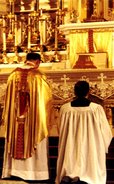
"No, Piero, in liturgy our focus isn't out there on them...it's on Him."

From the Shouts in the Piazza Archives

14 November 2006

Celebrating the Novus Ordo Ad Orientem?

Can the the Novus Ordo be celebrated Ad Orientem? The celebration of the Mass Ad Orientem (facing East, instead of facing the people) is implied in the General Instructions of the Roman Missal (GIRM). One does not even need to read it in depth. Here is a post from WDTPRS...

In #132 we find: Sacerdos genuflectit, accipit hostiam, eamque aliquantulum elevatam super patenam vel super calicem tenens, versus ad populum, clara voce dicit: Ecce Agnus Dei,.... The priest genuflects, takes the Host and, holding it raised a little way over the paten or over the chalice, having turned toward the people, says in a clear voice: Behold the Lamb of God….

The people make their response and then in #133 we find: Et sacerdos, versus ad altare, secreto dicit: Corpus Christi…. And the priest, having turned toward the altar, says silently: May the Body of Christ…

In these two rubrics there is a specific order of actions. First, the priest turns to the people. Then, he turns to the altar. This is only possible if the priest is celebrating Holy Mass facing the altar and the people are behind him facing the same direction as the priest. The rubric is clear in this moment before Communion.

Somewhat less immediately clear is the rubric at the Orate Fratres in #29, which says that the priest, while standing at the middle of the altar, turns to the people (versus ad populum) to say “Pray brethren, that my sacrifice and yours…”. Then in #30 the priest is directed to speak the Super Oblata prayer, but there is no indication that he turns back to the altar: there is no second versus. Why? The priest, turning to the people to invite their response, simply continues to turn in the same direction back to the altar. The single versus in this case indicates a completed turn in circle. In #132 and #133 (above) the two different instances of versus indicate two turns, one toward the people by the priest’s right and one toward the altar by his left. There is no complete circle. In this way the Novus Ordo is consistent with the older “Tridentine” Rite at this same moment in Mass. In the older, traditional way the priest turns by his right away from the altar and toward the people. He speaks the invitation. He turns back to the altar, always by his right, in the same direction, thus completing the circle. The rubric in the 2002MR has language very similar to the corresponding rubric in the 1962MR. Thus, HE of TN, we have clear support in the 2002MR for ad orientem celebration.

13 November 2006

How would the Old Mass help?

Taken from Fr Tim Finigan's Blog
Part 1, 2, 3

Personal experience
In response to my post on the Halloween Mass, Puella Paschalis asked how greater use of the Classical Rite would help to prevent or decrease liturgical abuses. We might also ask whether it is better to push for greater freedom of the Classical Rite or simply to further the more reverent celebration of the Novus Ordo.

Until December 2001, my own position was that in the vast majority of parishes in the Church, the Novus Ordo was well established and that, practically speaking, it was not worth expending much energy on the Classical Rite. I have many friends who only celebrate the Novus Ordo, who do so with great dignity and reverence, and whose parishes are beacons of good practice. Some of them were a little dismayed by my conversion to being a Classical Rite enthusiast: I am sure some of them discounted it as Tim Finigan being a bit inclined to seek a lost cause and a last ditch.

What brought about my conversion was something quite simple. I was asked to celebrate a funeral Mass for a parishioner who happened to be the aunt of a long-standing friend from Oxford days. My friend’s family were all devotees of the old rite and asked me to celebrate the funeral accordingly. I agreed without hesitation: whatever my views on the old rite, I always felt that it was foolish and unfair to persecute those who wanted it. When I got home, I realised that my snap decision left me less than two weeks to learn how to celebrate the rite. Fortunately, I had studied Latin in Rome with Fr Foster and was able to read through the Ritus Servandus and work things out more or less. My friend and near neighbour, Fr Charles Briggs gave me a run-through and I managed without any major gaffes.

From the day of that funeral, I became a passionate supporter of the rehabilitation of the Classical Rite. Frs Basden and Southwell helped me by recommending various books to read, and Michael Davies kindly gave me the instruction booklet, video and a set of altar cards. I progressively devoured Klaus Gamber’s “The Modern Roman Rite”, Alcuin Reid’s “The Organic Development of the Liturgy”, and Cardinal Ratzinger’s “The Spirit of the Liturgy”.

It is hard to pinpoint exactly what brought about such a complete volte face. I think I could summarise it by saying that the celebration of Mass in the Classical Rite brought into sharper focus than I had ever known before the priest’s personal devotion during the Mass; and crucially, the importance of this devotion for the genuine participation of the faithful.

Two things in particular brought about this “sharpening of focus”. The first was the old rite’s constant devotional reminders given by the private prayers of the priest. Psalm 42, the Aufer a nobis, the Oramus te, the longer preparation for the Gospel, the offertory prayers, the prayers before and after communion, and the Placeat tibi all emphasise the priest as a sinner in need of redemption, purification and, above all, humility before the majesty of the action which he is simultaneously participating in as a sinner and making present in persona Christi.

I say “sharpening of focus” because none of these themes of devotion is necessarily absent in a reverent celebration of the Novus Ordo and they can be absent in a hurried and mechanical celebration of the Classical Rite. However, the experience of celebrating the Classical Rite helped to strip away the consciousness of being a “presider” and outline starkly the reality of being an abjectly unworthy minister of such an awesome mystery.

Inextricably tied in with this sense of unworthiness is a very different emphasis on assisting the faithful to participate genuinely in the actio Dei. The priest has little choice in the use of texts. He may choose to add particular collects but this does not have the same impact as the vast range of choices presented by the Novus Ordo in the ordinary prayers of the Mass. In the Classical Rite, the priest is stripped of his power to impose his personality on the Mass. All that he can do to aid the genuine participation of the faithful is to celebrate Mass reverently and devoutly, knowing that his own state of soul is the only important factor in anything that depends on him.

Followers of this blog may contrast this with the huge impact of the priest’s personality in something as aberrant as the “Halloween Mass” or in something as mildly personal as a slightly humorous remark in the introduction to the Mass permitted in the Novus Ordo. To celebrate the Classical Rite can remind any priest of his true place in the Liturgy.

Ecclesiological
I realise that part I of this essay does not entirely address the question asked by Puella Paschalis – How will the use of the Classical Rite stop abuses? At one level, of course, it will do nothing. Those who are implacably opposed to the old rite will carry on as before, perhaps deriding those parishes that make the old rite available, and finding any excuse to show how unpastoral it all is.

However, the principal effect of liberalising the Classical Rite would be to pass the initiative back to those who are loyal to the Church. At the present time, we have a veritable bibliography of official documents from the Vatican condemning abuses and ordering their cessation. Yet still we have the “Halloween Mass” and any number of lesser abuses perpetuated on a daily basis in parishes throughout the Western Church. In order to counteract these abuses, the faithful must write to the Bishop, or the Nuncio, or to the Congregation for Divine Worship, wait for replies, excuses, and diplomatic manoeuvres, and, in many cases, return unsatisfied.

Were the Classical Rite to be liberalised, the clergy, especially those young and full of zeal for tradition, would be free to take the initiative, without being slurred as disobedient or out of tune with “the mind of the Church”. The very existence of the Classical Rite as one of the family of Western rites, approved and allowed by the Church, would help to dispel some of the scruples and excessive rubricism that afflicts some modern liturgists. You say that good liturgy involves the priest “engaging with the people”? – well here is a liturgy in which the priest does not even raise his eyes above the altar rail when greeting them liturgically: and it is approved by the Holy See. You say that good liturgy involves a committee to choose the texts to ensure active participation? – well here is a liturgy in which the texts are set down, given, received: and it is approved by the Holy See.

General permission for the old rite would have the effect of wiping out many of the “given” principles of liturgical celebration that have plagued the Novus Ordo and hampered the efforts of many good priests in promoting a worthy and dignified celebration of the Mass. Their solemnity, their formality in the rites, their self-effacing attitude to “presiding”, their insistence on observing the rubrics: all of these things would overnight become part and parcel of the whole Western Church’s liturgical patrimony once more. Freedom to celebrate the old rite would have a very encouraging effect on those priests who celebrate the new rite with care.

Then there is the question of the “mixing of rites” which I consider to be a positive thing – but in one direction only.

Mixing of Rites
One common comment that I hear, especially from priests, regarding the old rite, is “I don’t agree with the mixing of rites.” I beg to differ. I do agree with the mixing of rites: but only in one direction.

I do not think it is a sensible thing to attempt to enforce upon the SSPX or the FSSP or the ICSP any of the liturgical reforms that have taken place in the wake of Vatican II. The principle is now firmly established that the Classical Roman Rite was not abolished, and it would be difficult to persuade any devotees of the old rite to accept even minor changes introduced during the 60s. There is a live debate in scholarly circles about the wisdom of some of the reforms introduced even before Vatican II, notably in the Breviary and in Holy Week. It makes sense to leave well alone as far as the old Mass is concerned.

However the Novus Ordo does not have any such privileged position. I was interested to read recently that Cardinal Estevez wished to modify the 3rd edition of the Pauline Missale Romanum to allow the use of the old Offertory Prayers. He was thwarted in this but it remains a sensible suggestion. In fact, I know of several priests who use the old prayers when saying the Offertory silently. Some people might wish to say that this is an abuse. I would argue that since these prayers have a venerable antiquity, it would be better simply to allow them officially and to absolve these good and faithful priests of any scruples.

Similarly, Cardinal Ratzinger himself advocated allowing the use of both priestly prayers before Communion, and the recitation of the Canon in silence. Mixing of rites? I would not be worried about this kind of mixing. Would it be such a terrible thing if priests were allowed to genuflect more during the Mass, to make more ceremonial gestures of blessing, to say the Leonine Prayers after Mass, or to recite the Last Gospel? Some of these things could be introduced without officially breaking the rubrics of the Novus Ordo (there is nothing to say that a priest cannot silently recite the Aufer a nobis as he goes up to the altar, and there is nothing to prevent a priest saying some prayers with the people after Mass.) However, official encouragement would again give the initiative to priests who are fully loyal to the Holy See and enable them to provide more devotional food for the faithful.

The Novus Ordo was produced in a hurry less than 40 years ago. It should not be considered immune from “contamination” with elements of the old rite. A “mixed rite” with vernacular readings but many ceremonial elements from the Roman tradition would be welcomed by many faithful priests. That sort of mixing – the introduction of traditional elements into the new rite – would be a great help, especially if it were officially sanctioned, removing any scruples from orthodox clergy who only celebrate the new rite.

However, this will probably only come about if the old rite (without changes) is liberalised and celebrated more freely. Such freedom will immensely help the reverent celebration of the new rite and will reinforce those who have remained resolutely loyal to the Church during difficult times.
Imprudent Posting of Liturgical Abuses

Taken from Te Deum Laudamus

I've learned a lot since I've started blogging and I've been debating about starting a series of posts to accumulate those lesson's learned so that I may revisit them periodically, and perhaps lead a few others to contemplate them. This is my first "Confession" in a series that will be ongoing as long as there are lessons learned. I know some of you will disagree with my decision here, and that's fine. I can't follow anyone else's conscience, I have to follow my own.

... It comes after much reflection in adoration today at the 40 Hours Devotion. This was prompted after two people were kind enough to express their disappointment with seeing such things on this blog. I owe them my thanks and would invite readers to please email me (see profile) with any such concerns in the future. This is a learning process for me. I can't guarantee I will agree with everyone who has a problem with my content - particularly on issues where there are varying opinions all the way up the heirarchy, such as Medjugorje. But, I can guarantee that I will pray and reflect on it, then make corrections where my conscience tells me it is necessary.

One might ask, "But, how will it ever stop if we do not put a spot light on it and spread it all over the internet?" My answer is simple: Those who made the video need to use the process the Church has asked us to use to report liturgical abuse. What is the process? It can be found in Redemptionis Sacramentum (Section VIII-6; Paragraph 184)

[184.] Any Catholic, whether Priest or Deacon or lay member of Christ’s faithful, has the right to lodge a complaint regarding a liturgical abuse to the diocesan Bishop or the competent Ordinary equivalent to him in law, or to the Apostolic See on account of the primacy of the Roman Pontiff.[290] It is fitting, however, insofar as possible, that the report or complaint be submitted first to the diocesan Bishop. This is naturally to be done in truth and charity.
Hence, it is actually best if the originators of the video were to seal it and send it to the diocesan bishop, then spend some time in adoration and prayer that the will of God be done - and, in God's timeframe, not ours. God knows all, far more than we do, so we must trust the process his Church provides. If there is low confidence in the bishop, nothing prevents a courtesy copy of the video from being sent to the Apostolic See (Cardinal Arinze at the CDW) at the same time.

We ought not be going out looking for abuses (or looking for abuses to post), but it's another matter if it occurs in our own parish and it happens to get on tape. From there, those who have such material have to discern the appropriate course of action just as we Catholic bloggers will have to discern whether to advocate some alternate, unofficial process by promoting those photos and videos on our blogs. For my part, I am publicly encouraging the official process be used.

With that, I would like to apologize to anyone who was offended with the content that was here previously and again, express my gratitude to those who in Christian charity gave me some things to ponder.

If we really want to do something about liturgical abuses we need to spend some time in prayer - in particular - the Rosary, and in adoration. The web has limits, but prayer has no boundaries. Help one priest through prayer, and you help all with whom the priest has contact. Prayer has the added benefit of gracing us with patience and charity, without which we are nothing more than clanging cymbals.

Mea Culpa!

A Canon Lawyer's Opinion on the Choral Sanctus

Taken from NLM

Can a choral Sanctus be sung according to the rubrics of the new missal? The most recent General Instruction on the Roman Missal seems to preclude this possibility.

But wait just a minute.

Some fine CMAA veterans to whom I am most grateful have unearthed an article from the Fall 2000 issue (vol. 127, no. 3) of Sacred Music writen by Duane L.C.M. Galles, a canon and civil lawyer. It explores the question of the choral Sanctus from the perspective of church law. Galles masterfully takes into consideration Canon Law, Sacrosanctum concilium, Inter oecumenici (1964), Musicam sacram (1967), and the General Instruction on the Roman Missal. He carefully sorts out the juridical nature of each of the most pertinent documents (e.g. forma specifica vs. forma generali; also the meaning of the term "instruction"), and untangles this seemingly impossible mess and comes to the conclusion that, yes, the choral Sanctus is quite permissible indeed.

The CMAA will soon make this document available online. Keep your eyes open.

Here are some excerpts to whet your appetite:

"(Musicam sacram's) article 34 foresees two ways of singing the Ordinary of the Mass, both a Plan A and a Plan B. Plan A is the case when there is 'part-singing for the chants of the Ordinary of the Mass (when) they may be sung by the choir alone in the customary way, that is either a cappella or with instrumental accompaniment.' Plan B is to divide the Ordinary between the choir and congregation in which case 'the Sanctus should as a rule be sung by the entire assembly along with the priest.' Musicam sacram thus provides as its Plan B for what is described in article 168 (of the GIRM. M.E.L.) as well as for a Plan A or polyphonic plan. This is perhaps why articles 15-17 of the 1975 instruction and articles 35-37 of Missal 2000 do not place the Sanctus (and certain other parts of the Ordinary) in the category of responses 'that the gathered faithful must contribute' or those 'assigned to the whole congregation called together.'"

snip....

"While canon 20 states that a later law derogates from an earlier one, a universal law does not derogate from a special one, unless the latter expressly so states. Here the 1975 or 2000 instruction forms a later general law and Musicam sacram forms a set of special norms governing sacred music. Thus we have the case contemplated by canon 20 and we may also note that Musicam sacram has also made provision--as its Plan B--for article 168. Since the latter general norm does not expressly abrogate Plan A of Musicam sacram, under canon 20 Musicam sacram's Plan A must be still lawful. This seems a true application of canon 20 and the result is reinforced by the approval of Musicam sacram in forma specifica."

I can't help but comment that it's very sad that we must work through so much legal jargon in order to defend a well-established practice in the Roman Rite. We should nevertheless be grateful to Galles for having taken the time to do so.

Still not convinced? One more snip:

"Furthermore, canon 21 says that where there is doubt whether a prior law has been revoked, revocation is not to be presumed but rather the later law is to be interpreted, so far as possible to harmonize it with the earlier one."

Let the Missa Papae Marcelli begin!

The Road to Restoration

Taken from NLM

[I quote this article in part.]

Mass of Ages
November 2006

by Msgr. Ignacio Barreiro

In these last months we can see a growing series of events that indicate that the Holy See is moving in a clear route of doctrinal and liturgical restoration. Without discussing the recent leadership changes in some of the main offices of the Holy See, nor the important process of doctrinal clarification that continues to move ahead, I limit myself in this article to analysing some of the events that mark the trend towards liturgical restoration.

Ingrained opposition
Beginning in mid-March there were a growing number of reports that the Holy Father was ready to grant the so-called universal indult, a general permission for priests to use the rite of St. Pius V publicly without requiring the permission of their bishops. Some were expecting a formal announcement after the second meeting of Curial Cardinals convened to debate this issue on 7 April. The fact is that the announcement was not made. We do not have any official confirmation of the intention of the Holy Father to issue this document, but we have several indirect indications that a document of this nature was being considered. First was the public announcement that two meetings of cardinals were convened to study this issue in a general fashion: the first on 13 February and the second on 23 March. Second, the statement issued by the French Bishops’ Conference at their meeting at Lourdes on 7 April. In this paper the French bishops acknowledged by their opposition the existence of a draft document on the Traditional Liturgy of the Church. In the second section of the paper: ‘The Reception of the “Traditionalist” Groups in Our Dioceses’, the French episcopate express the desire to receive Traditionalists groups but on their own terms, even denying them the right to criticise the New Mass.

We can sense their opposition to the establishment of juridical structures that would serve as a guarantee for the Traditionalist movement. As experience has shown, there is a need for these juridical structures. Some bishops have applied the provisions of the motu proprio, Ecclesia Dei with generosity, but regrettably many others cannot be praised in a like wise manner. It is not a question of establishing parallel Churches; it is a question of how to recognise a complementary diversity within the Catholic Church. If complementary diversity is recognised the unity of the only Church will be strengthened. If there is a legitimate diversity, the particularities have to be recognised by juridical structures that will strengthen the symphonic unity of the Church. A true unity is guaranteed by precise and clear juridical structures that avoid ambiguity and divisions. The French bishops then went on to signify their desire to continue their reflection on these issues and to consider at the meeting of their Permanent Council this November, the outcome of the deliberations of a task group. It is evident that the French bishops are playing a delaying game that underlines that sooner or later the Holy Father might make a decision on this very important matter. However, this opposition should be seen against the background of the well-documented decline of the Catholic Church in France.

Another important event was the launch in Rome on 27 April of the Italian translation of the book Turning Towards the Lord by Fr Michael Lang of the Oratory, London, with a foreword by the then Cardinal Joseph Ratzinger. It is know that Benedict XVI encouraged the publication of this translation. This gives fresh attention to the strong concern of the Holy Father on the need to reform the reform and preserve a sense of the sacred in the Liturgy. Archbishop Albert Ranjith, Secretary of the Congregation for Divine Worship, in his presentation underlined that: “The book demonstrates how the direction of the liturgical prayer in the post-conciliar reforms does not reflect the former praxis, and this is surprising.” And he pointed out: “In fact, in the Foreword to this book, His Holiness Pope Benedict XVI, at that time Prefect of the Congregation for the Doctrine of the Faith, affirms that ‘to the ordinary churchgoer, the two most obvious effects of the liturgical reform of the Second Vatican Council seem to be the disappearance of Latin and the turning of the altars towards the people. Those who read the relevant texts will be astonished to learn that neither is in fact found in the decrees of the Council. The use of the vernacular is certainly permitted, especially for the Liturgy of the Word, but the preceding general rule of the Council text says, “Particular law remaining in force, the use of the Latin language is to be preserved in the Latin rites” (Sacrosanctum Concilium, 36.1). There is nothing in the Council text about turning altars towards the people; that point is raised only in post-conciliar instructions.’” This presentation has been seen by some in Rome as the opening shots of the expected Reform of the Reform. (The full texts of Archbishop Ranjith’s lecture was published in Mass of Ages, August 2006.)

Correcting abuses
This statement was followed by an important interview which Archbishop Ranjith gave to I-Media in French on Thursday 22 June. After noting the importance of the liturgy in the life of the Church, he underlined that “regrettably, after the Council, certain changes were made rapidly, without reflection, in a burst of enthusiasm, in a rejection of some exaggerations of the past.” The result, he noted, was quite different from the Council's intent. Giving some examples of the negative results, he mentioned "the abandonment of the sacred and the mystical", the confusion between the common priesthood of all the faithful and the ordained ministry, and the concept of the Eucharist as a common banquet rather than a re-presentation of Christ's Sacrifice. He even noted a Protestant influence. These changes, he stated, have produced negative consequences for the Church even beyond the liturgy. In the face of a growing secular trend in society, he said, the Church urgently needs to cultivate a deeper sense of the sacred and a more active interior life. Fortunately, he said, there is a growing feeling among Catholics of the need to recover the sense of the sacred. The work of the Congregation for Divine Worship entails helping bishops and episcopal conferences to refine the liturgy by incorporating the strengths of the past. Asked whether he was hinting at the approval of the use of the Missal of St. Pius V, Archbishop Ranjith stated that requests for the use of the pre-conciliar liturgy have become more common, but the question is in the hands of Pope Benedict XVI. He said. "The Pope knows all this…he knows the questions, he is very conscious of the situation, he is reflecting, and we are waiting for his indications. " At the same time Archbishop Ranjith underlined that the use of the Tridentine rite "has never been abolished or banned." However, he said, because of the split in the Church caused by the traditionalist followers of the late Archbishop Lefebvre, the Traditional Mass "has taken a certain identity that is not fair." Whether Pope Benedict will now encourage the use of the Missal of St Pius V, or call for a reform of the 1970 Missal-- "what some people call 'the reform of the reform'" - is not yet known, the archbishop said. What is established, however, is the need for a liturgy that is "more beautiful, more transcendent. " He cautioned that it is imprudent to press for quick decisions, running the risk of falling into new errors because of haste. "We have to reflect a great deal," he stated; "and above all, we have to pray for the Holy Father and the Church, and listen to what the Lord wants of us." Even if, wisely, Archbishop Ranjith is calling for time to reflect, this second public intervention is a clear indication that something important is in the making.

As a follow-up, in another interview with I-Media on 13 July, Archbishop Ranjith underlined the many problems that exist with the post-concilliar liturgy, both in itself and with the way in which it is celebrated. After indicating some positive aspects of the new liturgy, he mentioned that several positive aspects of the tradition of the Church had been abandoned, like the use of the Latin language and the eastward orientation of the altar, quoting in this regard important comments made by the then Cardinal Ratzinger. In a very significant way he stated: “It is our duty to be vigilant…because, in the end, the people will assist at the Tridentine Mass, and our churches will be empty.”

[...]

160 years of Qui Pluribus

Taken from Rorate Caeli

The "liberal Pope" had been elected in June 1846, and many did not know what to expect from Mastai-Ferretti. Pope Pius would still suffer bitterly in the hands of men who would receive so much from his mercy. He was a generous man -- but he was no liberal, and nothing could make this as clear in the first year of his pontificate as his first encyclical, Qui Pluribus, signed at the Patriarchal Basilica of Saint Mary Major on November 9, 1846.

As with all great popes, the first remarks of Blessed Pius emphasized his view of his own weaknesses:

We are well aware of Our weakness. So when We reflect on the most serious duties of the supreme apostolate especially in a period of great instability, We would simply have fallen into great sadness, did We not place all Our hope in God who is Our Saviour.

Qui Pluribus is, however, much more than a simple "introductory" Encyclical. When, in one of the most sollemn moments of his reign, Pope Pius signs Quanta Cura and, with it, the Syllabus, in 1864, a great number of the collected errors are those condemnations mentioned in his first encyclical. In it, one can read all the signs of Pope Mastai-Ferretti's concerns for the salvation of souls and for the integrity of the Doctrine of the Faith in the post-Enlightenment age, which is also our own.

Let us read anew the always necessary teachings and warnings of that great and holy Pontiff.
__________________

Private Interpretation:
God Himself has set up a living authority to establish and teach the true and legitimate meaning of His heavenly revelation. This authority judges infallibly all disputes which concern matters of faith and morals, lest the faithful be swirled around by every wind of doctrine which springs from the evilness of men in encompassing error. And this living infallible authority is active only in that Church which was built by Christ the Lord upon Peter, the head of the entire Church, leader and shepherd, whose faith He promised would never fail.


Bible Societies and dangerous biblical translations:
...the crafty Bible Societies ... renew the old skill of the heretics and ceaselessly force on people of all kinds, even the uneducated, gifts of the Bible. They issue these in large numbers and at great cost, in vernacular translations, which infringe the holy rules of the Church. The commentaries which are included often contain perverse explanations; so, having rejected divine tradition, the doctrine of the Fathers and the authority of the Catholic Church, they all interpret the words of the Lord by their own private judgment, thereby perverting their meaning. As a result, they fall into the greatest errors.


Indifferentism and Universalism:
Also perverse is the shocking theory that it makes no difference to which religion one belongs, a theory which is greatly at variance even with reason. By means of this theory, those crafty men remove all distinction between virtue and vice, truth and error, honorable and vile action. They pretend that men can gain eternal salvation by the practice of any religion, as if there could ever be any sharing between justice and iniquity, any collaboration between light and darkness, or any agreement between Christ and Belial.

Priestly celibacy under attack...:
The sacred celibacy of clerics has also been the victim of conspiracy. Indeed, some churchmen have wretchedly forgotten their own rank and let themselves be converted by the charms and snares of pleasure.

Anti-Catholic teaching methods:
...the prevalent but wrong method of teaching, especially in the philosophical disciplines, a method which deceives and corrupts incautious youth in a wretched manner and gives it as drink the poison of the serpent in the goblet of Babylon.

Communism:
...the unspeakable doctrine of Communism ... a doctrine most opposed to the very natural law. For if this doctrine were accepted, the complete destruction of everyone's laws, government, property, and even of human society itself would follow.

The prophetic view of our depraved age:
As a result of this filthy medley of errors which creeps in from every side, and as the result of the unbridled license to think, speak and write, We see the following: morals deteriorated, Christ's most holy religion despised, the majesty of divine worship rejected, the power of this Apostolic See plundered, the authority of the Church attacked and reduced to base slavery, the rights of bishops trampled on, the sanctity of marriage infringed, the rule of every government violently shaken and many other losses for both the Christian and the civil commonwealth.

The duties of Bishops:
...in accordance with your pastoral care, work assiduously to protect and preserve this faith. Never cease to instruct all men in it, to encourage the wavering, to convince dissenters, to strengthen the weak in faith by never tolerating and letting pass anything which could in the slightest degree defile the purity of this faith. With the same great strength of mind, foster in all men their unity with the Catholic Church, outside of which there is no salvation; also foster their obedience towards this See of Peter on which rests the entire structure of our most holy religion. ... to assure the greater glory of God and the Church, venerable brothers, join together with all eagerness, care and wakefulness to repulse error and to root out vice.

May Our Lady ("our mediatrix, advocate, firmest hope, and greatest source of confidence", cf. Qui Pluribus) and Blessed Pius IX pray for the Church of the Lord in these even more perilous times.

The Latin Mass

Taken from NLM

Cardinal Francis Arinze, one of the most popular and powerful Vatican officials to visit St. Louis since Pope John Paul II's 1999 visit, told more than 250 people at the Chase Park Plaza Saturday morning that Latin should be used more frequently in the Roman Catholic liturgy.

The Latin language now, he said "is in the ecclesiastical refrigerator ... Mass today should be in Latin from time to time."

Arinze, as the head of the Vatican's Congregation for Divine Worship and the Discipline of the Sacraments, is the Roman Catholic church's chief liturgist. He was the keynote speaker on the final day of the Gateway Liturgical Conference, sponsored by the St. Louis Archdiocese. Arinze, 74, had been scheduled to give the keynote address at the 2005 Gateway Liturgical Conference, but had to cancel his trip when John Paul died less than a week before the cardinal's address was scheduled.

Arinze, a native of Nigeria, was president of the Vatican's Council for Inter-Religious Dialogue for 17 years before being named to his present position four years ago. Partially because of the explosive growth of the Roman Catholic church in Africa and because of the his expertise on Islam, Arinze was frequently mentioned as a papabile — or likely next pope — in the immediate wake of John Paul's death.

In his address on Saturday, titled, "Language in the Latin Rite Liturgy: Latin and Vernacular," Arinze said the Roman church used Greek in its early years, but was "Latinized" in the fourth century. "The Roman rite has Latin as its official language," he said. The great religions of the world all "hold on" to their founding languages — Judaism to Hebrew and Aramaic, Islam to Arabic, Hindu to Sanskrit and Buddhism to Pali.

"Is it a small matter," he asked, for priests or bishops from around the world to be able to speak to each other in universal language of the church? Or for "a million students" who gather for World Youth Day every few years "to be able to say parts of the Mass in Latin?"

In an hourlong, often humorous, address that received several standing ovations, Arinze suggested that, in order to give Catholics options, large parishes offer the Mass in Latin at least once a week, and in smaller, rural parishes, at least once a month. (Homilies, he said, should always be in the faithful's native language.) Latin "suits a church that is universal. It has a stability modern languages don't have," he said.

8 November 2006

Sacred Music Motu Proprio?

Taken from NLM

Not that you needed yet another Vatican rumor to keep track of but this is impossible not to pass on (and not the full Mass setting from Mozart's Coronation Mass on November 19):

Sources close the Holy See are saying that during his upcoming visit to the St. Cecilia Music Academy Pope Benedict XVI may address the need to recover the quality of sacred music in the liturgical life of the Church.

The feast of St. Cecilia, patroness of music, will be celebrated on November 22, and the Pontiff has announced that during that week he intends to visit the academy of music in Rome that bears the saint’s name.

According to Vatican sources consulted by the Catholic News Agency, the Holy Father, who has expressed his concern over liturgical music, may addres! s the need to recover the place of sacred music, “both Gregorian and polyphonic,” in the Catholic liturgy.

“This pronouncement could even take the form of a ‘Motu Propio,’ an official document issued on the Holy Father’s own initiative,” sources said.

Since the election of Pope Benedict XVI, sacred music has been given greater attention in the Roman liturgy

On November 19, as part of the year of Mozart—one of Pope’s favorite composers—Cardinal Christoph Schönborn, Archbishop of Vienna, will preside at a Mass in St. Peter’s Basilica, in which the famous Philharmonic Orchestra of Vienna will present Mozart’s Mass of Coronation.

Although no time has been official allotted for remarks by the Holy Father, it is possible he will address the faithful at the conclusion of the liturgical celebration.

Thoughts about Vocations

Taken from Domine, da mihi hanc aquam

I’ve been thinking about vocations a lot lately. My province—Province of St Martin de Porres—is having a vocations weekend at the priory on Nov 10-12th. I’ve invited several young men from the university to attend and most of them have accepted. We’re expecting between 10 and 12 retreatants.

I wanted to suggest the following about vocations:

1). There is no vocations crisis. God is calling more than enough men to the priesthood to cover the needs of the Church. The real crisis is twofold: a). crisis of commitment and b). crisis of encouragement. The crisis of commitment is the result of the reluctance of the men who are called to say YES to their call. Most men called to priesthood are opting for careers that will only partially perfect their gifts. They can be happy, of course, but they are not picking up the greater challenge of sacrificial service in the Church. The crisis of encouragement is more complex. Basically, mothers and fathers are not supporting sons who express an interest in say YES to God’s call. This has to do with a decline in the prestige of the priesthood and the easier availability of a formal education for lower and middle-class men. We also have to look to the bishops, their vocation directors, and their discernment and vetting processes. Do the people the bishop trusts to recruit and vet his vocations really believe that an ordained priesthood is necessary for the flourishing of the Church? Is there a culture of priestly community in the diocese? Are the priests happy and encouraging of vocations? Bottomline: no sensible young man with a vocation is remotely interested in signing on to a religious order or a diocese if it is clear that those in charge think his vocation to ordained ministry is an ideological problem, a theological inconvenience, or a political obstacle to the Great Lay Revolution. And no young man is remotely interested in joining an order or a diocese controlled by bitter, angry ideologues who loudly and proudly celebrate the coming demise of the priesthood. Who wants to jump on a failing project as it sinks under the weight of its stewards’ neglect?

2). If we have all the vocations we need, but those vocations aren’t saying YES, what do we need to do? First, give God constant thanks for the vocations He has called. Gratitude sets the stage for humility and the current crisis in commitment and encouragement needs all the humility it can get. Second, pray that God will encourage (literally, “strengthen the hearts of”) those whom He has called. Pray that they will say YES. Third, personally, one-on-one invite a young man to think about priesthood. If there’s any inkling in his mind that he has been called, your affirmation will reinforce that inkling into a stirring and the stirring into a desire and so on. Fourth, make sure that you understand who your priest is. I mean, study up on the nature of the priesthood. Get the Catechism and spend some time studying what the Church teaches about priesthood. Ignore functional models of priesthood (i.e., the priesthood is a job or a role) and ignore attempts to turn the Catholic priest into a Protestant minister (i.e., a minister of the Word in the pulpit but not a priest at the altar of sacrifice!). Also avoid all attempts to understand that priesthood is rooted in baptism only. We all minister to one another out of our baptisms. But the ordained priest ministers out of his baptism AND out of his ordination. To say that he ministers as a priest out of his baptism only is an attempt by some to diminish the sacramental character of Holy Orders and reduce the priesthood to something like a Parochial Facilitator of Charisms. One more thing to avoid: please don’t lump a vocation to the priesthood in with vocations to the married life, the single life, ad. nau. Of course, these vocations are perfectly true and good and beautiful. But we aren’t suffering as a Church from a lack of husbands and single women. Lumping priestly vocations in with all other Christian vocations tends to level the priestly vocation and hides the urgency of the crisises of commitment and encouragement. This is NOT about the priestly vocation being “better” than any other vocation. It is about the Church being loud and clear that we need priests and that we value the vocation for itself and not as a tacked-on afterthought during the prayers of the people.

Those called to priesthood will not be encouraged to say YES to their call until it is crystal clear to them that we need them. Communion Services and other forms of “celebrations in the absence of a priest” only serve to reinforce the idea that a priest for Mass is a luxury. Given all the other negatives about the priesthood these days, do we really need to carry on with our Sunday worship as if the priest were a rare creature slowly moving into extinction? I imagine a young man in the pews at St. Bubba’s, attending a month or two’s worth of Sunday Celebrations in the Absence of a Priest and thinking, “Hey, I don’t need to say YES to God’s call to priesthood. We’re getting along just fine here at St. Bubba’s w/o one.” In fact, why don’t we just elect one bishop somewhere in Kansas to consecrate several warehouses of hosts every week and then use FedEx to ship those hosts to all the parishes in the country for communion services. That way we can get rid of the priesthood and the episcopate altogether. Much cheaper and easier than educating men to be parish priests. Well, I guess we would have to keep one priest and one seminarian in the pipeline at all times as replacements.

4 November 2006

Those French Bishop...

Taken from CWNews

Today the French bishops opened a meeting at Lourdes, and in his capacity as president of the episcopal conference, Cardinal Jean-Pierre Ricard made the opening speech.

In the course of his address, Cardinal Ricard used the word peur (fear) 11 times, and confiance (confidence, trust) 15 times. He was urging his brother bishops not to panic.

Why would the French bishops be inclined toward panic?

- Because their parish churches are empty, their seminaries emptier, and Catholic parents aren't bothering to bring their children for Baptism? No.

- Because divorce, abortion, fornication, and sodomy are rife; and momentum is building toward general social acceptance of euthanasia and human cloning? No.

- Because Islam now has more practical impact on public policy than Catholicism, in the country once proud to be known as the "eldest daughter of the Church?" No.

- Because the Holy Father might sign a document allowing priests to celebrate Mass using the Tridentine rite? Yup, that's it.

Premonstratensian Rite Chant

Taken from NLM

Norbertine Gregorian Chant: Music between Heaven and Earth

A reader should not be surprised to learn that the NorbertineOrder has its "own" Gregorian chant. As any other ancient Order, that of Saint Norbert also has its traditions and liturgical practices.

From its earliest beginning, the Norbertine Order gave special care to liturgy and daily prayer in community. Besides pastoral activities, which the Norbertines always had, the care for liturgical celebrations has always been very important.

Saint Norbert and his successor, Abbot Hugo, were very attached to a certain uniformity within the growing Order. About eight years after the foundation in Premontre, Norbert left France and was appointed Archbishop of Magdeburg (1126). At that moment, the number of monasteries in France, the Low Countries and Germany was already 41! A century later there were some 1,500 throughout Europe! Unity in matters of liturgy, rule of life, clothing, chant and obedience to the statutes was therefore really necessary to avoid splitting.

But where does "Norbertine Gregorian" come from? Neither Norbert nor Hugo were composers. Long before there existed any official Roman Liturgy, a number of flourishing Christian communities in Western Germany and Gaul had their own "proper" rites, essentially consisting of Greek and Palestinian elements. Any bishopric or monastery of a certain repute had its own liturgical books for Eucharistic celebration, with prayers, lectures and chants. It is therefore highly presumable that Saint Norbert, besides prayers and lectures, also took over chants from the diocese of Laon, as Prémontré was part of it. It is nearly sure that those liturgical chants must have been fixed, together with other prescriptions, for all establishments of the Order. An ancient version of the Statues (dated 1143) devotes explicitly a whole chapter to liturgical books. It actually says that "missal, lectures, gradual, antiphonary, hymns, psalms, rule and liturgical calendar" must be identical with the Order. Versions of the Statutes from later centuries all contain this strict provision. Even certain papal documents stress this obligation of unity and abbots were regularly encouraged to maintain these valuable practices. At the yearly General Chapter which, at first was held each time in Prémontré, practice could be compared to and contrasted with the existing prescriptions.

The differences heard in Norbertine Gregorian are not exclusively due to bad copying in the scriptoria; musical connoisseurs once stated that in the many remarkable melodies proper to the Norbertine repertory, adding one sole note or a group of notes could considerably enrich the melody, as it was often inspired by the desire for beauty and an ingenius sense of creativity.

Gregorian Chant was always called "The unsurpassable summit of unisonous music and an irreplaceable vivifying principle within the Western Christian liturgy."

The Second Vatican Council preserved this view, even if the Constitution of the Holy Liturgy (4.XII.1964) issued a lot of directives and possibilities aiming at a liturgy celebrated in a more popular way and in the mother tongue. After twenty years of experiments and composition, it is somehow felt that Gregorian has nothing to do with monastic music belonging to the period of the triumphant church, nor with a chant that people don't understand nor feel drawn to. On the contrary: The renewed interest that comes up here and elsewhere indicates that we need to reevaluate Gregorian Chant as liturgical music and a precious culture-bearer. Many are tired of those masses with pop and beat songs, all failures that soon lose their attraction. Priests and pastoral workers progressively realize that those "renewals" they introduced too fast and unconsidered, don't give the results they expected.

The Gregorian Abbey Choir of Grimberg Abbey, that for 35 years now takes part in High Mass every Sunday at 10 a.m in the Abbey Church, wishes to prove that the beauty of Gregorian is eternal. Its beauty is, in the first place, an inner beauty, providing a spiritual value that enables both singer and listener to reach for God. Many other forms of music will be, no doubt, more beautiful than Gregorian, but in liturgy esthetics is not the object.

Gregorian has come a long way. In the eighth century, notes were written down on paper: up to then, music was transmitted orally. How music was performed when it wasn't written down can't be reconstructed, but there are many speculations. After the beginning history of Gregorian, the first marks were put above the texts in the scriptoria of East-and West Frankish cloisters, which we commonlycall "neumes." The monks of that time must have passed whole days copying these systems, having breaks only for singing lessons and prayer. The later development of a Western note writing system is actually a big handicap when reconstructing our former music history. The 13th Century marks the beginning of a decline through the increasing popularity of polyphonic music and the worldly theater music that were introduced into the churches and spoiled the melodies.

The restoration of Gregorian is mainly due to the monks of theFrench Abbey of Solemes in the second half of the last century. Abbot Gueranger (1875), who wanted to restore monastic life, asked hisconfreres to gather ancient manuscripts in order to restore through comparative studies the melodies in their original purity. At the beginning of this century, there was still a lot of work to do, and only in 1907 were their efforts crowned with the issue of the "Graduale Romanum." Within the Norbertine Order a workshop of Gregorian experts issued the "Graduale Premonstartense."

After the Second Vatican Council , the reform of the calendar and liturgical books (i.e. missal and lectionary) required a number of changes and adaptations to the Graduale Romanum. With the last issue in 1979 - known as the Graduale Triplex - the concern had really been to maintain the treasure of Gregorian chant in its original purity (Constitution of the Holy Liturgy, nr. 114).

Grimberg Abbey, founded by Saint Norbert around 1128, maintained its Gregorian tradition, even if several times throughout the centuries, the abbey was looted, burned and destroyed. The phoenix gracing the abbey's escutcheon, always rose from his ashes. In a similar way, Gregorian here has always persisted through trials and tribulations, and remains a distinctive part of the Norbertine tradition.

The Grimberg Abbey Choir, under the Direction of Dr. Gereon van Boesschoten, O. Praem., has made six CD Albums of Norbertine Chant, under the Eufoda label:

* Eufoda 1119
* Eufoda 1124
* Eufoda 1125
* Eufoda 1181
* Eufoda 1280 "Maria" (1998)
* Eufoda 1308 (2001) Chant from the Liturgy for Corpus Christi

3 November 2006

Purification of Sacred Vessels

Taken from Vivat Jesus

CDW On Purification Of Vessels

The following is the text of the letter sent by Francis Cardinal Arinze to Bishop William Skylstad, president of the USCCB, concerning the liturgical change in America such that extraordinary ministers will no longer be permitted to purify the vessels used at Mass.

CONGREGATIO CULTO DIVINO ET DISCIPLINA SACRAMENTORUM
Prot. n. 468/05/L
Rome, 12 October 2006

Your Excellency,
I refer to your letters of 9 March 2005 and 7 March 2006, in which, in the name of the Conference of Bishops of which you are President, you requested a renewal of the indult for extraordinary ministers of Holy Communion to purify the sacred vessels after Mass, where there are not enough priests or deacons to purify a large number of chalices that might be used at Mass.

I have put the whole matter before the Holy Father in an audience which he granted me on 9 June 2006, and received instructions to reply as follows:

1. There is no doubt that "the sign of Communion is more complete when given under both kinds, since in that form the sign of the Eucharistic meal appears more clearly" (General Instruction of the Roman Missal, no. 240; Catechism of the Catholic Church, no. 390).

2. Sometimes, however, the high number of communicants may render it inadvisable for everyone to drink from the chalice (cf. Redemptionis Sacramentum, no. 102). intinction with reception on the tongue always and everywhere remains a legitimate option, by virtue of the general liturgical law of the Roman Rite.

3. Catechesis of the people is important regarding the teaching of the Council of Trent that Christ is fully present under each of the species. Communion under the species of the bread alone, as a consequence, makes it possible to receive all the fruit of Eucharistic grace (cf. Denzinger-Schônmetzer, no. 1729; General Instruction of the Roman Missal, nos. 11, 282). "For pastoral reasons", therefore, "this manner of receiving Communion has been legitimately established as the most common form in the Latin rite" (Catechism of the Catholic Church, no. 390).

4. Paragraph 279 of the General Instruction of the Roman Missal directs that the sacred vessels are to be purified by the priest, the deacon or an instituted acolyte. The status of this text as legislation has recently been clarified by the Pontifical Council for Legislative Texts. It does not seem feasible, therefore, for the Congregation to grant the requested indult from this directive in the general law of the Latin Church.

5. This letter is therefore a request to the members of the Bishops' Conference of the United Status of America to prepare the necessary explanations and catechetical materials for your clergy and people so that henceforth the General Instruction of the Roman Missal, no. 279, as found in the editio typicatia of the Roman Missal, will be observed throughout its territories.

With the expression of my esteem and fraternal greetings, I remain, Your Excellency,
Devotedly yours in Christ,

+Francis Cardinal Arinze
Prefect

Monsignor Mario Marini
Under-Secretary

Black Vestments

Taken from NLM

Many are likely aware that there has been these past 40 years an aversion to black vestments for times such as funerals, or for the Feast of All Souls and so on. Thankfully this is decreasing with the newer generations of clergy.

Often black vestments have been excluded in liturgical practice (though not in liturgical law) -- enough so that there are entire generations who will have never seen a black vestment worn, let alone know of its existence as a liturgical colour. Some may even believe that black vestments are no longer permitted.

Now let us get it straight: the use of other colours is not a liturgical abuse as these are options which the Church has given. There are some, however, for whom this matter is actually rooted in an ideological opposition aimed at the perceived "negativity" of black as a liturgical colour. This latter idea is a problem and one which I wish to address. Further, I would also like to make a case for why I believe the effective disappearance of black is theologically undesirable, even when we are just exercising another legitimate liturgical option as a norm.

The use of black is representative of some fundamental Christian realities. While Christians are a people of hope (the oft used argument for those wishing to exclude black), we are also a people aware of the reality of sin and judgment. We do not presume to know the state of our loved one's soul; it is difficult enough to know the state of our own. Unfortunately, many, including a number of parish priests, acquiesce to this idea that the achievement of our heavenly reward is a fait accompli. While we indeed hope and pray that our loved one has attained his or her heavenly reward, it is not a hope that is without reservations or loving concern. As Christians we are hopeful and yet also have a humble realism. We know that we are sinful creatures and we do not always meet the mark, nor necessarily repent of our sins. As such, we both hope and pray. Black, with its echoes of mourning and reserve, both acknowledges our own emotional response to the loss of a loved one, and is further representative of our need to pray for the repose of our loved one's soul. It also is a reminder and symbol of our belief in purgatory wherein the suffering souls require our prayers and especially Masses. After all, Requiem masses are not merely memorials made for the living -- tools for our psychological and emotional comfort -- but are first and foremost powerful prayers and graces for the repose of our dearly beloved. If we approach the afterlife of heaven as "automatic" or as a given, whom will take seriously the need to pray for the souls of purgatory or our departed loved one? Eventually, who will see the need to have a funeral Mass? Black represents our mourning and also that there is work yet to be done -- the work of prayer; the offering up of the graces of the Holy Mass. The gold or silver which typically adorns the decoration of a black vestment gives us that silver-lining of Christian hope which we have for the resurrection of the departed.

From a cultural perspective, this absence of black vesture seems representative of a divide from the common cultural sentiment expressed at death which has been informed by religious principles for generations -- one cannot help but notice that black is still the colour of mourning amongst most at a funeral. If we are truly interested in speaking to people in symbols and language they can understand and relate to, the use of black at a funeral cannot be surpassed in this regard. (Note: I am not suggesting that culture must inform liturgical practice; in this case, I think the Faith has informed the culture and the culture still retains this formation on a deep seeded level.)

Liturgically, there is no impediment to stop a priest from re-introducing black vestments into the sacred liturgy when the rubrics allow for it -- and this I would heartily recommend to our parish priests here.

If, however, a parish priest finds he would receive too much opposition within his diocese, another option for the moment might be a chasuble of white (or preferably off-white, cream colour), with a large, substantial band of black brocade going up the centre of the vestment -- or also in a traditional Y-orphrey shape. If there is ornamentation of the black brocade, let it be in silver.

2 November 2006

NLM Letter Writing Campaign...

With all the talk of various discussions and debates surrounding the rumoured motu proprio on the use of the 1962 Missale Romanum, a NLM reader Jeff Ostrowski had a thought...

"I want to let others know about a comment, which comes from a good source (a smart bishop and friend of Cardinal Ratzinger):

"Why don't you just write to him [Benedict XVI]. The Holy See keeps tabs on the number of letters they receive."

We need to realize this.

Send to:
His Holiness Pope Benedict XVI
00120 Via del Pellegrino
Citta del Vaticano

In English, the Pope's E-mail address is benedictxvi@vatican.va


Additional Points to take note of...
Before describing how an address should be written, or how a letter to an ecclesiastical personage should be begun and ended, it may be well to say that the paper must always be white, no other colour being allowed. The size and form of stationery considered appropriate is that known in Italy as palomba; it is used by the Roman Congregations, and is so called because it has the watermark of a dove (It., palomba). In other countries the paper used for protocols or ministerial correspondence may be employed, but it should be handmade, as both stronger and more suitable.

The ink must always be black; coloured inks are forbidden; first, because they are contrary to traditional usage, and next because they are liable to changes, having, for the most part, a basis of aniline or of animal oil; moreover, these inks on being exposed to the light lose colour rapidly and soon make the letter impossible to read.

The letter must be written as our fathers wrote, and not, as business letters are now sometimes written, first on the right hand sheet and then on the left, in inverse order to that of the leaves of a book. This is expressly laid down in an instruction issued by Propaganda when Monsignor Ciasca was secretary, and rests on the necessity of providing for the due order of the archives and for facility of classification.

Lastly, it is better not to write on the back of the sheet, as the ink may soak through the paper and make the document less easy to read; in any case, it is a rule of politeness to facilitate the reading of a letter in every possible way.

Ten years ago the use of a typewriter was not permissible; at the present day it is. Many decrees of the Congregation of Rites are written in this way; the Congregation of Bishops and Regulars allow it in the case of documents addressed to them, and other ecclesiastical courts have followed their example, but letters addressed to the Sovereign Pontiff personally must still be written by hand. If the letter be sealed, red wax must be used, any other colour, or even black, being forbidden; but the use of wafers, made to look like seals of red wax, which are gummed on to the envelope, is now tolerated. Moreover, according to the practice of the ecclesiastical chanceries, the seal used should be smaller in proportion to the dignity of the person addressed. In practice, however, it is not easy to follow this rule, since it is not everyone who possesses seals of different sizes.


Forms of Address
The Sovereign Pontiff is addressed at the commencement of a letter as "Most Holy Father" (Beatissimo Padre); in the body of the letter as "His Holiness" (Sua or Vostra Santità). It is customary to speak to him always in the third person, and the letter ends with: "Prostrate at the feet of Your Holiness, I have the honour to profess myself, with the most profound respect, Your Holiness's most humble servant."

If, instead of a letter, a petition is sent to the Sovereign Pontiff, to be examined by him or by one of the Roman Congregations, it should begin: "Most Holy Father, Prostrate at the feet of Your Holiness, the undersigned N., of the diocese of N., has the honour to set forth as follows:" -- and the statement of the request ends with the words: "And may God . . ." (meaning, "May God enrich Your Holiness with His gifts"). If written in Italian the petition ends with the formula, Che della grazia . . ., the beginning of a phrase implying that the favour asked is looked for from the great kindness of the Sovereign Pontiff. After folding the petition lengthways to the paper, the petitioner should write at the top, "To His Holiness, Pope N. . . . ."; in the middle, "for the petitioner" (per l'infrascritto oratore), and at the bottom, to the right, the name of the agent, or the person charged with the transaction of that particular business at the Roman court.


From the Catholic Encyclopedia (1913 ed.)