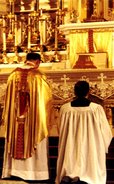
The initiative regarding which even the intra-Church attention has been focused in the past few months is the "Motu proprio" Summorum Pontificum, on the use of the Roman liturgy prior to the reform of 1970 and officially in force from the past September 14. The goal of this pronouncement is clearly entirely spiritual and pastoral. In fact, on the one hand, "it behooves all of us to preserve the riches which have developed in the Church’s faith and prayer" - as the Pope writes in the accompanying letter to the "Motu proprio" -; on the other, it is necessary "to make every effort to enable for all those who truly desire unity to remain in that unity or to attain it anew".
Within this horizon, he deigns to include as an "extraordinary" expression in the lex orandi of the Church the Roman Missal promulgated by Saint Pius V and aggiornato by Blessed John XXIII in 1962, though the "ordinary" way remains the Roman Missal published by Paul VI in 1970. And he insists in clarifying that there will not be two rites, but "two uses of the one Roman rite", who all [of us] wish always to be at the center of the ecclesial life, an occasion of full "reconciliation" and of a living unity in the Church herself.
What the Pope encourages us to adopt, beyond the cultural forces to which one is necessarily susceptible, is thus an inclusive, and not a confrontational, interpretative key. In the history of the liturgy, as in the life of the Church, there is "growth and progress, but never rupture", as he had already had the chance to affirm in the speech to the Roman Curia of December 22, 2005. In fact, in that occasion, celebrating the 40th anniversary of the Second Vatican Council, he indicated as valid not "the hermeneutic of discontinuity and rupture", but rather that of "reform, of renewal in continuity with the one subject-Church". In other words, it is the solicitude for the unity of the Church "in space and time" the motivating force which moves Benedict XVI, a matter which fundamentally pertains to the Successor of Peter.
But this passion for unity must move every Christian and every pastor considering the prospects which are opened with the "Motu proprio". And not, therefore, the search for a personal aesthetic fancy, detached from the community and often in opposition to others, but a will to include oneself always more in the Mystery of the Church which prays and celebrates, not excluding anyone and without a forestalling opposition regarding other liturgical forms or regarding the Second Vatican Council. Only thus will it be avoided that a measure intended towards greater unity and fervor in the Christian community be used instead to hurt and divide it.
I wish to add, nonetheless, that I am reasonably optimistic on a better appraisal of the "Motu proprio" in the life of our parishes. And I trust that certain pessimistic concerns, voiced [at the time], soon showed themselves to be unfounded. The sense of balance which has always characterized our clergy and, therefore, our pastoral [work], will allow [us] to find, thanks to the moderating action of the Bishops, the just way to make the new bud blossom in the living plant of ecclesial liturgy, and even, as a final result, to relaunch and increase the latter in its entirety
28 September 2007
President of the Italian Episcopal Conference speaks on the Motu Proprio
From the main address of the President of the Italian Episcopal Conference (CEI), Archbishop Angelo Bagnasco, to the permanent council of the Conference (September 17, 2007).


Reduced to a Show
[Taken from Catholic Conservative]
by Joseph Cardinal Ratzinger. Preface to the French edition of the Reform of the Roman Liturgy by Msgr Klaus Gamber.
A Young priest recently told me: "Today we need a new liturgical movement". He was expressing a desire, these days, only deliberately superficial souls would ignore.
What matters to that priest is not the conquest of new, bolder liberties. For, where is the liberty that we have yet to arrogate ourselves? That priest understood that we need a new beginning born from deep within the liturgy, as liturgical movement intended . . .
In its practical materialization, liturgical reform has moved further away from this origin. The result was not re-animation but devastation.
On the one hand, we have a liturgy which has degenerated so that it has become a show which, with momentary success for the group of liturgical fabricators, strives to render religion interesting in the wake of the frivolities of fashion and seductive moral maxims.
Consequently, the trend is the increasingly marked retreat of those who do not look to the liturgy for a spiritual show-master but for the encounter with the living God in whose presence all the "doing" becomes insignificant since only this encounter is able to guarantee us access to the true richness of being.
On the other hand, there is the conservation of ritual forms whose greatness is always moving but which, when pushed to extremes, manifests an obstinate isolationism and leaves, ultimately, a mark of sadness.
There is no doubt that between these two poles there are priests and parishioners who celebrate the new liturgy with respect and solemnity. But they, too, are made to feel doubtful by the contradiction of the two extremes and, in the final analysis, the lack of unity within the Church makes their faith seem - and wrongly so in most cases - just their own personal version of neo-conservatism.
Therefore, a new spiritual impulse is necessary so that the liturgy becomes a community activity of the Church for us once again and to remove it from the will of parish priests and their liturgical teams.
There can be no "fabricating" a liturgical movement of this kind, just as there can be no "fabricating" something which is alive. But a contribution can be made to its development by seeking to re- assimilate the sprit of the liturgy and by defending publicity that which was received.
The new beginning needs "fathers" who would serve as models, who would not content themselves with just showing the way . . . It is difficult to express in just a few words what is important in this diatribe of liturgists and what is not. But perhaps what I have to say will be of use. J.A. Jungman, one of the truly great liturgists of our century, offered his definition of the liturgy of his time, as it was intended in the West, and he represented it in terms of historical research. He described it as "liturgy which is the fruit of development".
This is probably in contrast with the Eastern notion which does not see liturgy as developing or growing in history but as the reflection of eternal liturgy whose light, through the sacred celebration, illumines our changing times with its unchanging beauty and greatness. Both conceptions are legitimate and by definition they are not irreconcilable.
What happened after the Council was totally different: in the place of liturgy as the fruit of development came fabricated liturgy.
We left the living process of growth and development to enter the realm of fabrication. There was no longer a desire to continue developing and maturing, as the centuries passed and so this was replaced - as if it were a technical production - with a construction, a banal on-the-spot product.
by Joseph Cardinal Ratzinger. Preface to the French edition of the Reform of the Roman Liturgy by Msgr Klaus Gamber.
A Young priest recently told me: "Today we need a new liturgical movement". He was expressing a desire, these days, only deliberately superficial souls would ignore.
What matters to that priest is not the conquest of new, bolder liberties. For, where is the liberty that we have yet to arrogate ourselves? That priest understood that we need a new beginning born from deep within the liturgy, as liturgical movement intended . . .
In its practical materialization, liturgical reform has moved further away from this origin. The result was not re-animation but devastation.
On the one hand, we have a liturgy which has degenerated so that it has become a show which, with momentary success for the group of liturgical fabricators, strives to render religion interesting in the wake of the frivolities of fashion and seductive moral maxims.
Consequently, the trend is the increasingly marked retreat of those who do not look to the liturgy for a spiritual show-master but for the encounter with the living God in whose presence all the "doing" becomes insignificant since only this encounter is able to guarantee us access to the true richness of being.
On the other hand, there is the conservation of ritual forms whose greatness is always moving but which, when pushed to extremes, manifests an obstinate isolationism and leaves, ultimately, a mark of sadness.
There is no doubt that between these two poles there are priests and parishioners who celebrate the new liturgy with respect and solemnity. But they, too, are made to feel doubtful by the contradiction of the two extremes and, in the final analysis, the lack of unity within the Church makes their faith seem - and wrongly so in most cases - just their own personal version of neo-conservatism.
Therefore, a new spiritual impulse is necessary so that the liturgy becomes a community activity of the Church for us once again and to remove it from the will of parish priests and their liturgical teams.
There can be no "fabricating" a liturgical movement of this kind, just as there can be no "fabricating" something which is alive. But a contribution can be made to its development by seeking to re- assimilate the sprit of the liturgy and by defending publicity that which was received.
The new beginning needs "fathers" who would serve as models, who would not content themselves with just showing the way . . . It is difficult to express in just a few words what is important in this diatribe of liturgists and what is not. But perhaps what I have to say will be of use. J.A. Jungman, one of the truly great liturgists of our century, offered his definition of the liturgy of his time, as it was intended in the West, and he represented it in terms of historical research. He described it as "liturgy which is the fruit of development".
This is probably in contrast with the Eastern notion which does not see liturgy as developing or growing in history but as the reflection of eternal liturgy whose light, through the sacred celebration, illumines our changing times with its unchanging beauty and greatness. Both conceptions are legitimate and by definition they are not irreconcilable.
What happened after the Council was totally different: in the place of liturgy as the fruit of development came fabricated liturgy.
We left the living process of growth and development to enter the realm of fabrication. There was no longer a desire to continue developing and maturing, as the centuries passed and so this was replaced - as if it were a technical production - with a construction, a banal on-the-spot product.
18 September 2007
Qui habitat
|
The above is a polyphonic piece for 24 voices composed by Josquin Desprez. The lyrics are as follows
Psalm 90:1-8 (Latin Vulgate)
Qui hábitat in adiutório Altíssimi, in protectióne Dei cæli commorábitur.
Dicet Dómino : Suscéptor meus es tu, et refúgium meum: Deus meus sperábo in eum.
Quóniam ipse liberávit me de láqueo venántium, et a verbo áspero.
Scápulis suis obumbrábit tibi: et sub pennis eius sperábis.
Scuto circúmdabit te véritas eius: non timébis a timóre noctúrno.
A sagitta volánte in die, a negótio perambulánte in ténebris: ab incúrsu et dæmónio meridiáno.
Cadent a látere tuo mille, et decem míllia a dextris tuis: ad te autem non appropinquábit.
Verúmtamen óculis tuis considerábis: et retributiónem peccatórum vidébis.
English Translation (Douay Rheims)
He that dwelleth in the aid of the most High, shall abide under the protection of the God of Jacob.
He shall say to the Lord: Thou art my protector, and my refuge: my God, in him will I trust.
For he hath delivered me from the snare of the hunters: and from the sharp word.
He will overshadow thee with his shoulders: and under his wings thou shalt trust.
His truth shall compass thee with a shield: thou shalt not be afraid of the terror of the night.
Of the arrow that flieth in the day, of the business that walketh about in the dark: of invasion, or of the noonday devil.
A thousand shall fall at thy side, and ten thousand at thy right hand: but it shall not come nigh thee.
But thou shalt consider with thy eyes: and shalt see the reward of the wicked.
And I should mention that the Desprez is a Lutheran. See, even Protestants use Latin haha.
16 September 2007
Archbishop Ranjith Interview
Courtesy of NLM, emphasis mine
[The following interview by Alessandro Gnocchi and Mario Palmaro with Archbishop Ranjith originally appeared in Italian in Il Foglio -- and was translated by the kindness of one of our readers. Archbishop Ranjith's comments are in italics.]
ROME. Today, September 14th, comes into force the Motu Proprio of Pope Benedict which "liberalises" the Tridentine Mass, thus allowing the faithful who so desire to participate, in every parish, in celebrations in Latin according to the Missal of St. Pius V. In contrast until now to do so a special dispensation by the diocesan bishop was necessary.
Archbishop Malcolm Ranjith is the secretary of the Congregation for Divine Worship and the Discipline of the Sacraments, the Vatican vice-minister of liturgy.
In this interview he expresses the expectations and concerns of his dicastery in view of the reception which the Motu Proprio "Summorum Pontificum" has had in the Catholic Church. The document through which Benedict XVI has liberalised the Tridentine Mass has in fact aroused a great deal of interest. But it seems that many judge it only in ideological terms in light of the so-called spirit of the II Vatican Council.
For Msgr. Ranjith, however, "the Pope has profoundly esteemed the increasing requests of faithful in favour of the return of the Tridentine rite, and, also taking into account the current results of the post-conciliar liturgical reforms has made his decision.
"What is to be done now is not seeing spectres of divisions or retrograde theologies behind this decision, but to listen attentively and to obey with loyalty. It is not true that the reform of Paul VI is being devaluated. The Pope calls it the ordinary expression of the Mass. I believe that because of this decision some essential values of the liturgy will again be emphasised more, be it in the one or in the other way of celebrating.
"I am certain that above all the bishops, who at the moment of assuming their episcopal ministry have professed their complete loyalty and obedience to the Supreme Pontiff, will accept this decision with sentiments of generous collaboration and will safeguard the faithful implementation of the instructions of the Motu Proprio in the manner in which it is assigned to them, respecting the specific identities of the two manners of celebrating.
"I see that generally, the Motu Proprio has been well received. In any case, to speak of this as a move against the II Vatican Council would not only be a complete misapprehension, but also an attempt to create divisions in the Church. I don't see any reason for such alarmism."
The Pope seems to have made the liturgical question one of the fundamental themes of his pontificate.
"Already since the time of his episcopal ministry in Munich he had shown a great interest for the liturgical question. That on which he, now as Pope, continues to insist is the centrality of the eternal principle lex orandi, lex credendi, and the absolute necessity to know, celebrate and live profoundly the mystery of the liturgy as life-giving principle of the Church.
"The Pope wants that all the faithful enjoy that noble and transcendent as well as profoundly transforming sense of the liturgy. The liturgy is not so much what is being studied, as what is being celebrated, believed and lived."
There are many young priests, under 40, who are interested in the traditional liturgy.
"It's an interesting phenomenon, this demand by the young priests. To me it is a sign of the times and the II Vatican Council advised us to always be attentive to these signs. I see a strong thirst among them to be true to the demands of their vocation. The youth of today who decide to become priests make a choice which entails perhaps more sacrifices than those of yesterday. When we entered seminary, for instance, the atmosphere was more religious than today. I see that in some cases, this search leads them to choose a more traditional sense of the liturgy, to wear the cassock or some priestly or religious insignia, and to be ready to make other choices indicative of their vocation.
"This should not signify a condemnation of others who maybe have thought not to insist so much on these external apsects of their identity. But the times change. The youth want more coherence. The enthusiasm of the youth is always encouraged, not disregarded."
In these years many liturgical celebrations have shown a tendency to an abasement of the divine towards the human instead of the raising of the human towards the supernatural. Do you believe that the traditional liturgy will contribute to remedy this fact?
"Not only the traditional liturgy, but also the one of the Novus Ordo, if it is celebrated with faith, devotion, decorum, a sense of faithfulness to the norms and spirtual rigour, is capable of raising the human heart towards a true adoration of God. As the Pope says, 'the liturgy ... is veritatis splendor'. It (sc. the liturgy) is not something which we are doing, but rather something heavenly to which we are called to conform ourselves also in the external aspects. On the other hand it is the Church who celebrates the liturgy: adoration and praise of its Lord, as his people. Because of this ecclesial dimension, in the words of the Council in "Sacrosanctum Concilium", "no one else at all, be he even a priest, shall add, subtract or change anything on his own initiative in matters liturgical." The current problem is a spirit of disorder in the liturgical discipline, widely spread in different parts of the world. This situation is the result of a defective liturgical formation on different levels. Various priests do not know the true meaning of what is celebrated and propagate a "do it yourself" liturgy.
"Unfortunately, in some cases even the bishops themselves have become immobile and inconsistent, passively tolerating this situation or even, in some rare cases encouraging such attitudes. And then there are rather pedantic attitudes of some theorists, who have unfortunately forgotten that the liturgy is not so much an intellectual act as an act of adoration, and therefore of profound spirituality and faith."
We are witnessing a flight of the faithful towards two opposite extremes: the search for mysticism at all costs or the banalisation.
"What has happened in the name of the so-called 'spirit of the Council', which has not even been faithful to the instructions of its (the Council's) various documents, has caused grave damages to the Church, above all because of certain liturgical adventurism. This observation must not be interpreted as a criticism of the Council, but as a proposal to link again to what it had really stated. Some of the major changes in the liturgy have never been wished for by the Council. The banalisation of the eternal mysteries of the liturgy, achieved and justified by some liturgists, is now creating a growing demand to abandon altogether the earthly aspects and enter a phase of marked mysticism. A sane sense of equilibrium between the two aspects, i.e. the descendent and the ascendent, as well as a true appreciation of the eternal value of what truly happens in the liturgy, is important. The constant clarifications of Pope Benedict on the true nature of the liturgy are indications for the Church and above all for the bishops and the clergy about that necessary equilibrium. Without such an attitude one risks falling into superficiality and formalism on one side, and on the other side into a spiritualism that does not inspire to make Christian choices in life."
By means of the liturgical errors also doctrinal errors have come to pass. Will it be possible to remedy these also by means of the Tridentine liturgy?
"I believe yes, but the word 'also' is important. We mustn't abandon the attempts to make known to all the eternal value of every form of liturgical celebration, above all of the Novus Ordo. By way of the correction of some of these liturgical exaggerations, which probably the Tridentine Mass will facilitate in the coming years, there will be a further improvement of the Novus Ordo and thus also an overcoming of the theological crisis caused by the banalising tendencies of the liturgy."
Many priests and many faithful seem fearful to request the application of what the Pope has determined to be their right. Perhaps an encouragement is needed.
"I don't see what we need fear, for fear means a lack of faith. Besides, it would be grave in a world which abandons the sense of discipline and suffers because of this, if any shepherd of the Church gave a negative example in this sense, disobeying the Pope. That would implicate a counter-witness to Christ Who humbled Himself, and became obedient to the Father unto the death of the cross."
[The following interview by Alessandro Gnocchi and Mario Palmaro with Archbishop Ranjith originally appeared in Italian in Il Foglio -- and was translated by the kindness of one of our readers. Archbishop Ranjith's comments are in italics.]
ROME. Today, September 14th, comes into force the Motu Proprio of Pope Benedict which "liberalises" the Tridentine Mass, thus allowing the faithful who so desire to participate, in every parish, in celebrations in Latin according to the Missal of St. Pius V. In contrast until now to do so a special dispensation by the diocesan bishop was necessary.
Archbishop Malcolm Ranjith is the secretary of the Congregation for Divine Worship and the Discipline of the Sacraments, the Vatican vice-minister of liturgy.
In this interview he expresses the expectations and concerns of his dicastery in view of the reception which the Motu Proprio "Summorum Pontificum" has had in the Catholic Church. The document through which Benedict XVI has liberalised the Tridentine Mass has in fact aroused a great deal of interest. But it seems that many judge it only in ideological terms in light of the so-called spirit of the II Vatican Council.
For Msgr. Ranjith, however, "the Pope has profoundly esteemed the increasing requests of faithful in favour of the return of the Tridentine rite, and, also taking into account the current results of the post-conciliar liturgical reforms has made his decision.
"What is to be done now is not seeing spectres of divisions or retrograde theologies behind this decision, but to listen attentively and to obey with loyalty. It is not true that the reform of Paul VI is being devaluated. The Pope calls it the ordinary expression of the Mass. I believe that because of this decision some essential values of the liturgy will again be emphasised more, be it in the one or in the other way of celebrating.
"I am certain that above all the bishops, who at the moment of assuming their episcopal ministry have professed their complete loyalty and obedience to the Supreme Pontiff, will accept this decision with sentiments of generous collaboration and will safeguard the faithful implementation of the instructions of the Motu Proprio in the manner in which it is assigned to them, respecting the specific identities of the two manners of celebrating.
"I see that generally, the Motu Proprio has been well received. In any case, to speak of this as a move against the II Vatican Council would not only be a complete misapprehension, but also an attempt to create divisions in the Church. I don't see any reason for such alarmism."
The Pope seems to have made the liturgical question one of the fundamental themes of his pontificate.
"Already since the time of his episcopal ministry in Munich he had shown a great interest for the liturgical question. That on which he, now as Pope, continues to insist is the centrality of the eternal principle lex orandi, lex credendi, and the absolute necessity to know, celebrate and live profoundly the mystery of the liturgy as life-giving principle of the Church.
"The Pope wants that all the faithful enjoy that noble and transcendent as well as profoundly transforming sense of the liturgy. The liturgy is not so much what is being studied, as what is being celebrated, believed and lived."
There are many young priests, under 40, who are interested in the traditional liturgy.
"It's an interesting phenomenon, this demand by the young priests. To me it is a sign of the times and the II Vatican Council advised us to always be attentive to these signs. I see a strong thirst among them to be true to the demands of their vocation. The youth of today who decide to become priests make a choice which entails perhaps more sacrifices than those of yesterday. When we entered seminary, for instance, the atmosphere was more religious than today. I see that in some cases, this search leads them to choose a more traditional sense of the liturgy, to wear the cassock or some priestly or religious insignia, and to be ready to make other choices indicative of their vocation.
"This should not signify a condemnation of others who maybe have thought not to insist so much on these external apsects of their identity. But the times change. The youth want more coherence. The enthusiasm of the youth is always encouraged, not disregarded."
In these years many liturgical celebrations have shown a tendency to an abasement of the divine towards the human instead of the raising of the human towards the supernatural. Do you believe that the traditional liturgy will contribute to remedy this fact?
"Not only the traditional liturgy, but also the one of the Novus Ordo, if it is celebrated with faith, devotion, decorum, a sense of faithfulness to the norms and spirtual rigour, is capable of raising the human heart towards a true adoration of God. As the Pope says, 'the liturgy ... is veritatis splendor'. It (sc. the liturgy) is not something which we are doing, but rather something heavenly to which we are called to conform ourselves also in the external aspects. On the other hand it is the Church who celebrates the liturgy: adoration and praise of its Lord, as his people. Because of this ecclesial dimension, in the words of the Council in "Sacrosanctum Concilium", "no one else at all, be he even a priest, shall add, subtract or change anything on his own initiative in matters liturgical." The current problem is a spirit of disorder in the liturgical discipline, widely spread in different parts of the world. This situation is the result of a defective liturgical formation on different levels. Various priests do not know the true meaning of what is celebrated and propagate a "do it yourself" liturgy.
"Unfortunately, in some cases even the bishops themselves have become immobile and inconsistent, passively tolerating this situation or even, in some rare cases encouraging such attitudes. And then there are rather pedantic attitudes of some theorists, who have unfortunately forgotten that the liturgy is not so much an intellectual act as an act of adoration, and therefore of profound spirituality and faith."
We are witnessing a flight of the faithful towards two opposite extremes: the search for mysticism at all costs or the banalisation.
"What has happened in the name of the so-called 'spirit of the Council', which has not even been faithful to the instructions of its (the Council's) various documents, has caused grave damages to the Church, above all because of certain liturgical adventurism. This observation must not be interpreted as a criticism of the Council, but as a proposal to link again to what it had really stated. Some of the major changes in the liturgy have never been wished for by the Council. The banalisation of the eternal mysteries of the liturgy, achieved and justified by some liturgists, is now creating a growing demand to abandon altogether the earthly aspects and enter a phase of marked mysticism. A sane sense of equilibrium between the two aspects, i.e. the descendent and the ascendent, as well as a true appreciation of the eternal value of what truly happens in the liturgy, is important. The constant clarifications of Pope Benedict on the true nature of the liturgy are indications for the Church and above all for the bishops and the clergy about that necessary equilibrium. Without such an attitude one risks falling into superficiality and formalism on one side, and on the other side into a spiritualism that does not inspire to make Christian choices in life."
By means of the liturgical errors also doctrinal errors have come to pass. Will it be possible to remedy these also by means of the Tridentine liturgy?
"I believe yes, but the word 'also' is important. We mustn't abandon the attempts to make known to all the eternal value of every form of liturgical celebration, above all of the Novus Ordo. By way of the correction of some of these liturgical exaggerations, which probably the Tridentine Mass will facilitate in the coming years, there will be a further improvement of the Novus Ordo and thus also an overcoming of the theological crisis caused by the banalising tendencies of the liturgy."
Many priests and many faithful seem fearful to request the application of what the Pope has determined to be their right. Perhaps an encouragement is needed.
"I don't see what we need fear, for fear means a lack of faith. Besides, it would be grave in a world which abandons the sense of discipline and suffers because of this, if any shepherd of the Church gave a negative example in this sense, disobeying the Pope. That would implicate a counter-witness to Christ Who humbled Himself, and became obedient to the Father unto the death of the cross."
Cardinal Darío Castrillón Hoyos Interview
Emphasis mine
VATICAN CITY, SEPT. 13, 2007 (Zenit.org).- Cardinal Darío Castrillón Hoyos says he hopes that the Eucharist is never a motive for discord, but only love.
The president of the Pontifical Commission Ecclesia Dei said this on Vatican Radio today, the day before "Summorum Pontificum" -- Benedict XVI's letter issued "motu proprio" (on his own initiative) on liberalizing the use of the 1962 Roman Missal -- goes into effect.
The cardinal spoke about the true meaning of the pontifical document.
Cardinal Castrillón Hoyos: I would say that John Paul II wanted to give to the faithful who loved the ancient rite -- some of whom left to join Archbishop Lefebvre's movement, but who later returned in order to maintain full unity with the Vicar of Christ -- the opportunity to celebrate the rite that was nearest to their sensibility.
The Holy Father Benedict XVI participated from the beginning in the Lefebvrite question and therefore knew well the problem created for those faithful by the liturgical reform.
The Pope has a special love for the liturgy -- a love that is translated into a capacity for study, of learning more about the liturgy itself. This is why Benedict XVI considers the liturgy from before the Council reform an inestimable treasure.
The Pope does not want to go backward. It is important to know and underline that the Council did not prohibit the liturgy of St. Pius V and we must also say that the Fathers of the Council celebrated the Mass of Pius V.
It is not -- as many sustain because they don't know the reality -- a step backward. On the contrary.
The Council wanted to give ample freedom to the faithful. One of these freedoms was that of taking this treasure -- as the Pope says -- which is the liturgy, to keep it alive.
Q: What has changed, really, with this "motu proprio"?
Cardinal Castrillón Hoyos: With this "motu proprio," in reality, there has not been a big change. The important thing is that in this moment, priests can decide, without permission from the Holy See or the bishop, to celebrate the Mass in the ancient rite. And this holds true for all priests. It is the parish priests who must open the doors to those priests that, having the faculty, go to celebrate. It is not therefore necessary to ask any other permission.
Q: Your Eminence, this document was accompanied by fear and polemics. What is not true about what has been said or read?
Cardinal Castrillón Hoyos: It is not true, for example, that power was taken away from bishops over the liturgy, because the Code of Canon Law says who must give permission to say Mass and it is not the bishop: The bishop gives the "celebret," the power to be able to celebrate, but when a priest has this power, it is the parish priest and the chaplain who must grant the altar to celebrate.
If anyone impedes him, it is up to the Pontifical Commission Ecclesia Dei, in the name of the Holy Father, to take measures until this right -- which is a right that is clear to the faithful by now -- is respected.
Q: On the vigil of the "motu proprio" taking effect, what are your hopes?
Cardinal Castrillón Hoyos: My hopes are these: The Eucharist is the greatest thing we have, it is the greatest manifestation of love, of God’s redemptive love who wants to stay with us with this Eucharistic presence. This must never be a motive for discord but only love.
I hope that this can be a reason for joy for all those who love tradition, a reason for joy for all those parishes that will no longer be divided, but will have -- on the contrary -- a multiplicity of holiness with a rite that was certainly a factor and instrument of sanctification for more than a thousand years.
We thank, therefore, the Holy Father who recovered this treasure for the Church. Nothing is imposed on anyone, the Pope does not impose the obligation; the Pope does impose offering this possibility where the faithful request it.
If there is a conflict, because humanly speaking two groups can enter into conflict, the authority of the bishop -- as written in the "motu proprio" -- must intervene to avoid it, but without canceling the right that the Pope gave to the entire Church.
VATICAN CITY, SEPT. 13, 2007 (Zenit.org).- Cardinal Darío Castrillón Hoyos says he hopes that the Eucharist is never a motive for discord, but only love.
The president of the Pontifical Commission Ecclesia Dei said this on Vatican Radio today, the day before "Summorum Pontificum" -- Benedict XVI's letter issued "motu proprio" (on his own initiative) on liberalizing the use of the 1962 Roman Missal -- goes into effect.
The cardinal spoke about the true meaning of the pontifical document.
Cardinal Castrillón Hoyos: I would say that John Paul II wanted to give to the faithful who loved the ancient rite -- some of whom left to join Archbishop Lefebvre's movement, but who later returned in order to maintain full unity with the Vicar of Christ -- the opportunity to celebrate the rite that was nearest to their sensibility.
The Holy Father Benedict XVI participated from the beginning in the Lefebvrite question and therefore knew well the problem created for those faithful by the liturgical reform.
The Pope has a special love for the liturgy -- a love that is translated into a capacity for study, of learning more about the liturgy itself. This is why Benedict XVI considers the liturgy from before the Council reform an inestimable treasure.
The Pope does not want to go backward. It is important to know and underline that the Council did not prohibit the liturgy of St. Pius V and we must also say that the Fathers of the Council celebrated the Mass of Pius V.
It is not -- as many sustain because they don't know the reality -- a step backward. On the contrary.
The Council wanted to give ample freedom to the faithful. One of these freedoms was that of taking this treasure -- as the Pope says -- which is the liturgy, to keep it alive.
Q: What has changed, really, with this "motu proprio"?
Cardinal Castrillón Hoyos: With this "motu proprio," in reality, there has not been a big change. The important thing is that in this moment, priests can decide, without permission from the Holy See or the bishop, to celebrate the Mass in the ancient rite. And this holds true for all priests. It is the parish priests who must open the doors to those priests that, having the faculty, go to celebrate. It is not therefore necessary to ask any other permission.
Q: Your Eminence, this document was accompanied by fear and polemics. What is not true about what has been said or read?
Cardinal Castrillón Hoyos: It is not true, for example, that power was taken away from bishops over the liturgy, because the Code of Canon Law says who must give permission to say Mass and it is not the bishop: The bishop gives the "celebret," the power to be able to celebrate, but when a priest has this power, it is the parish priest and the chaplain who must grant the altar to celebrate.
If anyone impedes him, it is up to the Pontifical Commission Ecclesia Dei, in the name of the Holy Father, to take measures until this right -- which is a right that is clear to the faithful by now -- is respected.
Q: On the vigil of the "motu proprio" taking effect, what are your hopes?
Cardinal Castrillón Hoyos: My hopes are these: The Eucharist is the greatest thing we have, it is the greatest manifestation of love, of God’s redemptive love who wants to stay with us with this Eucharistic presence. This must never be a motive for discord but only love.
I hope that this can be a reason for joy for all those who love tradition, a reason for joy for all those parishes that will no longer be divided, but will have -- on the contrary -- a multiplicity of holiness with a rite that was certainly a factor and instrument of sanctification for more than a thousand years.
We thank, therefore, the Holy Father who recovered this treasure for the Church. Nothing is imposed on anyone, the Pope does not impose the obligation; the Pope does impose offering this possibility where the faithful request it.
If there is a conflict, because humanly speaking two groups can enter into conflict, the authority of the bishop -- as written in the "motu proprio" -- must intervene to avoid it, but without canceling the right that the Pope gave to the entire Church.
13 July 2007
Newsweel and Fr Resse
[Taken from Washington Post, coments mine]
As editor of the Catholic weekly magazine "America" (americamagazine.org) [Defcon Level 1], Rev. Thomas J. Reese promoted discussion on current issues facing the Catholic Church and the world. The "On Faith" panelist is author of Inside the Vatican: The Politics and Organization of the Catholic Church. He is frequently quoted as an expert [the above make one an expert?] on Catholic issues.
Ita Missa Est
Ignoring one's past is ignoring one's roots. [Bingo] But repeating old prayers and doctrinal formulas without understanding them is not the way to respect tradition.
Any religious community with roots in the past has traditions. The challenge is to discern what is at the core of this tradition and what is peripheral.
Latin is a classic case of a peripheral issue. [burn this heretic at the stake :p] The Last Supper was not in Latin. [And here we border on the heresy of reducing the liturgy to how it was first done] For the first four centuries the Eucharist was celebrated in Greek. Why did the church switch from Greek to Latin? [Organic development of the liturgy remember?] Because Latin was the language of the masses. [Err... the Latin adopted into the Liturgy was more stylised and not the colloquial kind.] This switch caused the first schism in Rome between the antipope traditionalist Hippolytus and the Latin modernizer Pope Calistus. [Err... but the Latinization did not begin from Rome, it began in North Africa and the whole process took centuries to teach Rome.] Thus the true tradition of the church was to have the Eucharist in the language of the people so that they could understand and participate. [Err... it still did not mean that street language was used.]
The real issue in Benedict XVI’s motu proprio is not Latin in the liturgy. Any priest can say the current Catholic liturgy in Latin. Nor is the issue the Tridentine or pre-Vatican II mass. Any priest, with the permission of his bishop, has been able to say the Tridentine Latin mass since 1984 when John Paul II issued his indult. [But now the Bishop is free from that burden]
The real issue is the power of local bishop to decide whether the Tridentine mass will be said in his diocese. [So the lens of politics to look at Ecclesial issues give a sharper image?] Under the indult of John Paul, the local bishop had the power to approve or not approve the use of the Tridentine mass in his diocese. Under that system, a priest or a group of people petitioned the bishop to allow them to use the Tridentine mass. [So empowering the grassroots is a bad thing?] He then investigated the situation and decided on pastoral grounds whether it was a good idea or not. [So the bottom up approach is bad and the top down is good?] He usually required the petitioners to state that they accepted the new liturgy and Vatican II as legitimate. Around 130 U.S. dioceses (about 70%), including most of the large ones, allowed the Tridentine mass under limited circumstances. [And the late Pope said generous application not limited application]
Some bishops, especially in France, said no because they judged that the petitioners rejected the reforms of Vatican II and were divisive in their dioceses. By allowing the use of the Tridentine mass without the local bishop’s permission, the pope is saying that he does not trust the pastoral judgment of the bishops. [No the Bishop still remain the moderator of the liturgy] Those who have been fighting the bishops over the Tridentine mass are celebrating this as a victory over the bishops. [Many of whom have been anything but pastoral]
Some in the Vatican [actually the Holy See rather], including Benedict, hope that allowing free use of the Tridentine mass will make possible reunion with Society of St. Pius X, the schismatic group started by French Archbishop Marcel Lefebvre. [Still the reasons go far beyond this] The leaders of the group, however, have indicated that their rejection of Vatican II goes way beyond the vernacular liturgy.
Others in the Vatican hope that greater use of the Tridentine mass will undermine support for the Lefebvrite leaders and bring some of the society’s members back into union with the Catholic Church. Time will tell. [Speculation]
Benedict does not think allowing freer use to the Tridentine mass will be divisive. Let’s hope he is right, but pity the poor pastor who has a half dozen people in his parish requesting the old rite. [And being Pastoral means just attending to the needs of the majority?] Most priests are saying two or three masses on Sunday already, and only a few elderly priests know how to say the old mass properly. Luckily, the support for the new liturgy among the Catholic laity is overwhelming. [Oh so the Mass has to win the popularity contest?]
Some Catholics support the Tridentine mass [Now its Extraordinary Use of the Roman Rite] because they say it heightens the mystery of the Mass. The mystery of the Eucharist is not that it's in Latin. The mystery is the death and resurrection of Jesus that is being celebrated. To have the mysteriousness of Latin blocking people from seeing the true mystery is one of the reasons we went to English. [Oh so Latin was a blockage to Blessed Teresa of Calcutta while she was growing up?]
Some stories in the media expressed concern that the expansion of the use of the Tridentine by Benedict XVI would include the phrase "perfidious Jews" in the Good Friday liturgy. This is not the case since the 1962 version does not include this phrase. [Yes] It is the 1962 missal that was approved for limited use by John Paul II in his 1984 indult and by Benedict in his motu proprio. [No problem here]
The treatment of the Jews in the 1962 missal is not ideal. It prayed for the "conversion of the Jews."
For the conversion of the Jews. Let us pray also for the Jews that the Lord our God may take the veil from their hearts and that they also may acknowledge our Lord Jesus Christ.
Let us pray: Almighty and everlasting God, You do not refuse Your mercy even to the Jews; hear the prayers which we offer for the blindness of that people so that they may acknowledge the light of Your truth, which is Christ, and be delivered from their darkness.
It also prays for "heretics and schismatics."
The 1970 missal of Paul VI, which is used today, says:
Let us pray for the Jewish people, the first to hear the word of God, that they may continue to grow in the love of his name and in faithfulness to his covenant.
Almighty and eternal God, long ago you gave your promise to Abraham and his posterity. Listen to your Church as we pray that the people you first made your own may arrive at the fullness of redemption. We ask this through Christ our Lord. Amen.
The 1970 missal is far superior [superior is obscuring Catholic doctrine ;)] and in fact more traditional [but the prayer in the 1962 missal is expressed more traditionally] than the 1962 missal, which reflects the limited historical scholarship available in the time of Pius V. [And more recent scholarship demonstrates the opposite] It is not perfect and needs [a lot of actually] improvement, but the Vatican [Holy See] changes that are coming down the pike are going to make matters worse not better.
For example, the Vatican is insisting that the English translation be changed to make it more literal (word for word). [translating correctly is a bad thing?] In the not distant future, the people will be told to respond "And with your spirit" to "The Lord be with you" rather than "And also with you." This and other changes in the people's responses is going to cause chaos in parishes. [the sky is falling, the sky is falling :p] The English-speaking bishops fought this for a long time, but finally gave in. Pity the pastor who is going to have to explain this to his people, especially when he thinks it is a stupid idea. [Err... every single other language uses 'and with your spirit', English is the odd one out. 'And also with you' sounds plain stupid. Its a reference to St Paul's Epistles silly. Oh but the laity are just too stupid to read solid translations of Sacred Scripture.]
As editor of the Catholic weekly magazine "America" (americamagazine.org) [Defcon Level 1], Rev. Thomas J. Reese promoted discussion on current issues facing the Catholic Church and the world. The "On Faith" panelist is author of Inside the Vatican: The Politics and Organization of the Catholic Church. He is frequently quoted as an expert [the above make one an expert?] on Catholic issues.
Ita Missa Est
Ignoring one's past is ignoring one's roots. [Bingo] But repeating old prayers and doctrinal formulas without understanding them is not the way to respect tradition.
Any religious community with roots in the past has traditions. The challenge is to discern what is at the core of this tradition and what is peripheral.
Latin is a classic case of a peripheral issue. [burn this heretic at the stake :p] The Last Supper was not in Latin. [And here we border on the heresy of reducing the liturgy to how it was first done] For the first four centuries the Eucharist was celebrated in Greek. Why did the church switch from Greek to Latin? [Organic development of the liturgy remember?] Because Latin was the language of the masses. [Err... the Latin adopted into the Liturgy was more stylised and not the colloquial kind.] This switch caused the first schism in Rome between the antipope traditionalist Hippolytus and the Latin modernizer Pope Calistus. [Err... but the Latinization did not begin from Rome, it began in North Africa and the whole process took centuries to teach Rome.] Thus the true tradition of the church was to have the Eucharist in the language of the people so that they could understand and participate. [Err... it still did not mean that street language was used.]
The real issue in Benedict XVI’s motu proprio is not Latin in the liturgy. Any priest can say the current Catholic liturgy in Latin. Nor is the issue the Tridentine or pre-Vatican II mass. Any priest, with the permission of his bishop, has been able to say the Tridentine Latin mass since 1984 when John Paul II issued his indult. [But now the Bishop is free from that burden]
The real issue is the power of local bishop to decide whether the Tridentine mass will be said in his diocese. [So the lens of politics to look at Ecclesial issues give a sharper image?] Under the indult of John Paul, the local bishop had the power to approve or not approve the use of the Tridentine mass in his diocese. Under that system, a priest or a group of people petitioned the bishop to allow them to use the Tridentine mass. [So empowering the grassroots is a bad thing?] He then investigated the situation and decided on pastoral grounds whether it was a good idea or not. [So the bottom up approach is bad and the top down is good?] He usually required the petitioners to state that they accepted the new liturgy and Vatican II as legitimate. Around 130 U.S. dioceses (about 70%), including most of the large ones, allowed the Tridentine mass under limited circumstances. [And the late Pope said generous application not limited application]
Some bishops, especially in France, said no because they judged that the petitioners rejected the reforms of Vatican II and were divisive in their dioceses. By allowing the use of the Tridentine mass without the local bishop’s permission, the pope is saying that he does not trust the pastoral judgment of the bishops. [No the Bishop still remain the moderator of the liturgy] Those who have been fighting the bishops over the Tridentine mass are celebrating this as a victory over the bishops. [Many of whom have been anything but pastoral]
Some in the Vatican [actually the Holy See rather], including Benedict, hope that allowing free use of the Tridentine mass will make possible reunion with Society of St. Pius X, the schismatic group started by French Archbishop Marcel Lefebvre. [Still the reasons go far beyond this] The leaders of the group, however, have indicated that their rejection of Vatican II goes way beyond the vernacular liturgy.
Others in the Vatican hope that greater use of the Tridentine mass will undermine support for the Lefebvrite leaders and bring some of the society’s members back into union with the Catholic Church. Time will tell. [Speculation]
Benedict does not think allowing freer use to the Tridentine mass will be divisive. Let’s hope he is right, but pity the poor pastor who has a half dozen people in his parish requesting the old rite. [And being Pastoral means just attending to the needs of the majority?] Most priests are saying two or three masses on Sunday already, and only a few elderly priests know how to say the old mass properly. Luckily, the support for the new liturgy among the Catholic laity is overwhelming. [Oh so the Mass has to win the popularity contest?]
Some Catholics support the Tridentine mass [Now its Extraordinary Use of the Roman Rite] because they say it heightens the mystery of the Mass. The mystery of the Eucharist is not that it's in Latin. The mystery is the death and resurrection of Jesus that is being celebrated. To have the mysteriousness of Latin blocking people from seeing the true mystery is one of the reasons we went to English. [Oh so Latin was a blockage to Blessed Teresa of Calcutta while she was growing up?]
Some stories in the media expressed concern that the expansion of the use of the Tridentine by Benedict XVI would include the phrase "perfidious Jews" in the Good Friday liturgy. This is not the case since the 1962 version does not include this phrase. [Yes] It is the 1962 missal that was approved for limited use by John Paul II in his 1984 indult and by Benedict in his motu proprio. [No problem here]
The treatment of the Jews in the 1962 missal is not ideal. It prayed for the "conversion of the Jews."
For the conversion of the Jews. Let us pray also for the Jews that the Lord our God may take the veil from their hearts and that they also may acknowledge our Lord Jesus Christ.
Let us pray: Almighty and everlasting God, You do not refuse Your mercy even to the Jews; hear the prayers which we offer for the blindness of that people so that they may acknowledge the light of Your truth, which is Christ, and be delivered from their darkness.
It also prays for "heretics and schismatics."
The 1970 missal of Paul VI, which is used today, says:
Let us pray for the Jewish people, the first to hear the word of God, that they may continue to grow in the love of his name and in faithfulness to his covenant.
Almighty and eternal God, long ago you gave your promise to Abraham and his posterity. Listen to your Church as we pray that the people you first made your own may arrive at the fullness of redemption. We ask this through Christ our Lord. Amen.
The 1970 missal is far superior [superior is obscuring Catholic doctrine ;)] and in fact more traditional [but the prayer in the 1962 missal is expressed more traditionally] than the 1962 missal, which reflects the limited historical scholarship available in the time of Pius V. [And more recent scholarship demonstrates the opposite] It is not perfect and needs [a lot of actually] improvement, but the Vatican [Holy See] changes that are coming down the pike are going to make matters worse not better.
For example, the Vatican is insisting that the English translation be changed to make it more literal (word for word). [translating correctly is a bad thing?] In the not distant future, the people will be told to respond "And with your spirit" to "The Lord be with you" rather than "And also with you." This and other changes in the people's responses is going to cause chaos in parishes. [the sky is falling, the sky is falling :p] The English-speaking bishops fought this for a long time, but finally gave in. Pity the pastor who is going to have to explain this to his people, especially when he thinks it is a stupid idea. [Err... every single other language uses 'and with your spirit', English is the odd one out. 'And also with you' sounds plain stupid. Its a reference to St Paul's Epistles silly. Oh but the laity are just too stupid to read solid translations of Sacred Scripture.]
12 July 2007
Ecumenism?
Geneva/Moscow, Jul. 11, 2007 (CWNews.com) - Leading Protestant figures have criticized the new Vatican document affirming the central role of the Catholic Church, but the Russian Orthodox Church has welcomed the document as an "honest" statement that "shows how close or, on the contrary, how divided we are."
Rev. Setri Nyomi, the general secretary of the World Alliance of Reformed Churches, protested the Vatican statement in a letter to Cardinal Walter Kasper, the president of the Pontifical Council for Christian Unity. Rev. Nyomi said that the new Vatican statement, which says that Protestant groups are not "churches" in the proper sense, "makes us question the seriousness with which the Roman Catholic Church takes its dialogues with Reformed [Deformed is a more accurate term. Loss of Sacraments, Apostolic succession, Real Presence... :p] family and other families [The Church is the Bride of Christ not a harem ;)] of the Church."
The World Council of Churches (WCC) also expressed disagreement with the Vatican. In its own statement addressing the role of the Catholic Church, the WCC argued that the term "catholic" should be understood to mean "universal." [But the Catholic Church is the Universal Church.] In that sense, the WCC argued, "Each church is the Church catholic and not simply a part of it. [there only is one Holy, Catholic and Apostolic Church] Each church is the Church catholic, but not the whole of it." [Umm... universe and not whole... good oxymoron]
The Russian Orthodox Church, however, welcomed the Vatican satement. "For an honest theological dialogue to happen, one should have a clear view of the position of the other side," said Metropolitan Kirill of Smolensk, the leading ecumenical official of the Moscow patriarchate.
Metropolitan Kirill observed that he saw "nothing new" doctrinally in the statement released on july 10 by the Congregation for the Doctrine of the Faith. He argued that "everything contained in the Catholic document rightfully applies to the Orthodox Church," since the Orthodox Church has preserved apostolic succession.
The Vatican document acknowledged that the Orthodox churches are sister churches with valid sacraments, but added that in the Orthodox world, "of the division between Christians, the fullness of universality, which is proper to the Church governed by the Successor of Peter and the bishops in communion with him, is not fully realized in history."
Psalmus 42 Comment: Seems like sticking to clear Dogma, Doctrine and Teaching is a far better approach than beating round the bush and watering things down. Prior to Vatican II, Protestants has mistaken views about the Catholic Church. After Vatican II, Protestants don't even know what the Catholic Church is. Lets face it, what Protestants believe, regardless of how much 'scholarship' is put in, just does not hold any water. In muddy waters, Protestants are comfortable, but when the real light shines forth, they freak out. On the other hand, our Orthodox Brethren are sitting up to listen. Ecumenism moves forth! :)
Rev. Setri Nyomi, the general secretary of the World Alliance of Reformed Churches, protested the Vatican statement in a letter to Cardinal Walter Kasper, the president of the Pontifical Council for Christian Unity. Rev. Nyomi said that the new Vatican statement, which says that Protestant groups are not "churches" in the proper sense, "makes us question the seriousness with which the Roman Catholic Church takes its dialogues with Reformed [Deformed is a more accurate term. Loss of Sacraments, Apostolic succession, Real Presence... :p] family and other families [The Church is the Bride of Christ not a harem ;)] of the Church."
The World Council of Churches (WCC) also expressed disagreement with the Vatican. In its own statement addressing the role of the Catholic Church, the WCC argued that the term "catholic" should be understood to mean "universal." [But the Catholic Church is the Universal Church.] In that sense, the WCC argued, "Each church is the Church catholic and not simply a part of it. [there only is one Holy, Catholic and Apostolic Church] Each church is the Church catholic, but not the whole of it." [Umm... universe and not whole... good oxymoron]
The Russian Orthodox Church, however, welcomed the Vatican satement. "For an honest theological dialogue to happen, one should have a clear view of the position of the other side," said Metropolitan Kirill of Smolensk, the leading ecumenical official of the Moscow patriarchate.
Metropolitan Kirill observed that he saw "nothing new" doctrinally in the statement released on july 10 by the Congregation for the Doctrine of the Faith. He argued that "everything contained in the Catholic document rightfully applies to the Orthodox Church," since the Orthodox Church has preserved apostolic succession.
The Vatican document acknowledged that the Orthodox churches are sister churches with valid sacraments, but added that in the Orthodox world, "of the division between Christians, the fullness of universality, which is proper to the Church governed by the Successor of Peter and the bishops in communion with him, is not fully realized in history."
Psalmus 42 Comment: Seems like sticking to clear Dogma, Doctrine and Teaching is a far better approach than beating round the bush and watering things down. Prior to Vatican II, Protestants has mistaken views about the Catholic Church. After Vatican II, Protestants don't even know what the Catholic Church is. Lets face it, what Protestants believe, regardless of how much 'scholarship' is put in, just does not hold any water. In muddy waters, Protestants are comfortable, but when the real light shines forth, they freak out. On the other hand, our Orthodox Brethren are sitting up to listen. Ecumenism moves forth! :)
Coke Classic
[Taken from WDTPRS]
The Coca Cola Company allows production of "Coca Cola Classic"
By Coca Cola News Service
ATLANTA (CNS)—In a long-awaited overture to disaffected soda traditionalists, the president of the Coca Cola Company allowed limited production of "Coca Cola Classic," the original formula soft drink which was recently replaced by New Coke.
The president said the Classic formula should be made available in to consumers who desire it. He said that while New Coke, introduced a few months ago, will remain the flagship product of the brand, Classic Coke should be considered "the extraordinary form of the Coca Cola product."
This reintroduction implies no failure of the New Coke production and marketing plan, but simply "two variations on the one flagship Coca Cola product." The president’s directive came July 7 in a four-page letter to bottlers titled "Introducing Coca Cola Classic." The old formula will begin appearing in bottles and cans—not in fountains—Sept. 14. An accompanying personal letter from the president dismissed fears that the decisions would foment divisions among Coke drinkers or be seen as a retreat from the New Coke campaign.
The president said New Coke would certainly remain the company’s predominant product. Drinking Coca Cola Classic presupposes a certain degree of sophistication and traditional preferences and "neither of these is found very often," he said. But the president expressed sympathy with consumers who are attached to the old Coke formula and uncomfortable with New Coke.
In the period since the introduction of New Coke, he said, excessive, Pepsi-like sweetness often led to "unfinished bottles and unsatisfactory mixes with rum and bourbon which were hard to bear.""I am speaking from experience, since I, too, lived through that period with all its hopes and confusion. And I have seen how arbitrary changes in the formula caused deep pain to individuals totally rooted in the old formula," he said.
The president noted that many older consumers have a long connection with the Classic formula. But in recent years, he said, it has been clearly demonstrated that young people are also attracted by the old formula.
By widening its availability, the president said, he hoped to make the new and old Coca Cola formulas "mutually enriching."
The old formula has been hoarded and bottled by small, out-of-the-way bottlers since shortly after the introduction of the new formula, but customers had to make special trips—often hundreds of miles and beg bottlers for it, who did not always consent.
...[T]he new policy did not explicitly state that those buying Coca Cola Classic were also expected to buy New Coke. The company said that crossover purchasers would be presumed, however.
He emphasized that although the new formula was designed to replace the old formula, the old formula was "never formally abandoned." Its restoration as an extraordinary product thus does not undermine the company’s decisions with respect to New Coke, he said.
"There is no contradiction between the two formulas. In the history of our company there is growth and progress, but no rupture," he said."What earlier generations held as a good product remains such, and great for us too, and it cannot be all of a sudden entirely forbidden or even considered harmful," he said.
The Coca Cola Company allows production of "Coca Cola Classic"
By Coca Cola News Service
ATLANTA (CNS)—In a long-awaited overture to disaffected soda traditionalists, the president of the Coca Cola Company allowed limited production of "Coca Cola Classic," the original formula soft drink which was recently replaced by New Coke.
The president said the Classic formula should be made available in to consumers who desire it. He said that while New Coke, introduced a few months ago, will remain the flagship product of the brand, Classic Coke should be considered "the extraordinary form of the Coca Cola product."
This reintroduction implies no failure of the New Coke production and marketing plan, but simply "two variations on the one flagship Coca Cola product." The president’s directive came July 7 in a four-page letter to bottlers titled "Introducing Coca Cola Classic." The old formula will begin appearing in bottles and cans—not in fountains—Sept. 14. An accompanying personal letter from the president dismissed fears that the decisions would foment divisions among Coke drinkers or be seen as a retreat from the New Coke campaign.
The president said New Coke would certainly remain the company’s predominant product. Drinking Coca Cola Classic presupposes a certain degree of sophistication and traditional preferences and "neither of these is found very often," he said. But the president expressed sympathy with consumers who are attached to the old Coke formula and uncomfortable with New Coke.
In the period since the introduction of New Coke, he said, excessive, Pepsi-like sweetness often led to "unfinished bottles and unsatisfactory mixes with rum and bourbon which were hard to bear.""I am speaking from experience, since I, too, lived through that period with all its hopes and confusion. And I have seen how arbitrary changes in the formula caused deep pain to individuals totally rooted in the old formula," he said.
The president noted that many older consumers have a long connection with the Classic formula. But in recent years, he said, it has been clearly demonstrated that young people are also attracted by the old formula.
By widening its availability, the president said, he hoped to make the new and old Coca Cola formulas "mutually enriching."
The old formula has been hoarded and bottled by small, out-of-the-way bottlers since shortly after the introduction of the new formula, but customers had to make special trips—often hundreds of miles and beg bottlers for it, who did not always consent.
...[T]he new policy did not explicitly state that those buying Coca Cola Classic were also expected to buy New Coke. The company said that crossover purchasers would be presumed, however.
He emphasized that although the new formula was designed to replace the old formula, the old formula was "never formally abandoned." Its restoration as an extraordinary product thus does not undermine the company’s decisions with respect to New Coke, he said.
"There is no contradiction between the two formulas. In the history of our company there is growth and progress, but no rupture," he said."What earlier generations held as a good product remains such, and great for us too, and it cannot be all of a sudden entirely forbidden or even considered harmful," he said.
TANTUM AIR-GO
[Taken from WDTPRS]
National airline for the Holy See…
TANTUM AIR-GO
"Ultramontane" was never like this!
* three cabins: first, business, and preferential option
* all seats in first class are The Comfy Chair
* unjust stewardesses
* MP6 on every longhaul flight; MBJ23 in first class
* airport lounge for our Golden Chalice members
* currency exchange: pray for the conversion of your money
* free headset and rosary
* your captain: Pontius Pilot (kidding!)
* connect to the "Passetto" at Fiumicino for quick ground transport into Vatican City
* direct flights from Boston and San Francisco
* first Catholic plane at Heathrow since Reformation
* service to China expected soon
* confessors available to help with your "baggage"
* emergency procedures include absolution
* Keep in mind that the nearest holy water font may be behind you.
* planes by Boeing; nobis quoque pick up Airibus
* Swiss Guards on every flight, halberds at the ready (we’ve never seen a hijacker who wanted to be the beheadee rather than the beheader)
* the one true airline!
Call Bonnie Voluntatis or Jenny Torre at EtCumSpirit 220.
Note: MP6 = Mass of Paul VI, MBJ32 = Mass of Blessed John XXIII ;)
National airline for the Holy See…
TANTUM AIR-GO
"Ultramontane" was never like this!
* three cabins: first, business, and preferential option
* all seats in first class are The Comfy Chair
* unjust stewardesses
* MP6 on every longhaul flight; MBJ23 in first class
* airport lounge for our Golden Chalice members
* currency exchange: pray for the conversion of your money
* free headset and rosary
* your captain: Pontius Pilot (kidding!)
* connect to the "Passetto" at Fiumicino for quick ground transport into Vatican City
* direct flights from Boston and San Francisco
* first Catholic plane at Heathrow since Reformation
* service to China expected soon
* confessors available to help with your "baggage"
* emergency procedures include absolution
* Keep in mind that the nearest holy water font may be behind you.
* planes by Boeing; nobis quoque pick up Airibus
* Swiss Guards on every flight, halberds at the ready (we’ve never seen a hijacker who wanted to be the beheadee rather than the beheader)
* the one true airline!
Call Bonnie Voluntatis or Jenny Torre at EtCumSpirit 220.
Note: MP6 = Mass of Paul VI, MBJ32 = Mass of Blessed John XXIII ;)
11 July 2007
Another Commentary on the Chittister Whine :p
[Taken from V for Victory]
Now it's serious: the Pope has offended Sr. Joan Chittister. NOW what do we do? Maybe there's still time for the Holy Father to take back the Motu Proprio before the Patroness of Polyester Pantsuits holds her breath until she turns purple and passes out. Her outpourings on Rome's campaign to enforce the actual teachings of Vatican II are a classic backwards tribute to the Rule of St. Benedict: a perfect example of what happens to you when you vow to live by it, and then don't.
Here is Sister Joan's latest screed, with my comments, as always, in red.
It used to be that if you asked a question about the Catholic church, you got very straightforward answers. No, we did not eat meat on Friday. [Don't Benedictines still abstain from meat on Fridays?] Yes, we had to go to church every Sunday. [We still do.]
Not any more.
In fact, the answers are getting more confusing all the time [-- though this of course is not the fault of infiltrators like Sister Joan]. Consider the question of how the newly revised Roman Missal is better than the last, for instance.
They tell us now [NOW???] that Mass texts -- including even hymns -- may not include feminine references to God. And this in a church that has routinely addressed God as Key of David, Door of life, wind, fire, light and dove. God who is also, they tell us, "pure spirit" can never, ever, be seen as 'mother.' [Don't overdo it, Sister. Sit down; put your feet up; maybe a glass of water? Let this be a lesson to you: leave argumentation to the professionals. You really shouldn't try this at home.] Are we to think, then, that even hinting at the notion that the image of God includes the image of women as well as the image of men, as God in Genesis says it does, is dangerous to the faith? Antithetical to the faith? Heresy? [Don't sweat it, Sister: whatever church you've been going to that worships Goddess instead of God doesn't care what Rome has to say about liturgical texts anyway.]
Or, too, we learned that the words of the consecration itself would soon be edited to correct the notion that Jesus came to save "all" -- as we had been taught in the past -- to the idea that Jesus came to save "many." [If only Jesus had known better, He wouldn't have said "many" at the Last Supper, as recorded in the Gospels of Matthew and Mark.] The theological implications of changing from "all" to "many" boggles the mind[, particularly the implication that, having free will, we can choose to reject salvation, which is what "many" implies]. Who is it that Jesus did not come to save?
Does such a statement imply again that "only Catholics go to heaven?" And, if read like that by others, is this some kind of subtle retraction of the whole ecumenical movement? [If it's a rejection of the sort of ecumenism that requires Catholics to compromise on the faith, I for one am all for it.]
Now, this week, we got the word that the pope himself, contrary to the advice and concerns of the world's bishops, has restored the Tridentine Latin Rite[, which was never abrogated]. It is being done, the pope explains, to make reconciliation easier with conservative groups[, even though these nutjob fanatical kooks that are raining on your We Are Church parade really deserve to be written off, right, Sister?].
But it does not, at the same time, make reconciliation easier with women, who are now pointedly left out of the Eucharistic celebration entirely [the Blessed Mother doesn't count], certainly in its God-language, even in its pronouns[, which Sister is so busy counting and parsing that she doesn't have any time left for donning a habit, praying the Divine Office, or reading Scripture]. Nor does it seem to care [magical thinking extends to personifying the Motu Proprio -- or does "it" refer to the Holy Father?] about reconciliation with Jews who find themselves in the Tridentine Good Friday rite again as "blind" and objects of conversion[; after all, when someone needs conversion, it's much more compassionate to stop caring whether they go to Hell]. It's difficult not to wonder if reconciliation is really what it's all about[, particularly when you've given the Motu Proprio as careless a reading as Sister evidently has].
What's more, where, in the intervening years, bishops had to give permission for the celebration of Tridentine masses in the local diocese, the new document requires only that the rite be provided at the request of the laity[, who are too stupid to be entrusted with the right to ask for the preconciliar forms, and to have access to the rich patrimony that so many have been denied all these years].
But why the concerns? If some people prefer a Latin mass to an English mass, why not have it? [That's just what the Pope thinks. And by the way, we capitalize the word "Mass."]
The answer depends on what you think the Mass has to do with articulating the essence of the Christian faith. [After all, in the World According to Sister Joan, it has very little to do with worshiping God.]
The Latin Mass, for instance, in which the priest celebrates the Eucharist with his back to the people, in a foreign language -- much of it said silently or at best whispered -- makes the congregation, the laity, observers of the rite rather than participants in it. [A point of view typical of someone so shallow as to worship at the altar of appearances and belittle and discount the interior life, where the real action happens to be going on.]
The celebrant becomes the focal point of the process, the special human being, the one for whom God is a kind of private preserve. [If you think this is such a bad thing, then how come you want women to be priests?]
The symbology of a lone celebrant, removed from and independent of the congregation, is clear [only to a moron]: ordinary people have no access to God. They are entirely dependent on a special caste of males to contact God for them[ -- everyone knows a special caste of females to be the hoi polloi's sole intermediaries with God is infinitely preferable]. They are "not worthy," to receive the host, or as the liturgy says now, even to have Jesus "come under my roof." [No, we are NOT worthy. The only reason we sinners dare to approach the Host -- another word that needs to be capitalized -- is because we are commanded to do so.]
The Eucharist in such a setting is certainly not a celebration of the entire community. It is instead a priestly act, a private devotion of both priest and people, which requires for its integrity three "principal parts" alone -- the offertory, the consecration and the communion. [How terrible to waste all that time worshiping God, when we could be worshiping ourselves!] The Liturgy of the Word -- the instruction in what it means to live a Gospel life -- is, in the Tridentine Rite, at best, a minor element. [Sister lies so much, why should we start believing her now?]
In the Latin mass, the sense of mystery -- of mystique -- the incantation of "heavenly" rather than "vulgar" language in both prayer and music, underscores a theology of transcendence. It lifts a person out of the humdrum, the dusty, the noisy, the crowded chaos of normal life to some other world. It reminds us of the world to come -- beautiful, mystifying, hierarchical, perfumed -- and makes this one distant. It takes us beyond the present, enables us, if only for a while, to "slip the surly bonds of earth" for a world more mystical than mundane. [And the problem is...?]
It privatizes the spiritual life. The Tridentine Mass is a God-and-I liturgy. [Too stupid for comment.]
The Vatican II liturgy, on the other hand, steeps a person in community, in social concern, in the hard, cold, clear reality of the present. The people and priest pray the Mass together, in common language, with a common theme. They interact with one another. They sing "a new church into being,' non-sexist, inclusive, centered together in the Jesus who walked the dusty roads of Galilee curing the sick, raising the dead, talking to women and inviting the Christian community to do the same. [They prefer wallowing in the mud with Sister Joan to lifting their hearts to heaven.]
The Vatican II liturgy grapples with life from the point of view of the distance between life as we know it and life as the gospel defines it for us. It plunges itself into the sanctifying challenges of dailiness. [Yes, here is the key to sanctity: lower your standards to the point where they're already met.]
The Vatican II liturgy carries within it a theology of transformation. It does not seek to create on earth a bit of heaven [we sure would hate to see that]; it does set out to remind us all of the heaven we seek[, even though, as stated above, it's supposed to keep us firmly rooted in our sordid earthly existence.] It does not attempt to transcend the present. It does seek to transform it. [And these are the problems with Sister Joan's brand of "liturgy."] It creates community out of isolates in an isolating society. [Huh???]
There is a power and a beauty in both liturgical traditions, of course[, even though Sister just got done arguing that beauty is irrelevant at best, and a distraction at worst, proving that heresy really does lower your IQ]. No doubt they both need a bit of the other. Eucharist after all is meant to be both transcendent and transformative. But make no mistake: In their fundamental messages, they present us with more than two different styles of music or two different languages or two different sets of liturgical norms. They present us with two different churches. [Thus Pope Benedict is a liar when he says that the extraordinary form and the ordinary form are "two usages of the one Roman rite."]
The choice between these two different liturgies bring the church to a new crossroads, one more open, more ecumenical, more communal, more earthbound than the other. The question is which one of them is more likely to create the world Jesus models and of which we dream. [And here we all were, misguidedly thinking the purpose of the Mass was to worship God, and to re-present the Sacrifice of Calvary in an unbloody manner on the altar.]
There are many more questions ahead of us as a result of this new turn in the liturgical road than simply the effect of such a decree on parish architecture, seminary education, music styles, language acquisition and multiple Mass schedules[, all of which the faithful are too stupid to cope with].
The theological questions that lurk under the incense and are obscured by the language are far more serious than that. They're about what's really good for the church -- ecumenism or ecclesiastical ghettoism, altars and altar rails, mystique or mystery, incarnation as well as divinity, community or private spirituality[, the ersatz feminist "spirituality" of the Sister Joans of the world or the true Faith as handed down by the Apostles and their successors, the ravings of heretics or the teachings of Peter's Successor]?
From where I stand, it seems obvious that the Fathers of Vatican Council II knew the implications of the two different Eucharistic styles then and bishops around the world know it still. [That's because Sister has never read the actual teachings of Vatican II, which plainly stipulated that the preconciliar rites were to be preserved and nurtured, not suppressed.] But their concerns have been ignored. They don't have much to do with it anymore. Now it's up to the laity to decide which church they really want -- and why. [See, it's only the Golden Age of the Laity Who Dissent from the Magisterium; those who yearn for authentic Catholicism can go to Hell.] Which we choose may well determine the very nature of the church for years to come.
Sister Joan Chittister has forsaken her calling as a chosen soul, and has become a liar, a cheat, and a heretic desperately in need of (a) public refutation, and (b) prayers for conversion. Instead of being of real use to the Church and to the world, she prefers to gnaw her petty grievances, taking offense where none is intended and leading such of the faithful astray as are still capable of taking her seriously. The church of her dreams is the Communist Bloc of Christendom.
And like the political Communist Bloc, it too is destined for the ash heap of history.
Now it's serious: the Pope has offended Sr. Joan Chittister. NOW what do we do? Maybe there's still time for the Holy Father to take back the Motu Proprio before the Patroness of Polyester Pantsuits holds her breath until she turns purple and passes out. Her outpourings on Rome's campaign to enforce the actual teachings of Vatican II are a classic backwards tribute to the Rule of St. Benedict: a perfect example of what happens to you when you vow to live by it, and then don't.
Here is Sister Joan's latest screed, with my comments, as always, in red.
* * *
It used to be that if you asked a question about the Catholic church, you got very straightforward answers. No, we did not eat meat on Friday. [Don't Benedictines still abstain from meat on Fridays?] Yes, we had to go to church every Sunday. [We still do.]
Not any more.
In fact, the answers are getting more confusing all the time [-- though this of course is not the fault of infiltrators like Sister Joan]. Consider the question of how the newly revised Roman Missal is better than the last, for instance.
They tell us now [NOW???] that Mass texts -- including even hymns -- may not include feminine references to God. And this in a church that has routinely addressed God as Key of David, Door of life, wind, fire, light and dove. God who is also, they tell us, "pure spirit" can never, ever, be seen as 'mother.' [Don't overdo it, Sister. Sit down; put your feet up; maybe a glass of water? Let this be a lesson to you: leave argumentation to the professionals. You really shouldn't try this at home.] Are we to think, then, that even hinting at the notion that the image of God includes the image of women as well as the image of men, as God in Genesis says it does, is dangerous to the faith? Antithetical to the faith? Heresy? [Don't sweat it, Sister: whatever church you've been going to that worships Goddess instead of God doesn't care what Rome has to say about liturgical texts anyway.]
Or, too, we learned that the words of the consecration itself would soon be edited to correct the notion that Jesus came to save "all" -- as we had been taught in the past -- to the idea that Jesus came to save "many." [If only Jesus had known better, He wouldn't have said "many" at the Last Supper, as recorded in the Gospels of Matthew and Mark.] The theological implications of changing from "all" to "many" boggles the mind[, particularly the implication that, having free will, we can choose to reject salvation, which is what "many" implies]. Who is it that Jesus did not come to save?
Does such a statement imply again that "only Catholics go to heaven?" And, if read like that by others, is this some kind of subtle retraction of the whole ecumenical movement? [If it's a rejection of the sort of ecumenism that requires Catholics to compromise on the faith, I for one am all for it.]
Now, this week, we got the word that the pope himself, contrary to the advice and concerns of the world's bishops, has restored the Tridentine Latin Rite[, which was never abrogated]. It is being done, the pope explains, to make reconciliation easier with conservative groups[, even though these nutjob fanatical kooks that are raining on your We Are Church parade really deserve to be written off, right, Sister?].
But it does not, at the same time, make reconciliation easier with women, who are now pointedly left out of the Eucharistic celebration entirely [the Blessed Mother doesn't count], certainly in its God-language, even in its pronouns[, which Sister is so busy counting and parsing that she doesn't have any time left for donning a habit, praying the Divine Office, or reading Scripture]. Nor does it seem to care [magical thinking extends to personifying the Motu Proprio -- or does "it" refer to the Holy Father?] about reconciliation with Jews who find themselves in the Tridentine Good Friday rite again as "blind" and objects of conversion[; after all, when someone needs conversion, it's much more compassionate to stop caring whether they go to Hell]. It's difficult not to wonder if reconciliation is really what it's all about[, particularly when you've given the Motu Proprio as careless a reading as Sister evidently has].
What's more, where, in the intervening years, bishops had to give permission for the celebration of Tridentine masses in the local diocese, the new document requires only that the rite be provided at the request of the laity[, who are too stupid to be entrusted with the right to ask for the preconciliar forms, and to have access to the rich patrimony that so many have been denied all these years].
But why the concerns? If some people prefer a Latin mass to an English mass, why not have it? [That's just what the Pope thinks. And by the way, we capitalize the word "Mass."]
The answer depends on what you think the Mass has to do with articulating the essence of the Christian faith. [After all, in the World According to Sister Joan, it has very little to do with worshiping God.]
The Latin Mass, for instance, in which the priest celebrates the Eucharist with his back to the people, in a foreign language -- much of it said silently or at best whispered -- makes the congregation, the laity, observers of the rite rather than participants in it. [A point of view typical of someone so shallow as to worship at the altar of appearances and belittle and discount the interior life, where the real action happens to be going on.]
The celebrant becomes the focal point of the process, the special human being, the one for whom God is a kind of private preserve. [If you think this is such a bad thing, then how come you want women to be priests?]
The symbology of a lone celebrant, removed from and independent of the congregation, is clear [only to a moron]: ordinary people have no access to God. They are entirely dependent on a special caste of males to contact God for them[ -- everyone knows a special caste of females to be the hoi polloi's sole intermediaries with God is infinitely preferable]. They are "not worthy," to receive the host, or as the liturgy says now, even to have Jesus "come under my roof." [No, we are NOT worthy. The only reason we sinners dare to approach the Host -- another word that needs to be capitalized -- is because we are commanded to do so.]
The Eucharist in such a setting is certainly not a celebration of the entire community. It is instead a priestly act, a private devotion of both priest and people, which requires for its integrity three "principal parts" alone -- the offertory, the consecration and the communion. [How terrible to waste all that time worshiping God, when we could be worshiping ourselves!] The Liturgy of the Word -- the instruction in what it means to live a Gospel life -- is, in the Tridentine Rite, at best, a minor element. [Sister lies so much, why should we start believing her now?]
In the Latin mass, the sense of mystery -- of mystique -- the incantation of "heavenly" rather than "vulgar" language in both prayer and music, underscores a theology of transcendence. It lifts a person out of the humdrum, the dusty, the noisy, the crowded chaos of normal life to some other world. It reminds us of the world to come -- beautiful, mystifying, hierarchical, perfumed -- and makes this one distant. It takes us beyond the present, enables us, if only for a while, to "slip the surly bonds of earth" for a world more mystical than mundane. [And the problem is...?]
It privatizes the spiritual life. The Tridentine Mass is a God-and-I liturgy. [Too stupid for comment.]
The Vatican II liturgy, on the other hand, steeps a person in community, in social concern, in the hard, cold, clear reality of the present. The people and priest pray the Mass together, in common language, with a common theme. They interact with one another. They sing "a new church into being,' non-sexist, inclusive, centered together in the Jesus who walked the dusty roads of Galilee curing the sick, raising the dead, talking to women and inviting the Christian community to do the same. [They prefer wallowing in the mud with Sister Joan to lifting their hearts to heaven.]
The Vatican II liturgy grapples with life from the point of view of the distance between life as we know it and life as the gospel defines it for us. It plunges itself into the sanctifying challenges of dailiness. [Yes, here is the key to sanctity: lower your standards to the point where they're already met.]
The Vatican II liturgy carries within it a theology of transformation. It does not seek to create on earth a bit of heaven [we sure would hate to see that]; it does set out to remind us all of the heaven we seek[, even though, as stated above, it's supposed to keep us firmly rooted in our sordid earthly existence.] It does not attempt to transcend the present. It does seek to transform it. [And these are the problems with Sister Joan's brand of "liturgy."] It creates community out of isolates in an isolating society. [Huh???]
There is a power and a beauty in both liturgical traditions, of course[, even though Sister just got done arguing that beauty is irrelevant at best, and a distraction at worst, proving that heresy really does lower your IQ]. No doubt they both need a bit of the other. Eucharist after all is meant to be both transcendent and transformative. But make no mistake: In their fundamental messages, they present us with more than two different styles of music or two different languages or two different sets of liturgical norms. They present us with two different churches. [Thus Pope Benedict is a liar when he says that the extraordinary form and the ordinary form are "two usages of the one Roman rite."]
The choice between these two different liturgies bring the church to a new crossroads, one more open, more ecumenical, more communal, more earthbound than the other. The question is which one of them is more likely to create the world Jesus models and of which we dream. [And here we all were, misguidedly thinking the purpose of the Mass was to worship God, and to re-present the Sacrifice of Calvary in an unbloody manner on the altar.]
There are many more questions ahead of us as a result of this new turn in the liturgical road than simply the effect of such a decree on parish architecture, seminary education, music styles, language acquisition and multiple Mass schedules[, all of which the faithful are too stupid to cope with].
The theological questions that lurk under the incense and are obscured by the language are far more serious than that. They're about what's really good for the church -- ecumenism or ecclesiastical ghettoism, altars and altar rails, mystique or mystery, incarnation as well as divinity, community or private spirituality[, the ersatz feminist "spirituality" of the Sister Joans of the world or the true Faith as handed down by the Apostles and their successors, the ravings of heretics or the teachings of Peter's Successor]?
From where I stand, it seems obvious that the Fathers of Vatican Council II knew the implications of the two different Eucharistic styles then and bishops around the world know it still. [That's because Sister has never read the actual teachings of Vatican II, which plainly stipulated that the preconciliar rites were to be preserved and nurtured, not suppressed.] But their concerns have been ignored. They don't have much to do with it anymore. Now it's up to the laity to decide which church they really want -- and why. [See, it's only the Golden Age of the Laity Who Dissent from the Magisterium; those who yearn for authentic Catholicism can go to Hell.] Which we choose may well determine the very nature of the church for years to come.
* * *
Sister Joan Chittister has forsaken her calling as a chosen soul, and has become a liar, a cheat, and a heretic desperately in need of (a) public refutation, and (b) prayers for conversion. Instead of being of real use to the Church and to the world, she prefers to gnaw her petty grievances, taking offense where none is intended and leading such of the faithful astray as are still capable of taking her seriously. The church of her dreams is the Communist Bloc of Christendom.
And like the political Communist Bloc, it too is destined for the ash heap of history.
More Whining Regarding Summorum Pontificum
[Taken from WDTPRS]
Published on National Catholic Reporter Conversation Cafe
Coming soon to a church near you
By Joan Chittister
Created Jul 10 2007
It used to be that if you asked a question about the Catholic church, you got very straightforward answers. No, we did not eat meat on Friday. Yes, we had to go to church every Sunday. [Before legions of the discontinuity folks really snatched the reins of power in schools, chanceries, universities, seminaries, convents….]
They tell us now that Mass texts—including even hymns—may not include feminine references to God. And this in a church that has routinely addressed God as Key of David, Door of life, wind, fire, light and dove. God who is also, they tell us, "pure spirit" can never, ever, be seen as ‘mother.’ [sniff] Are we to think, then, that even hinting at the notion that the image of God includes the image of women as well as the image of men, as God in Genesis says it does, is dangerous to the faith? Antithetical to the faith? Heresy? [If the shoe…. well….]
Or, too, we learned that the words of the consecration itself would soon be edited to correct the notion that Jesus came to save "all" [Nooooooo… that is not what the correct translation "pro multis".] —as we had been taught in the past—to the idea [the FACT] that Jesus came to save "many." The theological implications of changing from "all" to "many" boggles the mind. Who is it that Jesus did not come to save? [This is just tendentious.]
Does such a statement imply again that "only Catholics go to heaven?" And, if read like that by others, is this some kind of subtle retraction of the whole ecumenical movement?
Now, this week, we got the word that the pope himself, contrary to the advice and concerns of the world’s bishops, [First, the Pope is not subject to the bishops. Second, the bishops are to be in union with Peter. Third, Peter’s role is to strengthen the brethren and govern the Church entrusted in the first place to him. Fourth, the Pope DID consult... and consult, and consult, and consult. And do you think he was just twiddling his thumbs without anything to do before he became Pope?] has restored the Tridentine Latin Rite. [Noooo….. even a fast reading of the MP shows that the older, extraordinary form of the Roman Rite had never been abrogated.] It is being done, the pope explains, to make reconciliation easier with conservative groups. [Noooo…. it doesn’t stop there. That is unjust. These provisions are for THREE, groups, those who are in questionable unity or broken with the Church (which subsists in its fullness in the Catholic Church), those who were wounded by the changes decades past, and those who have discovered the older ways and want them now. The writer was lacking in justice not to give the Pope’s document a fair reading. But here at WDTPRS we try to be just. If you want peace, work for justice, after all. This is a social-justice oriented blog, or rather an ad orientem justly social blog… well… you get it.]
But it does not, at the same time, make reconciliation easier with women, [HUH??? Whenever I go to a approved parish or chapel to celebrate the older use of Holy Mass (something the writer of this article will never do in any use) I always see lots of women. Women everywhere. Big women, old women, little women, young women, girls, and they are pretty happy to be there, too. You can tell by the way their chapel veils hang.] who are now pointedly left out of the Eucharistic celebration entirely, certainly in its God-language, even in its pronouns. [Nooooo….left out especially in its pronouns, Sister, let’s be precise.] Nor does it seem to care about reconciliation with Jews who find themselves in the Tridentine Good Friday rite again as "blind" and objects of conversion. It’s difficult not to wonder if reconciliation is really what it’s all about. [Well… it ain’t about reconciliation on your terms, Sister, I can tell you that. And the provisions for the use of the extraordinary right really aren’t about the Jews at all. They don’t figure in the equation. And, you know what? That’s okay. Moreover, the writer is not just wrong, but also unjust. True Catholics don’t treat other people as "objects". People, made in God’s image and likeness, are the dignified subjects of their own actions. That dignity cannot be violated. No one is forced to be a Catholic or to listen to us. But, darn it, we have a right to be Catholic, and have our own language, and symbols, and prayers. And if anyone is interested in talking, we’ll talk. But in the CATHOLIC Church, we are not going to betray Jesus Christ and compromise our beliefs for the sake of "buonismo".]
What’s more, where, in the intervening years, bishops had to give permission for the celebration of Tridentine masses in the local diocese, the new document requires only that the rite be provided at the request of the laity. [Right. This empowers the laity. It empowers WOMEN, come to think of it LAY WOMEN! And SISTERS! Sisters can now boss priests around and make them say the old Mass!]
But why the concerns? If some people prefer a Latin mass [I think the writer means the older form of Mass] to an English mass, why not have it?
The answer depends on what you think the Mass has to do with articulating the essence of the Christian faith.
The Latin Mass,[I think the writer means the older form of Mass] for instance, in which the priest celebrates the Eucharist with his back to the people, [kaCHING! Say da magic woid, winnahunnud dahlahs!] in a foreign language—much of it said silently or at best whispered [much of it said very much out loud]—makes the congregation, the laity, observers of the rite rather than participants in it. [I think we have covered what the Church really means by "active participation" here so often readers can recite it in their sleep. So, let’s just back away from this embarassing cliche and move on.]
The celebrant becomes the focal point of the process, the special human being, the one for whom God is a kind of private preserve. [Well…. yah… that’s about right. When the priest is at the altar, he IS special. He is alter Christus. That, Sister, is special!]
The symbology of a lone celebrant, [cue Clint Eastwood music….] removed from and independent of the congregation, [a clear whistled melody…. the distant howl of a wolf and… what’s that hear? Gunfire?!] is clear: ordinary people have no access to God. They are entirely dependent on a special caste of males to contact God for them. [B as in B. S as in S.] They are "not worthy," to receive the host, or as the liturgy says now, even to have Jesus "come under my roof." [Ehem…. one of those things the lone male priest is saying silently up there at the altar Sister can’t approach is "Domine, non sum dignus… Domine, non sum dignus… Domine, non sum dignus…" before anyone else says it. And, NEWS FLASH: No one is worthy to receive the Body, Blood, Soul and Divinity of Christ Jesus in the Eucharist. We approach Him because He invitingly commands it and we, in hope that He will crown His own merits in us, extends to us now this great pledge of future glory. We come with humility, not a sense of our own "worth". His Holiness even before his election wrote and warned eloquently about an unbridled sense of "self-sufficiency" in the Church.]
The Eucharist in such a setting is certainly not a celebration of the entire community. It is instead a priestly act, a private devotion of both priest and people, which requires for its integrity three "principal parts" alone—the offertory, the consecration and the communion. The Liturgy of the Word—the instruction in what it means to live a Gospel life—is, in the Tridentine Rite, at best, a minor element. [Riiiighhhht…. so… show me that list of great saints raised up solely on the newer form of Mass…. oppps…. where are they? It look like all these saints we so venerate were nourished on a Mass that had little to do with the Gospel life. I guess the Chinese and Spanish martyrs, Teresa of Calcutta, Damien of Molochai, Catherine of Siena, Bakhita, and well… others somehow just stumbled onto their…. thing… by chance.]
In the Latin mass, the sense of mystery—of mystique—the incantation of "heavenly" rather than "vulgar" language in both prayer and music, underscores a theology of transcendence. It lifts a person out of the humdrum, the dusty, the noisy, the crowded chaos of normal life to some other world. It reminds us of the world to come—beautiful, mystifying, hierarchical, perfumed—and makes this one distant. It takes us beyond the present, enables us, if only for a while, to "slip the surly bonds of earth" for a world more mystical than mundane. [So far so good.]
It privatizes the spiritual life. The Tridentine Mass is a God-and-I liturgy. [Riiiight…. that is why St. John of God and Camillus of Lellis, the aforementioned Teresa of Calcutta founded hospitals and houses for the desperate, why saintly mother foundresses built schools and shelters and orphanages, why holy missionaries left everything to go to the ends of the earth. This is why millions of quiet lay people saved and sacrificed to build their churches and support women religious (before they needed pants suits and hairdoos) and give to the poor and to missions. In the end, everyone of them, if you were to ask them after Mass why they did those things they would say without hesitation…. "It’s all about me and Jesus". That’s right! That’s sure what they would tell you.]
The Vatican II liturgy, on the other hand, steeps a person in community, in social concern, in the hard, cold, clear reality of the present. [Especially when those out of tune guitars start a strummin’ and the shouting into the microphone over the bongos begins…. hard, cold reality of the present… for an hour or so that seems never to end.] The people and priest pray the Mass together, in common language, with a common theme. They interact with one another. They sing "a new church into being,’ non-sexist, inclusive, centered together [BLEEEEEAAAAACHHH .... ‘scuse me o{]8¬{ sorry… please go on… ] in the Jesus who walked the dusty roads of Galilee curing the sick, raising the dead, talking to women and inviting the Christian community to do the same.
The Vatican II liturgy grapples with life from the point of view of the distance between life as we know it and life as the gospel defines it for us. It plunges itself into the sanctifying challenges of dailiness. [Wow… no one had EVER thought of that before 1963!]
The Vatican II liturgy carries within it a theology of transformation. It does not seek to create on earth a bit of heaven; it does set out to remind us all of the heaven we seek. It does not attempt to transcend the present. It does seek to transform it. It creates community out of isolates in an isolating society. [Ehem…. to me… that sounds like hell. That sound like exactly the OPPOSITE of what Vatican II asks of the baptized living in the world. Still… let’s all sing!
The choice between these two different liturgies bring the church to a new crossroads, one more open, more ecumenical, more communal, more earthbound than the other. The question is which one of them is more likely to create the world Jesus models and of which we dream. [While those who follow followed the heremeutic of rupture and "dreamed", in the bad old day Catholics WORKED and created the infrastructure the dreamers are still living off of. For people like this, who can see things only in blacks and whites without any flexibility and nuance, who are incapable of taking what is good from the last, say four decades, and then make corrections, I bet all of this really is pretty scary. We should be nicer…. .... .... later maybe… ]
There are many more questions ahead of us as a result of this new turn in the liturgical road than simply the effect of such a decree on parish architecture, seminary education, music styles, language acquisition and multiple Mass schedules. [I’ll settle for those.]
The theological questions that lurk under the incense and are obscured by the language are far more serious than that. They’re about what’s really good for the church—ecumenism or ecclesiastical ghettoism, [Always the drama… always with the drama.] altars and altar rails, [yeppp….. pretty scary] mystique or mystery, incarnation as well as divinity, community or private spirituality?
From where I stand, it seems obvious that the Fathers [and Mothers] of Vatican Council II knew the implications of the two different Eucharistic styles then and bishops around the world know it still. [And that is why the Fathers … and Mothers… of the Council mandated only VERY FEW changes to Holy Mass. Read the documents.] But their concerns have been ignored. They don’t have much to do with it anymore. Now it’s up to the laity to decide which church they really want—and why. Which we choose may well determine the very nature of the church for years to come.
Published on National Catholic Reporter Conversation Cafe
Coming soon to a church near you
By Joan Chittister
Created Jul 10 2007
It used to be that if you asked a question about the Catholic church, you got very straightforward answers. No, we did not eat meat on Friday. Yes, we had to go to church every Sunday. [Before legions of the discontinuity folks really snatched the reins of power in schools, chanceries, universities, seminaries, convents….]
They tell us now that Mass texts—including even hymns—may not include feminine references to God. And this in a church that has routinely addressed God as Key of David, Door of life, wind, fire, light and dove. God who is also, they tell us, "pure spirit" can never, ever, be seen as ‘mother.’ [sniff] Are we to think, then, that even hinting at the notion that the image of God includes the image of women as well as the image of men, as God in Genesis says it does, is dangerous to the faith? Antithetical to the faith? Heresy? [If the shoe…. well….]
Or, too, we learned that the words of the consecration itself would soon be edited to correct the notion that Jesus came to save "all" [Nooooooo… that is not what the correct translation "pro multis".] —as we had been taught in the past—to the idea [the FACT] that Jesus came to save "many." The theological implications of changing from "all" to "many" boggles the mind. Who is it that Jesus did not come to save? [This is just tendentious.]
Does such a statement imply again that "only Catholics go to heaven?" And, if read like that by others, is this some kind of subtle retraction of the whole ecumenical movement?
Now, this week, we got the word that the pope himself, contrary to the advice and concerns of the world’s bishops, [First, the Pope is not subject to the bishops. Second, the bishops are to be in union with Peter. Third, Peter’s role is to strengthen the brethren and govern the Church entrusted in the first place to him. Fourth, the Pope DID consult... and consult, and consult, and consult. And do you think he was just twiddling his thumbs without anything to do before he became Pope?] has restored the Tridentine Latin Rite. [Noooo….. even a fast reading of the MP shows that the older, extraordinary form of the Roman Rite had never been abrogated.] It is being done, the pope explains, to make reconciliation easier with conservative groups. [Noooo…. it doesn’t stop there. That is unjust. These provisions are for THREE, groups, those who are in questionable unity or broken with the Church (which subsists in its fullness in the Catholic Church), those who were wounded by the changes decades past, and those who have discovered the older ways and want them now. The writer was lacking in justice not to give the Pope’s document a fair reading. But here at WDTPRS we try to be just. If you want peace, work for justice, after all. This is a social-justice oriented blog, or rather an ad orientem justly social blog… well… you get it.]
But it does not, at the same time, make reconciliation easier with women, [HUH??? Whenever I go to a approved parish or chapel to celebrate the older use of Holy Mass (something the writer of this article will never do in any use) I always see lots of women. Women everywhere. Big women, old women, little women, young women, girls, and they are pretty happy to be there, too. You can tell by the way their chapel veils hang.] who are now pointedly left out of the Eucharistic celebration entirely, certainly in its God-language, even in its pronouns. [Nooooo….left out especially in its pronouns, Sister, let’s be precise.] Nor does it seem to care about reconciliation with Jews who find themselves in the Tridentine Good Friday rite again as "blind" and objects of conversion. It’s difficult not to wonder if reconciliation is really what it’s all about. [Well… it ain’t about reconciliation on your terms, Sister, I can tell you that. And the provisions for the use of the extraordinary right really aren’t about the Jews at all. They don’t figure in the equation. And, you know what? That’s okay. Moreover, the writer is not just wrong, but also unjust. True Catholics don’t treat other people as "objects". People, made in God’s image and likeness, are the dignified subjects of their own actions. That dignity cannot be violated. No one is forced to be a Catholic or to listen to us. But, darn it, we have a right to be Catholic, and have our own language, and symbols, and prayers. And if anyone is interested in talking, we’ll talk. But in the CATHOLIC Church, we are not going to betray Jesus Christ and compromise our beliefs for the sake of "buonismo".]
What’s more, where, in the intervening years, bishops had to give permission for the celebration of Tridentine masses in the local diocese, the new document requires only that the rite be provided at the request of the laity. [Right. This empowers the laity. It empowers WOMEN, come to think of it LAY WOMEN! And SISTERS! Sisters can now boss priests around and make them say the old Mass!]
But why the concerns? If some people prefer a Latin mass [I think the writer means the older form of Mass] to an English mass, why not have it?
The answer depends on what you think the Mass has to do with articulating the essence of the Christian faith.
The Latin Mass,[I think the writer means the older form of Mass] for instance, in which the priest celebrates the Eucharist with his back to the people, [kaCHING! Say da magic woid, winnahunnud dahlahs!] in a foreign language—much of it said silently or at best whispered [much of it said very much out loud]—makes the congregation, the laity, observers of the rite rather than participants in it. [I think we have covered what the Church really means by "active participation" here so often readers can recite it in their sleep. So, let’s just back away from this embarassing cliche and move on.]
The celebrant becomes the focal point of the process, the special human being, the one for whom God is a kind of private preserve. [Well…. yah… that’s about right. When the priest is at the altar, he IS special. He is alter Christus. That, Sister, is special!]
The symbology of a lone celebrant, [cue Clint Eastwood music….] removed from and independent of the congregation, [a clear whistled melody…. the distant howl of a wolf and… what’s that hear? Gunfire?!] is clear: ordinary people have no access to God. They are entirely dependent on a special caste of males to contact God for them. [B as in B. S as in S.] They are "not worthy," to receive the host, or as the liturgy says now, even to have Jesus "come under my roof." [Ehem…. one of those things the lone male priest is saying silently up there at the altar Sister can’t approach is "Domine, non sum dignus… Domine, non sum dignus… Domine, non sum dignus…" before anyone else says it. And, NEWS FLASH: No one is worthy to receive the Body, Blood, Soul and Divinity of Christ Jesus in the Eucharist. We approach Him because He invitingly commands it and we, in hope that He will crown His own merits in us, extends to us now this great pledge of future glory. We come with humility, not a sense of our own "worth". His Holiness even before his election wrote and warned eloquently about an unbridled sense of "self-sufficiency" in the Church.]
The Eucharist in such a setting is certainly not a celebration of the entire community. It is instead a priestly act, a private devotion of both priest and people, which requires for its integrity three "principal parts" alone—the offertory, the consecration and the communion. The Liturgy of the Word—the instruction in what it means to live a Gospel life—is, in the Tridentine Rite, at best, a minor element. [Riiiighhhht…. so… show me that list of great saints raised up solely on the newer form of Mass…. oppps…. where are they? It look like all these saints we so venerate were nourished on a Mass that had little to do with the Gospel life. I guess the Chinese and Spanish martyrs, Teresa of Calcutta, Damien of Molochai, Catherine of Siena, Bakhita, and well… others somehow just stumbled onto their…. thing… by chance.]
In the Latin mass, the sense of mystery—of mystique—the incantation of "heavenly" rather than "vulgar" language in both prayer and music, underscores a theology of transcendence. It lifts a person out of the humdrum, the dusty, the noisy, the crowded chaos of normal life to some other world. It reminds us of the world to come—beautiful, mystifying, hierarchical, perfumed—and makes this one distant. It takes us beyond the present, enables us, if only for a while, to "slip the surly bonds of earth" for a world more mystical than mundane. [So far so good.]
It privatizes the spiritual life. The Tridentine Mass is a God-and-I liturgy. [Riiiight…. that is why St. John of God and Camillus of Lellis, the aforementioned Teresa of Calcutta founded hospitals and houses for the desperate, why saintly mother foundresses built schools and shelters and orphanages, why holy missionaries left everything to go to the ends of the earth. This is why millions of quiet lay people saved and sacrificed to build their churches and support women religious (before they needed pants suits and hairdoos) and give to the poor and to missions. In the end, everyone of them, if you were to ask them after Mass why they did those things they would say without hesitation…. "It’s all about me and Jesus". That’s right! That’s sure what they would tell you.]
The Vatican II liturgy, on the other hand, steeps a person in community, in social concern, in the hard, cold, clear reality of the present. [Especially when those out of tune guitars start a strummin’ and the shouting into the microphone over the bongos begins…. hard, cold reality of the present… for an hour or so that seems never to end.] The people and priest pray the Mass together, in common language, with a common theme. They interact with one another. They sing "a new church into being,’ non-sexist, inclusive, centered together [BLEEEEEAAAAACHHH .... ‘scuse me o{]8¬{ sorry… please go on… ] in the Jesus who walked the dusty roads of Galilee curing the sick, raising the dead, talking to women and inviting the Christian community to do the same.
The Vatican II liturgy grapples with life from the point of view of the distance between life as we know it and life as the gospel defines it for us. It plunges itself into the sanctifying challenges of dailiness. [Wow… no one had EVER thought of that before 1963!]
The Vatican II liturgy carries within it a theology of transformation. It does not seek to create on earth a bit of heaven; it does set out to remind us all of the heaven we seek. It does not attempt to transcend the present. It does seek to transform it. It creates community out of isolates in an isolating society. [Ehem…. to me… that sounds like hell. That sound like exactly the OPPOSITE of what Vatican II asks of the baptized living in the world. Still… let’s all sing!
Not in the dark of buildings confining,
not in some heaven, light years away,
but here in this place, the new light is shining;
now is the Kingdom, now is the day.
Gather us in – and ….aaaaaaaand…..
not in some heaven, light years away,
but here in this place, the new light is shining;
now is the Kingdom, now is the day.
Gather us in – and ….aaaaaaaand…..
BLEEEEEAAAAACHHH .... sorry… sorry again…]
There is a power and a beauty in both liturgical traditions, of course. No doubt they both need a bit of the other. [After all that, you make this admission?] [The] Eucharist after all is meant to be both transcendent and transformative. But make no mistake: In their fundamental messages, they present us with more than two different styles of music or two different languages or two different sets of liturgical norms. [Which is a pretty good start, thank you very much.] They present us with two different churches. [B as in B. S as in S.]The choice between these two different liturgies bring the church to a new crossroads, one more open, more ecumenical, more communal, more earthbound than the other. The question is which one of them is more likely to create the world Jesus models and of which we dream. [While those who follow followed the heremeutic of rupture and "dreamed", in the bad old day Catholics WORKED and created the infrastructure the dreamers are still living off of. For people like this, who can see things only in blacks and whites without any flexibility and nuance, who are incapable of taking what is good from the last, say four decades, and then make corrections, I bet all of this really is pretty scary. We should be nicer…. .... .... later maybe… ]
There are many more questions ahead of us as a result of this new turn in the liturgical road than simply the effect of such a decree on parish architecture, seminary education, music styles, language acquisition and multiple Mass schedules. [I’ll settle for those.]
The theological questions that lurk under the incense and are obscured by the language are far more serious than that. They’re about what’s really good for the church—ecumenism or ecclesiastical ghettoism, [Always the drama… always with the drama.] altars and altar rails, [yeppp….. pretty scary] mystique or mystery, incarnation as well as divinity, community or private spirituality?
From where I stand, it seems obvious that the Fathers [and Mothers] of Vatican Council II knew the implications of the two different Eucharistic styles then and bishops around the world know it still. [And that is why the Fathers … and Mothers… of the Council mandated only VERY FEW changes to Holy Mass. Read the documents.] But their concerns have been ignored. They don’t have much to do with it anymore. Now it’s up to the laity to decide which church they really want—and why. Which we choose may well determine the very nature of the church for years to come.
More Media Nonsense on Summorum Pontificum
[Taken from WDTPRS]
Here is a gem from the Boston Globe. The author of this Op-Ed piece is Frank K. Flinn, adjunct professor of religious studies at Washington University in St. Louis, is author of "Encyclopedia of Catholicism." This fellow is heavily into studying cults. In his own bio, Flinn says: "From 1958 to 1964 I was a member of the Order of Friars Minor… I am a practicing Roman Catholic at All Saints Church, University City, Missouri".
The Boston Globe
Concilium Vaticanum IIum, vale!
By Frank K. Flinn | July 10, 2007
CATHOLICS AROUND the world should now have no illusions. Pope Benedict XVI’s recent decision to encourage [permit] wider use of the traditional Tridentine Mass in Latin is the latest move in his long campaign to undo liberal reforms in church practices popular with [some] Catholics since the 1960s.
The move may well trigger liturgical schisms in dioceses throughout the world. [And frogs will fall from the skies. Always with the drama! Sheesh!]
The form of the Mass was promulgated by Pope Paul V in the Roman Missal in 1570. In this rite the priest stands on an elevated altar, [whereas in many newer arrangments in churches microphoned priests grin at congregations from an elevated throne more splendid than Augustine Caesar ever had.] facing away from the people and mumbling [ka CHING! "Say da magic woid! Winnahundred dahlahs! Is there any description more cliche than this?] most sacred parts of the liturgy in Latin.
The Tridentine Mass lasted until the new form promulgated in 1969 by Pope Paul VI at Vatican Council II (1962-65). [Okay, so Paul VI promulgated the Missal in 1969, but that as "at" the Council which had ended four years before…. got it!] While drawing on some of the most ancient Christian forms of worship, the new Eucharist was translated into local languages. The priest now faced the congregation. [Did he still mumble? I bet not!] Around the world liturgical music expanded to include gospel music, African chants and drumming, Mexican mariachi bands, folk music, and even pop rhythms. [grooooovy!] Immediately conservative Catholics attacked the new rite, but Paul VI warned that the gospel would be lost to the modern world if it were not addressed to people in their language and their customs. [Ummmm…. he did? What did he write, precisely? That wasn’t in the same speech where he talked about the "smoke of Satan" entering the Church through some crack… I know it wasn’t then. I know he didn’t talk about that in humane vitae... which surely is to be defended as fiercely as the Novus Ordo is by progressivists. Hmmm…. I wonder where Paul VI wrote that.]
Criticism continued unabated by a traditionalist minority. [And an non-traditionalist, if you consider many people who simply wanted the Novus Ordo without abuses and with decent, appropriate sacred music and architecture, etc.] In 1988 former French Archbishop Marcel LeFebvre [spelling!] led a small minority of Catholics into schism over what he and his followers labeled the heretical "Mass of Paul VI." The Lefebvrists not only rejected the new liturgy, they rejected key doctrines of Vatican II on ecumenism, religious liberty, and collegiality. Collegiality was the central ecclesiastical concept that shaped Vatican II. The depth of the traditionalists’ hatred of Vatican II teachings was and remains astounding. [This deep analysis does not, however, consider what their reasons were for those views.]
On the other edge of the church, progressives wanted to advance the openings [notice the spin] begun at Vatican II, not only in the liturgy but also in ecumenism, lay involvement, Christian social action (liberation theology, feminism, ecology), and ethical theory (priestly celibacy, birth control). Paul VI started to apply the brakes, but Pope John Paul II and Cardinal Joseph Ratzinger, his new prefect for the Congregation for the Doctrine of the Faith , went in for a whole new brake job. [If we are going to use the car analogy, who would say that having brakes is a bad thing? I like my brakes when I am heading for the edge of the cliff.]
They set out to thwart the progressive [notice the spin] side of the church. In the 1980s they silenced the liberation theologian Leonardo Boff, removed Swiss Hans Küng and American Charles Curran from their teaching posts, and unscrupulously [Can you believe this?] oversaw the unlawful excommunication of the Indian Tissa Balasuriya [More about what Fr. Balasuriya taught, below. And he taught it to others. I once lived with an Indian priest student of Balasuriya and he held much of the heresy he had been taught]. (That act was reversed.) Just this year the pope censured Salvadoran Jesuit liberation theologian Jon Sobrino by using the old Vatican tactic of stringing together quotations out of context. [This is a simplistic dodge of the left. It doesn’t matter that some statement is taken out of context, if it is straight forward heresy. The only way taking something out of context would be problematic in this case is if a negation was improperly excised. But if a guy teaches or writes soemthing that is against the Church’s teaching, then what difference does it make how much context you put around the fundamental position?]
In contrast, the papacy remained inexplicably lenient toward the schismatic Lefebvrists despite the scorn they continued to heap in the direction of the Vatican itself. [This is obtuse. Archbishop Lefebvre was EXCOMMUNICATED. That doesn’t sound lenient to me. What does this lefty want the Vatican ot do? Use the rack on conservatives but give milk and cookies to heretics? Lefebvre wasn’t a heretic. He might have been a schismatic, might have been, in taht he refused submission to the Roman Pontiff. But he didn’t deny dogmas of the faith as Balasuriya and others have. Balasuriya was RECONCILED when he abjured his errors. Archbp. Lefebvre died excommunicated. The Holy See worked with Balasuriya and ALL the other questionable theologians in processes lasting for YEARS. Do conservatives not deserve the same justice?] Indeed, in the 1980s Cardinal Ratzinger gave them free ammunition. In the preface to a liturgical treatise he accused modern Masses of being faddish "showpieces" and "fabrications." [Has anyone shown this writer video clips from the Masses, say, in L.A. for the annual conference?] He went on to praise the Eastern Catholic and Orthodox Eucharist as exemplars of an "eternal liturgy." [Okay… so would being anti-Eastern or anti-Orthodox be helpful in some way?] One can detect a Eurocentric prejudice in his remarks. [Has this thoroughly clueless writer read Pope Benedict’s addresses when he went to Turkey or when he has received Orthodox figures? How about Ratzinger’s liturgical writings?]
The pope has not been evenhanded in his dealings with the many branches of the Catholic church. He has simply capitulated to the Lefebvrists, who continue to look down contemptuously on average Catholic parishioners who like to worship in their own tongue and see their priest face-to-face. The appeal to an "eternal liturgy" is false. [Who has weight here…. Frank Flinn of the Boston Globe or Joseph Ratzinger?] The liturgies of the earliest churches were both multiform and multilingual within the first generation going from Aramaic to Greek and Syriac in short order. The earliest known church, recently excavated at Megiddo in Israel, has the altar not elevated and apart but at the very center of the worshiping community. A true traditionalist would gladly embrace the many languages and cultures of the world as did the early church. [Obtuse does not beginning to cover this man’s approach.]
Why do I say farewell to Vatican II? [Always with the drama…] One of the roots of that council was the liturgical movement that preceded it by half a century. [Of which His Holiness is deeply aware and which he supported and IS supporting now. This is Benedict’s hermeneutic of CONTINUITY" not the rupture being thrust down the readers throat by Flinn.] The liturgical reformers were convinced that the liturgy was of, by, and for the whole people of God, clergy, and lay alike. The very word liturgia in Greek means "the work of the people." This notion embodies at its fullest the principle of collegiality, [HUH!?? It doesn’t embody the confusion of roles and diversity this guy suggests!] the key theological idea that shaped Vatican II. The Tridentine Mass is the work of the priest. [Not if you understand what true "active participation means". He doesn’t. In the older Mass as in the newer form the priest said "Pray brethren that MY SACRIFICE AND YOURS may be acceptable to God the Almighty Father. "He meant it then and means it now no less than before.] By turning back the liturgical clock [and the cliches just keep rolling in] not to the creative multiplicity [good grief] of the early Christian communities but to the heyday of the Inquisition and papal monarchism at Trent, [How we love the smell of thumbscrews in the morning.] Pope Benedict XVI is abandoning the principle of collegiality [Which is why he had a seemingly endless process of consultation every time in the CDF there was a problem with a theologian, or why he consulted and consulted and consulted again before this Motu Proprio.] that embraces all bishops, all priests, all deacons, and all lay people as the worshiping community of the beloved faithful. [It’s like drowning in syrup.] That says to Vatican II, "Farewell!"
Here is a gem from the Boston Globe. The author of this Op-Ed piece is Frank K. Flinn, adjunct professor of religious studies at Washington University in St. Louis, is author of "Encyclopedia of Catholicism." This fellow is heavily into studying cults. In his own bio, Flinn says: "From 1958 to 1964 I was a member of the Order of Friars Minor… I am a practicing Roman Catholic at All Saints Church, University City, Missouri".
The Boston Globe
Concilium Vaticanum IIum, vale!
By Frank K. Flinn | July 10, 2007
CATHOLICS AROUND the world should now have no illusions. Pope Benedict XVI’s recent decision to encourage [permit] wider use of the traditional Tridentine Mass in Latin is the latest move in his long campaign to undo liberal reforms in church practices popular with [some] Catholics since the 1960s.
The move may well trigger liturgical schisms in dioceses throughout the world. [And frogs will fall from the skies. Always with the drama! Sheesh!]
The form of the Mass was promulgated by Pope Paul V in the Roman Missal in 1570. In this rite the priest stands on an elevated altar, [whereas in many newer arrangments in churches microphoned priests grin at congregations from an elevated throne more splendid than Augustine Caesar ever had.] facing away from the people and mumbling [ka CHING! "Say da magic woid! Winnahundred dahlahs! Is there any description more cliche than this?] most sacred parts of the liturgy in Latin.
The Tridentine Mass lasted until the new form promulgated in 1969 by Pope Paul VI at Vatican Council II (1962-65). [Okay, so Paul VI promulgated the Missal in 1969, but that as "at" the Council which had ended four years before…. got it!] While drawing on some of the most ancient Christian forms of worship, the new Eucharist was translated into local languages. The priest now faced the congregation. [Did he still mumble? I bet not!] Around the world liturgical music expanded to include gospel music, African chants and drumming, Mexican mariachi bands, folk music, and even pop rhythms. [grooooovy!] Immediately conservative Catholics attacked the new rite, but Paul VI warned that the gospel would be lost to the modern world if it were not addressed to people in their language and their customs. [Ummmm…. he did? What did he write, precisely? That wasn’t in the same speech where he talked about the "smoke of Satan" entering the Church through some crack… I know it wasn’t then. I know he didn’t talk about that in humane vitae... which surely is to be defended as fiercely as the Novus Ordo is by progressivists. Hmmm…. I wonder where Paul VI wrote that.]
Criticism continued unabated by a traditionalist minority. [And an non-traditionalist, if you consider many people who simply wanted the Novus Ordo without abuses and with decent, appropriate sacred music and architecture, etc.] In 1988 former French Archbishop Marcel LeFebvre [spelling!] led a small minority of Catholics into schism over what he and his followers labeled the heretical "Mass of Paul VI." The Lefebvrists not only rejected the new liturgy, they rejected key doctrines of Vatican II on ecumenism, religious liberty, and collegiality. Collegiality was the central ecclesiastical concept that shaped Vatican II. The depth of the traditionalists’ hatred of Vatican II teachings was and remains astounding. [This deep analysis does not, however, consider what their reasons were for those views.]
On the other edge of the church, progressives wanted to advance the openings [notice the spin] begun at Vatican II, not only in the liturgy but also in ecumenism, lay involvement, Christian social action (liberation theology, feminism, ecology), and ethical theory (priestly celibacy, birth control). Paul VI started to apply the brakes, but Pope John Paul II and Cardinal Joseph Ratzinger, his new prefect for the Congregation for the Doctrine of the Faith , went in for a whole new brake job. [If we are going to use the car analogy, who would say that having brakes is a bad thing? I like my brakes when I am heading for the edge of the cliff.]
They set out to thwart the progressive [notice the spin] side of the church. In the 1980s they silenced the liberation theologian Leonardo Boff, removed Swiss Hans Küng and American Charles Curran from their teaching posts, and unscrupulously [Can you believe this?] oversaw the unlawful excommunication of the Indian Tissa Balasuriya [More about what Fr. Balasuriya taught, below. And he taught it to others. I once lived with an Indian priest student of Balasuriya and he held much of the heresy he had been taught]. (That act was reversed.) Just this year the pope censured Salvadoran Jesuit liberation theologian Jon Sobrino by using the old Vatican tactic of stringing together quotations out of context. [This is a simplistic dodge of the left. It doesn’t matter that some statement is taken out of context, if it is straight forward heresy. The only way taking something out of context would be problematic in this case is if a negation was improperly excised. But if a guy teaches or writes soemthing that is against the Church’s teaching, then what difference does it make how much context you put around the fundamental position?]
In contrast, the papacy remained inexplicably lenient toward the schismatic Lefebvrists despite the scorn they continued to heap in the direction of the Vatican itself. [This is obtuse. Archbishop Lefebvre was EXCOMMUNICATED. That doesn’t sound lenient to me. What does this lefty want the Vatican ot do? Use the rack on conservatives but give milk and cookies to heretics? Lefebvre wasn’t a heretic. He might have been a schismatic, might have been, in taht he refused submission to the Roman Pontiff. But he didn’t deny dogmas of the faith as Balasuriya and others have. Balasuriya was RECONCILED when he abjured his errors. Archbp. Lefebvre died excommunicated. The Holy See worked with Balasuriya and ALL the other questionable theologians in processes lasting for YEARS. Do conservatives not deserve the same justice?] Indeed, in the 1980s Cardinal Ratzinger gave them free ammunition. In the preface to a liturgical treatise he accused modern Masses of being faddish "showpieces" and "fabrications." [Has anyone shown this writer video clips from the Masses, say, in L.A. for the annual conference?] He went on to praise the Eastern Catholic and Orthodox Eucharist as exemplars of an "eternal liturgy." [Okay… so would being anti-Eastern or anti-Orthodox be helpful in some way?] One can detect a Eurocentric prejudice in his remarks. [Has this thoroughly clueless writer read Pope Benedict’s addresses when he went to Turkey or when he has received Orthodox figures? How about Ratzinger’s liturgical writings?]
The pope has not been evenhanded in his dealings with the many branches of the Catholic church. He has simply capitulated to the Lefebvrists, who continue to look down contemptuously on average Catholic parishioners who like to worship in their own tongue and see their priest face-to-face. The appeal to an "eternal liturgy" is false. [Who has weight here…. Frank Flinn of the Boston Globe or Joseph Ratzinger?] The liturgies of the earliest churches were both multiform and multilingual within the first generation going from Aramaic to Greek and Syriac in short order. The earliest known church, recently excavated at Megiddo in Israel, has the altar not elevated and apart but at the very center of the worshiping community. A true traditionalist would gladly embrace the many languages and cultures of the world as did the early church. [Obtuse does not beginning to cover this man’s approach.]
Why do I say farewell to Vatican II? [Always with the drama…] One of the roots of that council was the liturgical movement that preceded it by half a century. [Of which His Holiness is deeply aware and which he supported and IS supporting now. This is Benedict’s hermeneutic of CONTINUITY" not the rupture being thrust down the readers throat by Flinn.] The liturgical reformers were convinced that the liturgy was of, by, and for the whole people of God, clergy, and lay alike. The very word liturgia in Greek means "the work of the people." This notion embodies at its fullest the principle of collegiality, [HUH!?? It doesn’t embody the confusion of roles and diversity this guy suggests!] the key theological idea that shaped Vatican II. The Tridentine Mass is the work of the priest. [Not if you understand what true "active participation means". He doesn’t. In the older Mass as in the newer form the priest said "Pray brethren that MY SACRIFICE AND YOURS may be acceptable to God the Almighty Father. "He meant it then and means it now no less than before.] By turning back the liturgical clock [and the cliches just keep rolling in] not to the creative multiplicity [good grief] of the early Christian communities but to the heyday of the Inquisition and papal monarchism at Trent, [How we love the smell of thumbscrews in the morning.] Pope Benedict XVI is abandoning the principle of collegiality [Which is why he had a seemingly endless process of consultation every time in the CDF there was a problem with a theologian, or why he consulted and consulted and consulted again before this Motu Proprio.] that embraces all bishops, all priests, all deacons, and all lay people as the worshiping community of the beloved faithful. [It’s like drowning in syrup.] That says to Vatican II, "Farewell!"
Summorum Pontificum & the Media Spin
As usual hilarious comments by Fr Z
[Taken from WDTPRS]
Catholics fear [I don’t, do you?] Pope’s revival of traditional ways
By Peter Popham in Rome
Published: 10 July 2007
Pope Benedict XVI faces uproar [The Independent hopes] among liberal Catholics amid signs that he is trying to turn back the clock on an era of modernisation and reform. [The chestnuts are roasting again, friends!]
From today, the Church wakes up to a new set of rules [Would that "wake up" were true! The "new rules" part, however, is not true. Virtually everything in the MP could already have been established by any diocesan bishop. He could have given every priest in his diocese faculties to use all the older books, he himself could use all the books, he could establish parishes, religious communities, etc. etc.] regarding the way in which the Mass may be celebrated. For the first time since 1962 the Tridentine Mass, the form of the service always said in Latin, will be permitted. [Wrong wrong wrong. The MP itself, which the reporter might have read first, states clearly that permission had already been granted in 1986 and explanded in 1988.]
It is the Pope’s personal effort to heal a rift created when the followers of French Archbishop Lefèbvre rebelled, and insisted on continuing the use the Mass introduced at the Council of Trent in the 16th century.
But even before the publication of the new rules the intensity of opposition has shaken the Church. One bishop interviewed by La Repubblica said the day the Pope’s letter was published confirming the reform was "the saddest day of my life". [yawn]
The Pope has confirmed that the existing form of the Mass, dating from the Second Vatican Council of the 1960s, [not precisely, but let that pass] will continue to be the standard one, said in the language of the local congregation. [When not said in the official language, Latin.]
But many liberal Catholics see the return of a Mass which, in the form in which it was used until 1962, stigmatised "heretics", "schismatics" [Not nice things to be, really.] and Jews ["The Mass" does not "stigmatize" Jews. Not even the Good Friday prayers do that: they ask what we pray for ouselves: take the veil of blindness from our hearts so that we may be ever more disciples of Christ. It is fair for Catholics to want people to be Catholics.] and which presented the Catholic Church as the only true version of the faith, as a reckless step backwards. [NOT BAKWARD: the Church has always taught this. This is always cutting edge teaching.]
And when they review the changes Benedict has brought to the papal wardrobe, they see a pattern. [Shallow] Ever since his installation in April 2005, the German Pope has been speeding back to the future.
The magnificent papal wardrobe has been steadily modified since Vatican II. Pope Paul VI symbolically laid his splendid tiara on the altar of St Peter’s at the end of the council; it was sold and the proceeds donated to charity. Benedict has yet to buy it back, but he has repeatedly stunned Vaticanologists with the variety of archaic hats, capes and other adornments he chooses to sport.
In his first winter as Pope he donned the snug, Santa Claus-like "camauro" hat, red velvet with a border of white ermine, which had not been worn since John XXIII, who died in 1963. He also affected the "galero", a cowboy-like number in red, and the "greca", the ankle-length cashmere overcoat last worn by Pope Pius XII. He has also moved to restore some of the dignity of the Pope sacrificed by his predecessors in the interests of humility and conciliation. Benedict has been photographed seated in the little-used golden throne in the Vatican’s Sala Paolina, where Pius XII used to receive important visitors on their knees. [This is simply too daft to be believed.]
[Taken from WDTPRS]
Catholics fear [I don’t, do you?] Pope’s revival of traditional ways
By Peter Popham in Rome
Published: 10 July 2007
Pope Benedict XVI faces uproar [The Independent hopes] among liberal Catholics amid signs that he is trying to turn back the clock on an era of modernisation and reform. [The chestnuts are roasting again, friends!]
From today, the Church wakes up to a new set of rules [Would that "wake up" were true! The "new rules" part, however, is not true. Virtually everything in the MP could already have been established by any diocesan bishop. He could have given every priest in his diocese faculties to use all the older books, he himself could use all the books, he could establish parishes, religious communities, etc. etc.] regarding the way in which the Mass may be celebrated. For the first time since 1962 the Tridentine Mass, the form of the service always said in Latin, will be permitted. [Wrong wrong wrong. The MP itself, which the reporter might have read first, states clearly that permission had already been granted in 1986 and explanded in 1988.]
It is the Pope’s personal effort to heal a rift created when the followers of French Archbishop Lefèbvre rebelled, and insisted on continuing the use the Mass introduced at the Council of Trent in the 16th century.
But even before the publication of the new rules the intensity of opposition has shaken the Church. One bishop interviewed by La Repubblica said the day the Pope’s letter was published confirming the reform was "the saddest day of my life". [yawn]
The Pope has confirmed that the existing form of the Mass, dating from the Second Vatican Council of the 1960s, [not precisely, but let that pass] will continue to be the standard one, said in the language of the local congregation. [When not said in the official language, Latin.]
But many liberal Catholics see the return of a Mass which, in the form in which it was used until 1962, stigmatised "heretics", "schismatics" [Not nice things to be, really.] and Jews ["The Mass" does not "stigmatize" Jews. Not even the Good Friday prayers do that: they ask what we pray for ouselves: take the veil of blindness from our hearts so that we may be ever more disciples of Christ. It is fair for Catholics to want people to be Catholics.] and which presented the Catholic Church as the only true version of the faith, as a reckless step backwards. [NOT BAKWARD: the Church has always taught this. This is always cutting edge teaching.]
And when they review the changes Benedict has brought to the papal wardrobe, they see a pattern. [Shallow] Ever since his installation in April 2005, the German Pope has been speeding back to the future.
The magnificent papal wardrobe has been steadily modified since Vatican II. Pope Paul VI symbolically laid his splendid tiara on the altar of St Peter’s at the end of the council; it was sold and the proceeds donated to charity. Benedict has yet to buy it back, but he has repeatedly stunned Vaticanologists with the variety of archaic hats, capes and other adornments he chooses to sport.
In his first winter as Pope he donned the snug, Santa Claus-like "camauro" hat, red velvet with a border of white ermine, which had not been worn since John XXIII, who died in 1963. He also affected the "galero", a cowboy-like number in red, and the "greca", the ankle-length cashmere overcoat last worn by Pope Pius XII. He has also moved to restore some of the dignity of the Pope sacrificed by his predecessors in the interests of humility and conciliation. Benedict has been photographed seated in the little-used golden throne in the Vatican’s Sala Paolina, where Pius XII used to receive important visitors on their knees. [This is simply too daft to be believed.]
10 July 2007
Another Present from the Holy See
[http://www.vatican.va/roman_curia/congregations/cfaith/documents/rc_con_cfaith_doc_20070629_responsa-quaestiones_en.html, emphasis mine]
Congregation for the Doctrine of the Faith:
"Responses to some questions regarding certain aspects of the doctrine on the Church"
Introduction
The Second Vatican Council, with its Dogmatic Constitution Lumen gentium, and its Decrees on Ecumenism (Unitatis redintegratio) and the Oriental Churches (Orientalium Ecclesiarum), has contributed in a decisive way to the renewal of Catholic ecclesiolgy. The Supreme Pontiffs have also contributed to this renewal by offering their own insights and orientations for praxis: Paul VI in his Encyclical Letter Ecclesiam suam (1964) and John Paul II in his Encyclical Letter Ut unum sint (1995).
The consequent duty of theologians to expound with greater clarity the diverse aspects of ecclesiology has resulted in a flowering of writing in this field. In fact it has become evident that this theme is a most fruitful one which, however, has also at times required clarification by way of precise definition and correction, for instance in the declaration Mysterium Ecclesiae (1973), the Letter addressed to the Bishops of the Catholic Church Communionis notio (1992), and the declaration Dominus Iesus (2000), all published by the Congregation for the Doctrine of the Faith.
The vastness of the subject matter and the novelty of many of the themes involved continue to provoke theological reflection. Among the many new contributions to the field, some are not immune from erroneous interpretation which in turn give rise to confusion and doubt. A number of these interpretations have been referred to the attention of the Congregation for the Doctrine of the Faith. Given the universality of Catholic doctrine on the Church, the Congregation wishes to respond to these questions by clarifying the authentic meaning of some ecclesiological expressions used by the magisterium which are open to misunderstanding in the theological debate.
RESPONSES TO THE QUESTIONS
First Question: Did the Second Vatican Council change the Catholic doctrine on the Church?
Response: The Second Vatican Council neither changed nor intended to change this doctrine, rather it developed, deepened and more fully explained it.
This was exactly what John XXIII said at the beginning of the Council[1]. Paul VI affirmed it[2] and commented in the act of promulgating the Constitution Lumen gentium: "There is no better comment to make than to say that this promulgation really changes nothing of the traditional doctrine. What Christ willed, we also will. What was, still is. What the Church has taught down through the centuries, we also teach. In simple terms that which was assumed, is now explicit; that which was uncertain, is now clarified; that which was meditated upon, discussed and sometimes argued over, is now put together in one clear formulation"[3]. The Bishops repeatedly expressed and fulfilled this intention[4].
Second Question: What is the meaning of the affirmation that the Church of Christ subsists in the Catholic Church?
Response: Christ "established here on earth" only one Church and instituted it as a "visible and spiritual community"[5], that from its beginning and throughout the centuries has always existed and will always exist, and in which alone are found all the elements that Christ himself instituted.[6] "This one Church of Christ, which we confess in the Creed as one, holy, catholic and apostolic […]. This Church, constituted and organised in this world as a society, subsists in the Catholic Church, governed by the successor of Peter and the Bishops in communion with him"[7].
In number 8 of the Dogmatic Constitution Lumen gentium ‘subsistence’ means this perduring, historical continuity and the permanence of all the elements instituted by Christ in the Catholic Church[8], in which the Church of Christ is concretely found on this earth.
It is possible, according to Catholic doctrine, to affirm correctly that the Church of Christ is present and operative in the churches and ecclesial Communities not yet fully in communion with the Catholic Church, on account of the elements of sanctification and truth that are present in them.[9] Nevertheless, the word "subsists" can only be attributed to the Catholic Church alone precisely because it refers to the mark of unity that we profess in the symbols of the faith (I believe... in the "one" Church); and this "one" Church subsists in the Catholic Church.[10]
Third Question: Why was the expression "subsists in" adopted instead of the simple word "is"?
Response: The use of this expression, which indicates the full identity of the Church of Christ with the Catholic Church, does not change the doctrine on the Church. Rather, it comes from and brings out more clearly the fact that there are "numerous elements of sanctification and of truth" which are found outside her structure, but which "as gifts properly belonging to the Church of Christ, impel towards Catholic Unity"[11].
"It follows that these separated churches and Communities, though we believe they suffer from defects, are deprived neither of significance nor importance in the mystery of salvation. In fact the Spirit of Christ has not refrained from using them as instruments of salvation, whose value derives from that fullness of grace and of truth which has been entrusted to the Catholic Church"[12].
Fourth Question: Why does the Second Vatican Council use the term "Church" in reference to the oriental Churches separated from full communion with the Catholic Church?
Response: The Council wanted to adopt the traditional use of the term. "Because these Churches, although separated, have true sacraments and above all – because of the apostolic succession – the priesthood and the Eucharist, by means of which they remain linked to us by very close bonds"[13], they merit the title of "particular or local Churches"[14], and are called sister Churches of the particular Catholic Churches[15].
"It is through the celebration of the Eucharist of the Lord in each of these Churches that the Church of God is built up and grows in stature"[16]. However, since communion with the Catholic Church, the visible head of which is the Bishop of Rome and the Successor of Peter, is not some external complement to a particular Church but rather one of its internal constitutive principles, these venerable Christian communities lack something in their condition as particular churches[17].
On the other hand, because of the division between Christians, the fullness of universality, which is proper to the Church governed by the Successor of Peter and the Bishops in communion with him, is not fully realised in history[18].
Fifth Question: Why do the texts of the Council and those of the Magisterium since the Council not use the title of "Church" with regard to those Christian Communities born out of the Reformation of the sixteenth century?
Response: According to Catholic doctrine, these Communities do not enjoy apostolic succession in the sacrament of Orders, and are, therefore, deprived of a constitutive element of the Church. These ecclesial Communities which, specifically because of the absence of the sacramental priesthood, have not preserved the genuine and integral substance of the Eucharistic Mystery[19] cannot, according to Catholic doctrine, be called "Churches" in the proper sense[20].
The Supreme Pontiff Benedict XVI, at the Audience granted to the undersigned Cardinal Prefect of the Congregation for the Doctrine of the Faith, ratified and confirmed these Responses, adopted in the Plenary Session of the Congregation, and ordered their publication.
Rome, from the Offices of the Congregation for the Doctrine of the Faith, June 29, 2007, the Solemnity of the Holy Apostles Peter and Paul.
William Cardinal Levada
Prefect
Angelo Amato, S.D.B.
Titular Archbishop of Sila
Secretary
[1] JOHN XXIII, Address of 11 October 1962: "…The Council…wishes to transmit Catholic doctrine, whole and entire, without alteration or deviation…But in the circumstances of our times it is necessary that Christian doctrine in its entirety, and with nothing taken away from it, is accepted with renewed enthusiasm, and serene and tranquil adherence… it is necessary that the very same doctrine be understood more widely and more profoundly as all those who sincerely adhere to the Christian, Catholic and Apostolic faith strongly desire …it is necessary that this certain and immutable doctrine, to which is owed the obedience of faith, be explored and expounded in the manner required by our times. The deposit of faith itself and the truths contained in our venerable doctrine are one thing, but the manner in which they are annunciated is another, provided that the same fundamental sense and meaning is maintained" : AAS 54 [1962] 791-792.
[2] Cf. PAUL VI, Address of 29 September 1963: AAS 55 [1963] 847-852.
[3] PAUL VI, Address of 21 November 1964: AAS 56 [1964] 1009-1010.
[4] The Council wished to express the identity of the Church of Christ with the Catholic Church. This is clear from the discussions on the decree Unitatis redintegratio. The Schema of the Decree was proposed on the floor of the Council on 23.9.1964 with a Relatio (Act Syn III/II 296-344). The Secretariat for the Unity of Christians responded on 10.11.1964 to the suggestions sent by Bishops in the months that followed (Act Syn III/VII 11-49). Herewith are quoted four texts from this Expensio modorum concerning this first response.
A) [In Nr. 1 (Prooemium) Schema Decreti: Act Syn III/II 296, 3-6]
"Pag. 5, lin. 3-6: Videtur etiam Ecclesiam catholicam inter illas Communiones comprehendi, quod falsum esset.
R(espondetur): Hic tantum factum, prout ab omnibus conspicitur, describendum est. Postea clare affirmatur solam Ecclesiam catholicam esse veram Ecclesiam Christi" (Act Syn III/VII 12).
B) [In Caput I in genere: Act Syn III/II 297-301]
"4 - Expressius dicatur unam solam esse veram Ecclesiam Christi; hanc esse Catholicam Apostolicam Romanam; omnes debere inquirere, ut eam cognoscant et ingrediantur ad salutem obtinendam...
R(espondetur): In toto textu sufficienter effertur, quod postulatur. Ex altera parte non est tacendum etiam in aliis communitatibus christianis inveniri veritates revelatas et elementa ecclesialia"(Act Syn III/VII 15). Cf. also ibid pt. 5.
C) [In Caput I in genere: Act Syn III/II 296s]
"5 - Clarius dicendum esset veram Ecclesiam esse solam Ecclesiam catholicam romanam...
R(espondetur): Textus supponit doctrinam in constitutione ‘De Ecclesia’ expositam, ut pag. 5, lin. 24-25 affirmatur" (Act Syn III/VII 15). Thus the commission whose task it was to evaluate the responses to the Decree Unitatis redintegratio clearly expressed the identity of the Church of Christ with the Catholic Church and its unicity, and understood this doctrine to be founded in the Dogmatic Constitution Lumen gentium.
D) [In Nr. 2 Schema Decreti: Act Syn III/II 297s]
"Pag. 6, lin. 1- 24: Clarius exprimatur unicitas Ecclesiae. Non sufficit inculcare, ut in textu fit, unitatem Ecclesiae.
R(espondetur): a) Ex toto textu clare apparet identificatio Ecclesiae Christi cum Ecclesia catholica, quamvis, ut oportet, efferantur elementa ecclesialia aliarum communitatum".
"Pag. 7, lin. 5: Ecclesia a successoribus Apostolorum cum Petri successore capite gubernata (cf. novum textum ad pag. 6, lin.33-34) explicite dicitur ‘unicus Dei grex’ et lin. 13 ‘una et unica Dei Ecclesia’ " (Act Syn III/VII).
The two expressions quoted are those of Unitatis redintegratio 2.5 e 3.1.
[5] Cf. SECOND VATICAN COUNCIL, Dogmatic Constitution Lumen gentium, 8.1.
[6] Cf. SECOND VATICAN COUNCIL, Decree Unitatis redintegratio, 3.2; 3.4; 3.5; 4.6.
[7] SECOND VATICAN COUNCIL, Dogmatic Constitution, Lumen gentium, 8.2.
[8] Cf. CONGREGATION FOR THE DOCTRINE OF THE FAITH, Declaration Mysterium Ecclesiae, 1.1: AAS 65 [1973] 397; Declaration Dominus Iesus, 16.3: AAS 92 [2000-II] 757-758; Notification on the Book of Leonardo Boff, OFM, "Church: Charism and Power": AAS 77 [1985] 758-759.
[9] Cf. JOHN PAUL II, Encyclical Letter Ut unum sint, 11.3: AAS 87 [1995-II] 928.
[10] Cf. SECOND VATICAN COUNCIL, Dogmatic Constitution Lumen gentium, 8.2.
[11] SECOND VATICAN COUNCIL, Dogmatic Constitution Lumen gentium, 8.2.
[12] SECOND VATICAN COUNCIL, Decree Unitatis redintegratio, 3.4.
[13] SECOND VATICAN COUNCIL, Decree Unitatis redintegratio, 15.3; cf. CONGREGATION FOR THE DOCTRINE OF THE FAITH, Letter Communionis notio, 17.2: AAS, 85 [1993-II] 848.
[14] SECOND VATICAN COUNCIL, Decree Unitatis redintegratio, 14.1.
[15] Cf. SECOND VATICAN COUNCIL, Decree Unitatis redintegratio, 14.1; JOHN PAUL II, Encyclical Letter Ut unum sint, 56 f: AAS 87 [1995-II] 954 ff.
[16] SECOND VATICAN COUNCIL, Decree Unitatis redintegratio, 15.1.
[17] Cf. CONGREGATION FOR THE DOCTRINE OF THE FAITH, Letter Communionis notio, 17.3: AAS 85 [1993-II] 849.
[18] Ibid.
[19] Cf. SECOND VATICAN COUNCIL, Decree Unitatis redintegratio, 22.3.
[20] Cf. CONGREGATION FOR THE DOCTRINE OF THE FAITH, Declaration Dominus Iesus, 17.2: AAS 92 [2000-II] 758.
Congregation for the Doctrine of the Faith:
"Responses to some questions regarding certain aspects of the doctrine on the Church"
Introduction
The Second Vatican Council, with its Dogmatic Constitution Lumen gentium, and its Decrees on Ecumenism (Unitatis redintegratio) and the Oriental Churches (Orientalium Ecclesiarum), has contributed in a decisive way to the renewal of Catholic ecclesiolgy. The Supreme Pontiffs have also contributed to this renewal by offering their own insights and orientations for praxis: Paul VI in his Encyclical Letter Ecclesiam suam (1964) and John Paul II in his Encyclical Letter Ut unum sint (1995).
The consequent duty of theologians to expound with greater clarity the diverse aspects of ecclesiology has resulted in a flowering of writing in this field. In fact it has become evident that this theme is a most fruitful one which, however, has also at times required clarification by way of precise definition and correction, for instance in the declaration Mysterium Ecclesiae (1973), the Letter addressed to the Bishops of the Catholic Church Communionis notio (1992), and the declaration Dominus Iesus (2000), all published by the Congregation for the Doctrine of the Faith.
The vastness of the subject matter and the novelty of many of the themes involved continue to provoke theological reflection. Among the many new contributions to the field, some are not immune from erroneous interpretation which in turn give rise to confusion and doubt. A number of these interpretations have been referred to the attention of the Congregation for the Doctrine of the Faith. Given the universality of Catholic doctrine on the Church, the Congregation wishes to respond to these questions by clarifying the authentic meaning of some ecclesiological expressions used by the magisterium which are open to misunderstanding in the theological debate.
RESPONSES TO THE QUESTIONS
First Question: Did the Second Vatican Council change the Catholic doctrine on the Church?
Response: The Second Vatican Council neither changed nor intended to change this doctrine, rather it developed, deepened and more fully explained it.
This was exactly what John XXIII said at the beginning of the Council[1]. Paul VI affirmed it[2] and commented in the act of promulgating the Constitution Lumen gentium: "There is no better comment to make than to say that this promulgation really changes nothing of the traditional doctrine. What Christ willed, we also will. What was, still is. What the Church has taught down through the centuries, we also teach. In simple terms that which was assumed, is now explicit; that which was uncertain, is now clarified; that which was meditated upon, discussed and sometimes argued over, is now put together in one clear formulation"[3]. The Bishops repeatedly expressed and fulfilled this intention[4].
Second Question: What is the meaning of the affirmation that the Church of Christ subsists in the Catholic Church?
Response: Christ "established here on earth" only one Church and instituted it as a "visible and spiritual community"[5], that from its beginning and throughout the centuries has always existed and will always exist, and in which alone are found all the elements that Christ himself instituted.[6] "This one Church of Christ, which we confess in the Creed as one, holy, catholic and apostolic […]. This Church, constituted and organised in this world as a society, subsists in the Catholic Church, governed by the successor of Peter and the Bishops in communion with him"[7].
In number 8 of the Dogmatic Constitution Lumen gentium ‘subsistence’ means this perduring, historical continuity and the permanence of all the elements instituted by Christ in the Catholic Church[8], in which the Church of Christ is concretely found on this earth.
It is possible, according to Catholic doctrine, to affirm correctly that the Church of Christ is present and operative in the churches and ecclesial Communities not yet fully in communion with the Catholic Church, on account of the elements of sanctification and truth that are present in them.[9] Nevertheless, the word "subsists" can only be attributed to the Catholic Church alone precisely because it refers to the mark of unity that we profess in the symbols of the faith (I believe... in the "one" Church); and this "one" Church subsists in the Catholic Church.[10]
Third Question: Why was the expression "subsists in" adopted instead of the simple word "is"?
Response: The use of this expression, which indicates the full identity of the Church of Christ with the Catholic Church, does not change the doctrine on the Church. Rather, it comes from and brings out more clearly the fact that there are "numerous elements of sanctification and of truth" which are found outside her structure, but which "as gifts properly belonging to the Church of Christ, impel towards Catholic Unity"[11].
"It follows that these separated churches and Communities, though we believe they suffer from defects, are deprived neither of significance nor importance in the mystery of salvation. In fact the Spirit of Christ has not refrained from using them as instruments of salvation, whose value derives from that fullness of grace and of truth which has been entrusted to the Catholic Church"[12].
Fourth Question: Why does the Second Vatican Council use the term "Church" in reference to the oriental Churches separated from full communion with the Catholic Church?
Response: The Council wanted to adopt the traditional use of the term. "Because these Churches, although separated, have true sacraments and above all – because of the apostolic succession – the priesthood and the Eucharist, by means of which they remain linked to us by very close bonds"[13], they merit the title of "particular or local Churches"[14], and are called sister Churches of the particular Catholic Churches[15].
"It is through the celebration of the Eucharist of the Lord in each of these Churches that the Church of God is built up and grows in stature"[16]. However, since communion with the Catholic Church, the visible head of which is the Bishop of Rome and the Successor of Peter, is not some external complement to a particular Church but rather one of its internal constitutive principles, these venerable Christian communities lack something in their condition as particular churches[17].
On the other hand, because of the division between Christians, the fullness of universality, which is proper to the Church governed by the Successor of Peter and the Bishops in communion with him, is not fully realised in history[18].
Fifth Question: Why do the texts of the Council and those of the Magisterium since the Council not use the title of "Church" with regard to those Christian Communities born out of the Reformation of the sixteenth century?
Response: According to Catholic doctrine, these Communities do not enjoy apostolic succession in the sacrament of Orders, and are, therefore, deprived of a constitutive element of the Church. These ecclesial Communities which, specifically because of the absence of the sacramental priesthood, have not preserved the genuine and integral substance of the Eucharistic Mystery[19] cannot, according to Catholic doctrine, be called "Churches" in the proper sense[20].
The Supreme Pontiff Benedict XVI, at the Audience granted to the undersigned Cardinal Prefect of the Congregation for the Doctrine of the Faith, ratified and confirmed these Responses, adopted in the Plenary Session of the Congregation, and ordered their publication.
Rome, from the Offices of the Congregation for the Doctrine of the Faith, June 29, 2007, the Solemnity of the Holy Apostles Peter and Paul.
William Cardinal Levada
Prefect
Angelo Amato, S.D.B.
Titular Archbishop of Sila
Secretary
[1] JOHN XXIII, Address of 11 October 1962: "…The Council…wishes to transmit Catholic doctrine, whole and entire, without alteration or deviation…But in the circumstances of our times it is necessary that Christian doctrine in its entirety, and with nothing taken away from it, is accepted with renewed enthusiasm, and serene and tranquil adherence… it is necessary that the very same doctrine be understood more widely and more profoundly as all those who sincerely adhere to the Christian, Catholic and Apostolic faith strongly desire …it is necessary that this certain and immutable doctrine, to which is owed the obedience of faith, be explored and expounded in the manner required by our times. The deposit of faith itself and the truths contained in our venerable doctrine are one thing, but the manner in which they are annunciated is another, provided that the same fundamental sense and meaning is maintained" : AAS 54 [1962] 791-792.
[2] Cf. PAUL VI, Address of 29 September 1963: AAS 55 [1963] 847-852.
[3] PAUL VI, Address of 21 November 1964: AAS 56 [1964] 1009-1010.
[4] The Council wished to express the identity of the Church of Christ with the Catholic Church. This is clear from the discussions on the decree Unitatis redintegratio. The Schema of the Decree was proposed on the floor of the Council on 23.9.1964 with a Relatio (Act Syn III/II 296-344). The Secretariat for the Unity of Christians responded on 10.11.1964 to the suggestions sent by Bishops in the months that followed (Act Syn III/VII 11-49). Herewith are quoted four texts from this Expensio modorum concerning this first response.
A) [In Nr. 1 (Prooemium) Schema Decreti: Act Syn III/II 296, 3-6]
"Pag. 5, lin. 3-6: Videtur etiam Ecclesiam catholicam inter illas Communiones comprehendi, quod falsum esset.
R(espondetur): Hic tantum factum, prout ab omnibus conspicitur, describendum est. Postea clare affirmatur solam Ecclesiam catholicam esse veram Ecclesiam Christi" (Act Syn III/VII 12).
B) [In Caput I in genere: Act Syn III/II 297-301]
"4 - Expressius dicatur unam solam esse veram Ecclesiam Christi; hanc esse Catholicam Apostolicam Romanam; omnes debere inquirere, ut eam cognoscant et ingrediantur ad salutem obtinendam...
R(espondetur): In toto textu sufficienter effertur, quod postulatur. Ex altera parte non est tacendum etiam in aliis communitatibus christianis inveniri veritates revelatas et elementa ecclesialia"(Act Syn III/VII 15). Cf. also ibid pt. 5.
C) [In Caput I in genere: Act Syn III/II 296s]
"5 - Clarius dicendum esset veram Ecclesiam esse solam Ecclesiam catholicam romanam...
R(espondetur): Textus supponit doctrinam in constitutione ‘De Ecclesia’ expositam, ut pag. 5, lin. 24-25 affirmatur" (Act Syn III/VII 15). Thus the commission whose task it was to evaluate the responses to the Decree Unitatis redintegratio clearly expressed the identity of the Church of Christ with the Catholic Church and its unicity, and understood this doctrine to be founded in the Dogmatic Constitution Lumen gentium.
D) [In Nr. 2 Schema Decreti: Act Syn III/II 297s]
"Pag. 6, lin. 1- 24: Clarius exprimatur unicitas Ecclesiae. Non sufficit inculcare, ut in textu fit, unitatem Ecclesiae.
R(espondetur): a) Ex toto textu clare apparet identificatio Ecclesiae Christi cum Ecclesia catholica, quamvis, ut oportet, efferantur elementa ecclesialia aliarum communitatum".
"Pag. 7, lin. 5: Ecclesia a successoribus Apostolorum cum Petri successore capite gubernata (cf. novum textum ad pag. 6, lin.33-34) explicite dicitur ‘unicus Dei grex’ et lin. 13 ‘una et unica Dei Ecclesia’ " (Act Syn III/VII).
The two expressions quoted are those of Unitatis redintegratio 2.5 e 3.1.
[5] Cf. SECOND VATICAN COUNCIL, Dogmatic Constitution Lumen gentium, 8.1.
[6] Cf. SECOND VATICAN COUNCIL, Decree Unitatis redintegratio, 3.2; 3.4; 3.5; 4.6.
[7] SECOND VATICAN COUNCIL, Dogmatic Constitution, Lumen gentium, 8.2.
[8] Cf. CONGREGATION FOR THE DOCTRINE OF THE FAITH, Declaration Mysterium Ecclesiae, 1.1: AAS 65 [1973] 397; Declaration Dominus Iesus, 16.3: AAS 92 [2000-II] 757-758; Notification on the Book of Leonardo Boff, OFM, "Church: Charism and Power": AAS 77 [1985] 758-759.
[9] Cf. JOHN PAUL II, Encyclical Letter Ut unum sint, 11.3: AAS 87 [1995-II] 928.
[10] Cf. SECOND VATICAN COUNCIL, Dogmatic Constitution Lumen gentium, 8.2.
[11] SECOND VATICAN COUNCIL, Dogmatic Constitution Lumen gentium, 8.2.
[12] SECOND VATICAN COUNCIL, Decree Unitatis redintegratio, 3.4.
[13] SECOND VATICAN COUNCIL, Decree Unitatis redintegratio, 15.3; cf. CONGREGATION FOR THE DOCTRINE OF THE FAITH, Letter Communionis notio, 17.2: AAS, 85 [1993-II] 848.
[14] SECOND VATICAN COUNCIL, Decree Unitatis redintegratio, 14.1.
[15] Cf. SECOND VATICAN COUNCIL, Decree Unitatis redintegratio, 14.1; JOHN PAUL II, Encyclical Letter Ut unum sint, 56 f: AAS 87 [1995-II] 954 ff.
[16] SECOND VATICAN COUNCIL, Decree Unitatis redintegratio, 15.1.
[17] Cf. CONGREGATION FOR THE DOCTRINE OF THE FAITH, Letter Communionis notio, 17.3: AAS 85 [1993-II] 849.
[18] Ibid.
[19] Cf. SECOND VATICAN COUNCIL, Decree Unitatis redintegratio, 22.3.
[20] Cf. CONGREGATION FOR THE DOCTRINE OF THE FAITH, Declaration Dominus Iesus, 17.2: AAS 92 [2000-II] 758.
Subscribe to:
Posts (Atom)