Showing posts with label Eastern Catholic and Orthodox. Show all posts

2 December 2006

The Wisdom from Phanar

Taken from WDTPRS

With the grace of God, Your Holiness, we have been blessed to enter the joy of the Kingdom, to "see the true light and receive the heavenly Spirit." Every celebration of the Divine Liturgy is a powerful and inspiring con-celebration of heaven and of history. [BOOM. This concise phrase also expresses what the Latin Church thinks. This is an encounter with the transcendent. An encounter which transforms the human experience.] Every Divine Liturgy is both an anamnesis of the past and an anticipation of the Kingdom. [Holy Mass makes the historical event present in a sacramental way, which is no less "real" than the reality we sense and touch, etc.] We are convinced that during this Divine Liturgy, we have once again been transferred spiritually in three directions: toward the kingdom of heaven where the angels celebrate; toward the celebration of the liturgy through the centuries; and toward the heavenly kingdom to come. [Perfect. Beautifully put.]

This overwhelming continuity with heaven as well as with history means that the Orthodox [And Latin!] liturgy is the mystical experience and profound conviction that "Christ was, is, and ever shall be in our midst!" For in Christ, there is a deep connection between past, present, and future. In this way, the liturgy is more than merely the recollection of Christ’s words and acts. It is the realization of the very presence of Christ Himself, who has promised to be wherever two or three are gathered in His name.

At the same time, we recognize that the rule of prayer is the rule of faith (lex orandi lex credendi), [When I heard this phrase, in Latin, from the lips of the Ecumenical Patriarch I almost did a spit-take on my monitor! In my opinion, the Patriarch is letting us know one of their serious points of concern about their Western brothers. What are we doing with our liturgy? If you Latins are celebrating your Mass in the way we see you celebrating, what on earth do you believe? Do you believe what we believe?] that the doctrines of the Person of Christ and of the Holy Trinity have left an indelible mark on the liturgy, which comprises one of the undefined doctrines, "revealed to us in mystery," of which St. Basil the Great so eloquently spoke. This is why, in liturgy, we are reminded of the need to reach unity in faith as well as in prayer. Therefore, we kneel in humility [This is amazingly ironic. The Orthodox don’t kneel as much as Latins do, in one sense, as when we enter our churches. No… wait… in a lot of places you never see Latins kneel at all anymore, do you? Especially during Mass?] and repentance before the living God and our Lord Jesus Christ, whose precious Name we bear and yet at the same time whose seamless garment we have divided. We confess in sorrow that we are not yet able to celebrate the holy sacraments in unity. And we pray that the day may come when this sacramental unity will be realized in its fullness.

And yet, Your Holiness and beloved brother in Christ, this con-celebration of heaven and earth, of history and time, brings us closer to each other today through the blessing of the presence, together with all the saints, of the predecessors of our Modesty, namely St. Gregory the Theologian and St. John Chrysostom. [Good reminder.] We are honored to venerate the relics of these two spiritual giants after the solemn restoration of their sacred relics in this holy church two years ago when they were graciously returned to us by the venerable Pope John Paul II. Just as, at that time, during our Thronal Feast, we welcomed and placed their saintly relics on the Patriarchal Throne, chanting "Behold your throne!", so today we gather in their living presence and eternal memory as we celebrate the Liturgy named in honor of St. John Chrysostom.

Thus our worship coincides with the same joyous worship in heaven and throughout history. Indeed, as St. John Chrysostom himself affirms: "Those in heaven and those on earth form a single festival, a shared thanksgiving, one choir" (PG 56.97). Heaven and earth offer one prayer, one feast, one doxology. The Divine Liturgy is at once the heavenly kingdom and our home, "a new heaven and a new earth" (Rev. 21.1), the ground and center where all things find their true meaning. The Liturgy teaches us to broaden our horizon and vision, to speak the language of love and communion, but also to learn that we must be with one another in spite of our differences and even divisions. In its spacious embrace, it includes the whole world, the communion of saints, and all of God’s creation. The entire universe becomes "a cosmic liturgy", to recall the teaching of St. Maximus the Confessor. This kind of Liturgy can never grow old or outdated. [Again, I ask, what must they think about what we are doing in our churches? what we are doing to those who want the traditional forms?]

The only appropriate response to this showering of divine benefits and compassionate mercy is gratitude (eucharistia). Indeed, thanksgiving and glory are the only fitting response of human beings to their Creator. For to Him belong all glory, honor, and worship: Father, Son, and Holy Spirit; now and always, and to the ages of ages. Amen.

Truly, particular and wholehearted gratitude fills our hearts toward the loving God, for today, on the festive commemoration of the Apostle founder and protector of this Church, the Divine Liturgy is attended by His Holiness our brother and bishop of the elder Rome, Pope Benedict XVI, together with his honorable entourage. Once again, we gratefully greet this presence as a blessing from God, as an expression of brotherly love and honor toward our Church, and as evidence of our common desire to continue – in a spirit of love and faithfulness to the Gospel Truth and the common tradition of our Fathers – the unwavering journey toward the restoration of full communion among our Churches, which constitutes His divine will and command. May it be so.

1 December 2006

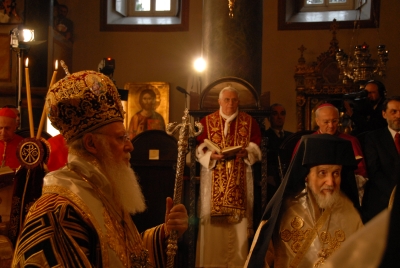
Divine Liturgy of St. John Chrysostom

Watching the Divine Liturgy for the first time was a real eye opener for me. Witnessing His All Holiness Ecumenical Paticarch, Bartholomew I celebrating the Divine Liturgy with the Pope in attendance was really a sight to behold. Somehow the more prevalent Missal of Paul VI that is celebrated within the Latin Rite of the Church just seems very alien to the Divine Liturgy. Compared to the Divine Liturgy, one can validly say that the Novus Ordo just seems so shallow. Its was very interesting to hear the Dominus Vobiscum, Susum Corda and Gratias Agamus Deo Nostro all in Greek. Hearing the Credo and Pater Noster in Greek was also another very educational experience. In many parts of the Divine Liturgy, Kyrie Eleison is chanted to a rather refreshing notation. Reception of Communion is exclusively on the tongue via a spoon and there is no such thing as altar girls, extraordinary ministers of holy communion or liturgical dancers. There was chanting in Greek throughout with no such thing as contemporary noise passing off as music. The Liturgy very clearly was a Sacred act and the Mystery of Faith remained. The depth of the words used in the Liturgy very clearly expressed the lex orandi, lex credendi of the Church.


The Divine Liturgy of St. John Chrysostom was telecast live from Vatican Television Centre and I caught it Live via the EWTN. Hearing Pope Benedict XVI saying the Pater Noster in Greek was just sublime. Yet fret not, the technological innovations of this age has allowed one to view it again at their own convenience. Watch it here. (Note: This Divine Liturgy was apparently considered short as there are certain parts that have been omitted, but it still is 3 hours worth. Still it is really worth one's time.)

Special thanks to NLM for the video link.

27 November 2006

Byzantine Divine Liturgy

The Byzantine Divine Liturgy has three parts: the preparation of the priest and the gifts of bread and wine (prothesis); the liturgy of the catechumens (liturgy of the word); and the liturgy of the faithful.

A. The preparation of the gifts has two parts. First, the preparation of the priest, which includes the prayers and his clothing with the sacred vestments. In the prayers the priest asks the Lord in his mercy to make him worthy to offer the sacrifice, to intercede for the people, to call down the Holy Spirit.

There follows the preparation of the gifts of bread and wine. Although the rite of preparation is performed by the priest alone, the whole Church, in heaven and in earth, is symbolically present.

B. The liturgy of the catechumens calls for the participation of the catechumens, who are then dismissed after the proclamation of the Gospel.

The Divine Liturgy begins with an invocation of the Holy Trinity: “Blessed be the kingdom of the Father and the Son and the Holy Spirit…”. Three litanies follow, a longer one and two shorter ones, which invoke the Lord’s mercy upon the whole world and the entire Church. Mention is made of the Church, her members and all those in need. These litanies always include an invocation to the Mother of God, who intercedes for everyone and for the Holy Church. After the second litany the christological hymn, “Only-Begotten” is sung; this is an ancient liturgical hymn that summarizes the principal dogmas of the Christian faith: the Trinity, the Incarnation of the Word of God, the divine maternity of Mary, the salvation that is bestowed on us by Christ’s passion, death and resurrection. There follows the “Small Entrance”. In a solemn procession, the priest and the deacon take the Gospel from the altar, show it to the faithful and set it again on the altar, in order to indicate the beginning of the proclamation of the word of God: originally this was the entrance procession. Before the readings the Trisagion is chanted: “Holy God, Holy Mighty, Holy Immortal…”. Two readings are then proclaimed from the New Testament. The Gospel is usually followed by a homily.

C. The Liturgy of the Faithful. The third part of the Divine Liturgy is the liturgy of the faithful, in which those who are baptized participate fully. It begins with the “Great Entrance”, the procession with the bread and wine towards the altar. The choir sings the hymn: “We who mystically represent the Cherubim…”, another ancient liturgical text in which the Church of heaven and earth is united in praise and thanksgiving to God for his gifts. The priest incenses the altar, the church, the gifts and the faithful, all of which are icons of Christ. He then solemnly takes the paten and the chalice, and after asking the Lord to remember all those who have been commemorated and the whole Church, he sets them on the altar and covers them with the veil. The priest then recites for himself and the whole Church the words of the Good Thief from his cross: “Remember me, Lord, in your Kingdom…”. The gifts, a symbol of Christ, the Lamb who was slain, are then placed on the altar, as if in the tomb from which, after the consecration or sanctification, the life-giving Body of Christ will be given to each of the faithful. After the entrance, litanies are sung, the sign of peace is exchanged, and the Nicene-Constantinopolitan Creed is recited. There follows the anaphora of Saint John Chrysostom, which has a structure similar to that of the other anaphoras of the Eastern and Western liturgies: an initial trinitarian dialogue, Preface, Sanctus, anamnesis, institution narrative, epiclesis, intercessions and conclusion.

This is followed by the Our Father, the breaking of the bread and communion. Before communion the priest pours some boiling water (called the zéon) into the chalice as a symbol of the outpouring and presence of the Holy Spirit, as well as a sign of the life which comes from communion in the living and life-giving Body and Blood of Christ himself. Communion is received under both species.

The Divine Liturgy concludes with the final blessing.

The Liturgy of the Word in the Armenian Apostolic Cathedral of Saint Mary

The prayers and ritual sequences making up the prayer service have been drawn from various elements of the Eucharistic celebration of the Armenian Liturgy.

Before the entrance procession in the Cathedral, in accordance with the Armenian national tradition, the Holy Father is presented with bread, salt and rose water as symbols of welcome and good wishes.

As His Holiness and His Beatitude enter the Cathedral, the choir performs the chant Herasciapar Asdvadz (“O Wondrous God”), which recounts the story of the conversion of the Armenian people to Christianity through the efforts of Saint Gregory the Illuminator.

At the foot of the altar, a prayer is said. The Holy Father and His Beatitude then take their places before the sacred altar, from which the Gospel, carried in procession from the entrance of the Cathedral, is solemnly proclaimed.

The prayer service in the Armenian Apostolic Cathedral expresses the joy of the Armenian Apostolic Church at the visit of His Holiness Pope Benedict XVI.

(Apostolic Journey to Turkey: Presentation)

Turning Towards the East

In Turkey, the Pope will soon be in Turkey and he will be attending Eastern Liturgies. Our Eastern Brethren will show us Latins how the Liturgy is to be done. Face East.

"The celebration of the Byzantine Divine Liturgy, as of those of others Oriental Churches, is performed towards the East. The priest with all the faithful look towards the East from which Christ will come one day in His glory. The priest intercedes with the Lord for his people; he walks before the people towards the meeting with the Lord. There are several moments in which the priest turns towards the people: to proclaim the Gospel, in the dialog before the Anaphora, for the Communion with the Holy Gifts, and for all the blessings." - Apostolic Journey to Turkey: Presentation